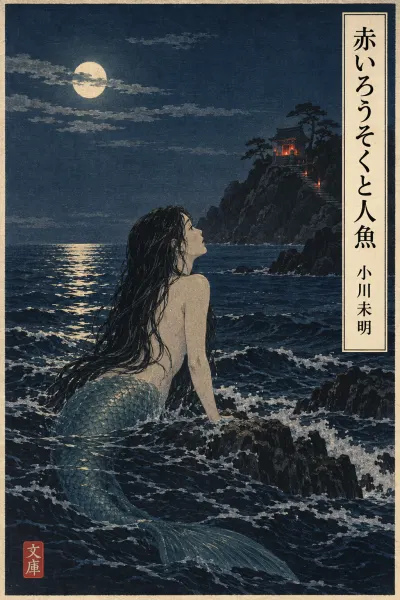
Part 4 of 5 · JLPT N3
赤いろうそくと人魚(四) Akai Rōsoku to Ningyo, part 4: The Mermaid Is Sold to a Showman
In this part
A showman from the south learns that the girl is a mermaid and offers the old couple a large sum of money for her. He persuades them that mermaids bring bad luck, and in their greed they agree to sell her, ignoring her tearful pleas. On a moonlit night he arrives with an iron-barred cage, and the girl, hurried away before she can finish her pictures, paints her last candles red and leaves a few behind.
AI translation · independently checked
あるとき、南の方の国から、香具師が入ってきました。One day, a showman came in from a country to the south.
なにか北の国へいって、珍しいものを探して、それをば南の国へ持っていって、金をもうけようというのであります。His plan, it seems, was to travel to the northern lands, seek out rare things, carry them back to the south, and make money from them.
香具師は、どこから聞き込んできたものか、または、いつ娘の姿を見て、ほんとうの人間ではない、じつに世に珍しい人魚であることを見抜いたものか、ある日のこと、こっそりと年寄り夫婦のところへやってきて、娘にはわからないように、大金を出すから、その人魚を売ってはくれないかと申したのであります。Whether he had heard of her somewhere, or had caught sight of the girl at some point and seen through her, seen that she was no true human but a mermaid, a creature rare indeed in this world, no one can say; but one day the showman came quietly to the old couple and, taking care that the girl should not find out, asked whether they would not sell him that mermaid, for he would pay them a great sum of money.
年寄り夫婦は、最初のうちは、この娘は、神さまがお授けになったのだから、どうして売ることができよう。At first the old couple said that this girl had been granted to them by the gods, so how could they ever sell her?
そんなことをしたら、罰が当たるといって承知をしませんでした。If they did such a thing, heaven would surely punish them, they said, and they would not agree.
香具師は一度、二度断られてもこりずに、またやってきました。Even though he was turned down once or twice, the showman, undeterred, came back again.
そして、年より夫婦に向かって、And, turning to the old couple,
「昔から、人魚は、不吉なものとしてある。いまのうちに、手もとから離さないと、きっと悪いことがある。」と、まことしやかに申したのであります。"Since olden times, mermaids have been held to be creatures of ill omen. If you do not let her out of your hands while there is still time, something dreadful is sure to befall you," he said, as though it were the plain truth.
年より夫婦は、ついに香具師のいうことを信じてしまいました。In the end, the old couple came to believe what the showman told them.
それに大金になりますので、つい金に心を奪われて、娘を香具師に売ることに約束をきめてしまったのであります。Besides, it meant a great deal of money, and so, their hearts seized by greed before they knew it, they went so far as to promise to sell the girl to the showman.
香具師は、たいそう喜んで帰りました。The showman went away very pleased.
いずれそのうちに、娘を受け取りにくるといいました。He said he would come to fetch the girl before long.
この話を娘が知ったときは、どんなに驚いたでありましょう。How shocked the girl must have been when she learned of this!
内気な、やさしい娘は、この家から離れて、幾百里も遠い、知らない、熱い南の国へゆくことをおそれました。The shy, gentle girl dreaded leaving this house and going to a hot southern country she did not know, many hundreds of leagues away.
そして、泣いて、年より夫婦に願ったのであります。And she wept and pleaded with the old couple.
「わたしは、どんなにでも働きますから、どうぞ知らない南の国へ売られてゆくことは、許してくださいまし。」といいました。"I will work as hard as ever you wish, so please, I beg you, spare me from being sold away to a southern country I do not know," she said.
しかし、もはや、鬼のような心持ちになってしまった年寄り夫婦は、なんといっても、娘のいうことを聞き入れませんでした。But the old couple, whose hearts had by now become like the hearts of demons, would not listen to the girl, no matter what she said.
娘は、へやのうちに閉じこもって、いっしんにろうそくの絵を描いていました。The girl shut herself away in her room and painted pictures on candles with all her heart.
しかし、年寄り夫婦はそれを見ても、いじらしいとも、哀れとも、思わなかったのであります。Yet even when they saw this, the old couple felt neither that she was touching nor that she was pitiable.
月の明るい晩のことであります。It was a night when the moon shone bright.
娘は、独り波の音を聞きながら、身の行く末を思うて悲しんでいました。The girl, all alone, listened to the sound of the waves and grieved as she thought of what lay ahead for her.
波の音を聞いていると、なんとなく、遠くの方で、自分を呼んでいるものがあるような気がしましたので、窓から、外をのぞいてみました。As she listened to the waves, she somehow felt that someone far away was calling to her, so she looked out of the window.
けれど、ただ青い、青い海の上に月の光が、はてしなく、照らしているばかりでありました。But there was nothing but the moonlight, shining endlessly over the blue, blue sea.
娘は、また、すわって、ろうそくに絵を描いていました。The girl sat down again and went on painting pictures on the candles.
すると、このとき、表の方が騒がしかったのです。Just then, there was a commotion at the front of the house.
いつかの香具師が、いよいよこの夜娘を連れにきたのです。The showman from before had at last come that night to take the girl away.
大きな、鉄格子のはまった、四角な箱を車に乗せてきました。He had brought, on a cart, a large square box fitted with iron bars.
その箱の中には、かつて、とらや、ししや、ひょうなどを入れたことがあるのです。That box had once held tigers, lions, leopards and the like.
このやさしい人魚も、やはり海の中の獣物だというので、とらや、ししと同じように取り扱おうとしたのであります。Saying that this gentle mermaid, too, was after all a beast of the sea, he meant to treat her just as he would a tiger or a lion.
ほどなく、この箱を娘が見たら、どんなにたまげたでありましょう。How startled the girl would be when, before long, she saw this box!
娘は、それとも知らずに、下を向いて、絵を描いていました。Knowing nothing of it, the girl sat with her head bowed, painting.
そこへ、おじいさんと、おばあさんとが入ってきて、Just then the old man and the old woman came in,
「さあ、おまえはゆくのだ。」といって、連れだそうとしました。"Come now, you are going," they said, and tried to lead her out.
娘は、手に持っていたろうそくに、せきたてられるので絵を描くことができずに、それをみんな赤く塗ってしまいました。Because she was being hurried, the girl could not paint pictures on the candles she held in her hands, and so she painted them all red.
娘は、赤いろうそくを、自分の悲しい思い出の記念に、二、三本残していったのであります。The girl left behind two or three red candles as a keepsake of her sad memories.
Vocabulary
| Word | Meaning | JLPT |
|---|---|---|
| 香具師やし | travelling showman; peddler at fairsA fixed reading that cannot be guessed from the kanji. It suggests someone who makes money from shows and curiosities, often a little shady. | — |
| もうけようもうける | to make a profit, to earn moneydictionary form: 儲ける金をもうける is the set phrase "to make money". | N2 |
| 見抜いたみぬく | to see through, to perceive the truth aboutdictionary form: 見抜く見る + 抜く (pull out, go right through). | — |
| 大金たいきん | a large sum of money | N1 |
| 罰ばち | divine punishment罰が当たる means "to be punished by heaven". Read ばつ, it means an ordinary penalty. | N1 |
| 承知しょうち | consent, agreement承知をしない means "to refuse to agree"; 承知しました is a polite "certainly". | N4 |
| こりずこりる | to learn one's lesson (and stop)dictionary form: 懲りるこりずに means "undeterred, without giving up". | N1 |
| まことしやかまことしやか | plausible, as if trueUsed of lies told convincingly, so the narrator hints that the showman is lying. | — |
| 内気うちき | shy, timid, reserved | — |
| いじらしいいじらしい | touching, pitiful (of someone weak and earnest)Used for a child or gentle person whose brave efforts move you to pity. | — |
| 行く末ゆくすえ | one's future, what lies aheadLiterary; 身の行く末 means "one's own fate". | — |
| 鉄格子てつごうし | iron bars, iron grating鉄 (iron) + 格子 (lattice). Note the rendaku: こうし becomes ごうし. | — |
| たまげたたまげる | to be astonished, to be startleddictionary form: たまげるA colloquial, slightly old-fashioned word, originally 魂消る ("one's soul vanishes"). | — |
| せきたてられるせきたてる | to hurry someone, to rushdictionary form: 急き立てるHere it is in the passive: "she is being hurried". | — |
Grammar
〜ものか、または〜ものか N1 whether it was … or …
Two possibilities are set side by side, each ending in ものか, to show that the narrator does not know which is true. The main clause, what actually happened, follows.
どこから聞き込んできたものか、または、いつ娘の姿を見て、ほんとうの人間ではない、じつに世に珍しい人魚であることを見抜いたものか
whether he had heard of her somewhere, or had at some point seen the girl and seen through her, seen that she was no true human but a mermaid rare indeed in this world
〜てはくれないか N3 won't you (please) …?
A negative question with くれる makes a request. The added は softens it and makes it a little more insistent, like "wouldn't you perhaps …?"
その人魚を売ってはくれないか
won't you sell me that mermaid?
どうして〜よう N2 how could one possibly …? (= surely not)
The volitional form (できよう) after どうして makes a rhetorical question. It expresses strong denial: there is no way they could sell her.
どうして売ることができよう。
How could we ever sell her?
どんなに〜でありましょう N3 how … she must have been!
でありましょう is a very polite, old-fashioned form of でしょう. With どんなに it makes an exclamation of the narrator's guess about the girl's feelings.
この話を娘が知ったときは、どんなに驚いたでありましょう。
How shocked the girl must have been when she learned of this!
〜とも、〜とも思わない N2 think neither … nor …
とも after each adjective lists feelings that are all denied by the final negative verb. It stresses that the couple felt no pity at all.
いじらしいとも、哀れとも、思わなかったのであります。
they felt neither that she was touching nor that she was pitiable.
ただ〜ばかり N3 nothing but …, only …
ただ at the start and ばかり after the verb work together to say that only this one thing was there. Here nothing but moonlight can be seen on the sea.
ただ青い、青い海の上に月の光が、はてしなく、照らしているばかりでありました。
there was nothing but the moonlight shining endlessly over the blue, blue sea.