 N4 · easy
Simplified retelling · JLPT N4
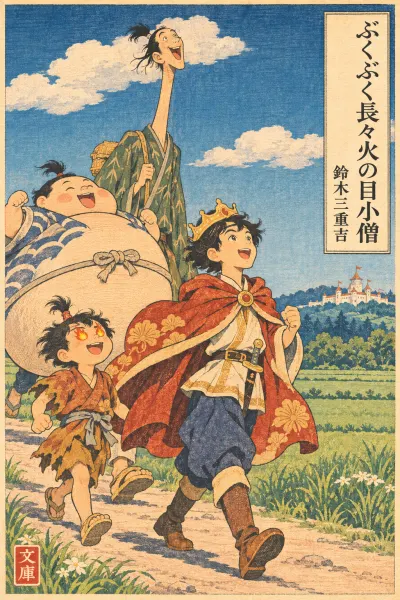
ぶくぶく長々火の目小僧 Bukubuku Naganaga Hi no Mekozō in easy Japanese (N4)
This is our own simplified retelling of Puff, Stretch and Fire-Eyes, written for N4 learners and checked word by word against the N4 vocabulary list. A few story words and grammar patterns go beyond N4; the notes below give each one's level. It keeps the characters, events and ending of the original. When it feels easy, move on to the original text.
The story in brief
A princess will marry only a man who can keep her in her room for three nights, and every suitor who falls asleep is put to death. A young prince sets out with three strange servants, Bukubuku, Naganaga and Hinome Kozō, who catch her each time she escapes by magic as a dove, a fly and a fish. The angry king sends an army after the couple, but the servants defeat it, and in the end the king gladly agrees to the marriage.
AI translation · independently checked
むかしのお話です。This is a story from long ago.
ある国のおうさまに、きれいなおうじょがいました。The king of a certain country had a beautiful princess.
世界のおうさまやおうじが、おうじょとけっこんしたいと思って、たくさん来ました。Many kings and princes from all over the world wanted to marry the princess, and they came in great numbers.
でも、おうじょはいつも「いやです」と言いました。But the princess always said, "No, thank you."
ある日、おうじょは言いました。One day, the princess spoke.
「三ばんの間、私をへやの外に出さない人がいたら、その人とけっこんします。」おうさまは「とちゅうでねむった人は、切ります」と言いました。"If there is anyone who can keep me from leaving my room for three nights, I will marry him." The king said, "Anyone who falls asleep partway through will be cut down."
たくさんの人が来ました。Many men came.
でも、夜になると、みんなねむりました。But when night came, every one of them fell asleep.
そして、みんなおうさまに切られて、死にました。And so they were all cut down by the king and died.
ある国に、わかくて強いおうじがいました。In another country there was a young, strong prince.
おうじはこの話を聞いて、行きたいと思いました。When the prince heard this story, he wanted to go.
お父さんは、はじめは「だめだ」と言いました。At first his father said, "No, you may not."
でも、おうじが毎日たのんだので、とうとう「いい」と言いました。But the prince asked him every day, so at last he said, "Very well."
おうじは一人で出かけました。The prince set off alone.
とちゅうで、ふとった男に会いました。On the way, he met a fat man.
名前はぶくぶくです。His name was Bukubuku.
ぶくぶくは、体をとても大きくすることができます。Bukubuku could make his body very, very big.
つぎに、ほそくて長い男に会いました。Next, he met a thin, long man.
名前は長々です。His name was Naganaga.
長々は体をのばして、くもの中まで頭を入れることができます。Naganaga could stretch his body and push his head right up into the clouds.
それに、とおくまですぐに歩いて行けます。What's more, he could walk to faraway places in no time at all.
それから、もりで火の目こぞうに会いました。After that, in a forest, he met Hinome Kozō.
火の目こぞうは、目から火を出して、木をやくことができます。Hinome Kozō could shoot fire from his eyes and burn trees.
三人は、おうじのけらいになりました。The three became the prince's servants.
ぶくぶくはとてもたくさん食べましたが、おうじはいやな顔をしないで、お金をはらいました。Bukubuku ate a tremendous amount, but the prince never made a sour face and paid the bill.
町に着くと、おうじはおうじょのへやに入りました。When they reached the town, the prince went into the princess's room.
三人は、へやの外とまどの下にいました。The three servants stayed outside the room and under the window.
おうじょは「ねむいです」と言って、ねました。The princess said, "I'm sleepy," and went to bed.
でも、それはうそでした。But that was a lie.
おうじも三人も、だんだんねむくなって、ねむりました。The prince and the three servants grew sleepier and sleepier, and they fell asleep.
おうじょは、まほうではとになって、まどからとびました。By magic, the princess turned into a dove and flew out of the window.
でも、はとは長々のかみにさわりました。But the dove brushed against Naganaga's hair.
長々は目をさまして、「だれかがにげたぞ」と言いました。Naganaga woke up and said, "Somebody's escaped!"
火の目こぞうが目から火を出すと、はとの体がやけました。When Hinome Kozō shot fire from his eyes, the dove's body was scorched.
はとは高い木にとまりました。The dove landed in a tall tree.
長々は体をのばして、はとをつかまえました。Naganaga stretched out his body and caught the dove.
つぎの朝、おうさまはびっくりしました。The next morning, the king was astonished.
二ばんめの夜も、同じでした。On the second night, it was the same.
三ばんめの夜の前に、おうさまはおうじょに言いました。Before the third night, the king spoke to the princess.
「今夜はかならずにげなさい。」"Tonight you must escape, no matter what."
その夜、おうじょははえになって、とびました。That night, the princess turned into a fly and flew away.
でも、火の目こぞうのはなにさわりました。But she brushed against Hinome Kozō's nose.
火の目こぞうが火を出すと、はえは小さな魚になって、いずみに入りました。When Hinome Kozō shot out fire, the fly turned into a little fish and slipped into a spring.
いずみはとてもふかいです。The spring was very deep.
長々が手をのばして、さがしました。Naganaga stretched out his arm and searched.
でも、魚は見つかりません。But he could not find the fish.
ぶくぶくが体を大きくして、いずみに入りました。Bukubuku made his body big and climbed into the spring.
水が外に出ましたが、魚は見つかりません。The water spilled out, but still the fish could not be found.
さいごに、火の目こぞうが水を見て、火を出しつづけました。Finally, Hinome Kozō stared at the water and kept on shooting fire.
水はあついおゆになりました。The water turned into very hot water.
魚はあつくて外にとび出して、おうじょになりました。The fish got so hot that it leapt out and became the princess again.
おうじは「三ばんとも、ちゃんとつかまえましたよ」と言いました。The prince said, "I caught you properly on all three nights, didn't I?"
おうじょは顔を赤くして、「私をつれて行ってください」と言いました。The princess blushed and said, "Please take me with you."
おうじは、じぶんがおうじだと話しました。The prince told her that he was a prince.
おうじょはよろこびました。The princess was delighted.
でも、おうさまはおうじょをあげたくありません。But the king did not want to give the princess away.
「だめだ」とおこりました。"No!" he said angrily.
おうじたちは、おうじょをつれて、にげました。The prince and the others took the princess and ran away.
おうさまは、何千人ものへいたいを出しました。The king sent out thousands and thousands of soldiers.
へいたいは、後ろからどんどん来ました。The soldiers came on and on from behind.
おうじょが、かおにかけていた物を後ろになげると、大きなもりができました。When the princess threw the thing she had been wearing over her face behind her, a great forest appeared.
つぎに、おうじょがなくと、大きな川ができました。Next, when the princess wept, a great river appeared.
それでも、へいたいはまだ来ます。Even so, the soldiers kept coming.
長々は空まで体をのばして、ぼうしをお日さまにかけました。Naganaga stretched his body all the way up to the sky and hung his hat over the sun.
へいたいのほうは、夜のようにくらくなりました。Where the soldiers were, it grew as dark as night.
さいごに、ぶくぶくが山のように大きくなって、口を開けました。Last of all, Bukubuku grew as big as a mountain and opened his mouth.
へいたいは、その口を町のもんだと思いました。The soldiers thought his mouth was the town gate.
そして、みんな口の中に入りました。And they all marched into his mouth.
ぶくぶくは町に帰って、町のまん中で、へいたいを口から出しました。Bukubuku went back to the town, and in the very middle of it he let the soldiers out of his mouth.
へいたいは顔が青くなって、にげて帰りました。The soldiers turned pale and ran off home.
町の人はみんなわらいました。All the people of the town laughed.
おうじとおうじょは、けっこんすることになりました。It was decided that the prince and the princess would marry.
長々が、おうじょのお父さんをよびに行きました。Naganaga went to fetch the princess's father.
おうさまは、おうじがりっぱな人だと聞いて、よろこんで来ました。When the king heard that the prince was a fine man, he gladly came.
二人はけっこんしました。The two of them were married.
三人のけらいも、たくさんおれいをもらいました。The three servants also received many rewards.
Vocabulary
| Word | Meaning | JLPT |
|---|---|---|
| けっこんけっこん | marriage; to marry (as けっこんする)dictionary form: 結婚The partner is marked with と: おうじょとけっこんする. | N5 |
| とちゅうとちゅう | partway through; on the waydictionary form: 途中とちゅうで = in the middle of something, or along the road (as in a later sentence). | N4 |
| ねむったねむる | to fall asleep; to sleepdictionary form: 眠るRelated adjective: ねむい (sleepy). | N4 |
| けらいけらい | servant; retainerdictionary form: 家来A follower who serves a lord or prince; an old-fashioned, story-book word. | N1 |
| はらいましたはらう | to paydictionary form: 払うお金をはらう = to pay money. | N4 |
| まほうまほう | magicdictionary form: 魔法まほうで = by means of magic. | — |
| にげたにげる | to run away; to escapedictionary form: 逃げる | N4 |
| つかまえましたつかまえる | to catch; to capturedictionary form: 捕まえる | N4 |
| かならずかならず | without fail; surelydictionary form: 必ずWith a command, it means "you must, whatever happens." | N4 |
| いずみいずみ | spring (of water)dictionary form: 泉A natural pool where water comes up from the ground. | N3 |
| おゆおゆ | hot waterdictionary form: お湯Japanese uses a separate word for hot water; みず is cold or ordinary water. | — |
| へいたいへいたい | soldier(s)dictionary form: 兵隊 | N2 |
| どんどんどんどん | on and on; one after anotherDescribes something moving forward steadily and quickly. | N4 |
| おれいおれい | reward; thanks (a gift given as thanks)dictionary form: お礼おれいをもらう = to receive a reward. | N4 |
Grammar
〜たら N4 if / when
The た-form plus ら sets up a condition. Here, if such a person exists, the princess will marry him.
私をへやの外に出さない人がいたら、その人とけっこんします。
If there is anyone who can keep me from leaving my room, I will marry him.
〜ことができる N4 can; to be able to
The dictionary form of a verb plus ことができる expresses ability. It is used here to describe each servant's special power.
ぶくぶくは、体をとても大きくすることができます。
Bukubuku could make his body very, very big.
〜と (when / whenever) N4 when ~, then (naturally) ~
The plain form plus と shows that the second event follows the first as a natural result. Night comes, and then everyone falls asleep.
夜になると、みんなねむりました。
When night came, every one of them fell asleep.
〜ないで N4 without doing ~
The ない-form plus で means doing the second action without doing the first. The prince paid without making a sour face.
おうじはいやな顔をしないで、お金をはらいました。
The prince never made a sour face and paid the bill.
〜つづける N4 to keep on doing ~
The ます-stem of a verb plus つづける means the action continues without stopping.
火の目こぞうが水を見て、火を出しつづけました。
Hinome Kozō stared at the water and kept on shooting fire.
〜ことになる N4 it is decided that ~; it turns out that ~
The dictionary form plus ことになる shows a decision or outcome reached by circumstances or by others, not simply by one person's choice.
おうじとおうじょは、けっこんすることになりました。
It was decided that the prince and the princess would marry.