 N5 · easy
Simplified retelling · JLPT N5
土神ときつね Dojin to Kitsune in easy Japanese (N5)
This is our own simplified retelling of The Birch Tree's Two Friends, written for N5 learners and checked word by word against the N5 vocabulary list. A few story words and grammar patterns go beyond N5; the notes below give each one's level. It keeps the characters, events and ending of the original. When it feels easy, move on to the N4 version or the original text.
The story in brief
A birch tree in a meadow has two friends: a rough but honest Earth God and a polite fox who tells lies, and the birch likes the fox better. The god's jealousy grows through the summer, and one autumn morning he chases the fox and kills him. Inside the fox's den there is nothing at all, and in his coat pocket there are only two brown stalks of grass, so the god cries out loud.
AI translation · independently checked
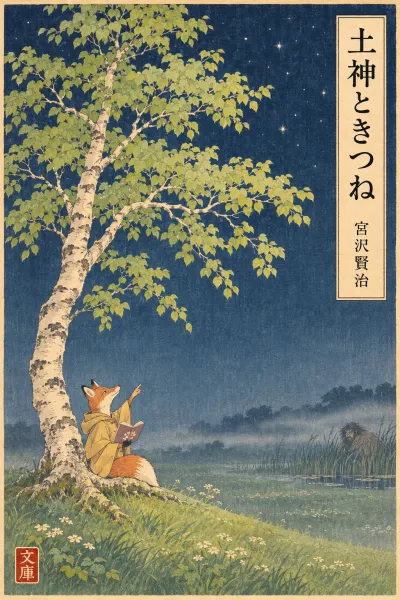
のはらの北に、一本のきれいなかばの木がありました。In the north of the meadow there stood a single beautiful birch tree.
かばの木には、友だちが二人いました。The birch tree had two friends.
一人は、水のおおいところにすむつちがみです。One was the Earth God, who lived in a wet, marshy place.
つちがみは、きたないふくをきています。The Earth God wore dirty clothes.
めはあかくて、よくおこります。His eyes were red, and he often got angry.
でも、うそはいいません。But he never told lies.
もう一人は、南から来るきつねです。The other was a fox who came from the south.
きつねは、いつもりっぱなせびろをきています。The fox always wore a fine suit.
やさしく話しますが、ときどきうそをいいます。He spoke gently, but sometimes he told lies.
かばの木は、きつねの方が大すきでした。The birch tree liked the fox much better.
なつのはじめのばんでした。It was an evening at the beginning of summer.
そらには、ほしがたくさんありました。There were many stars in the sky.
きつねが来て、ほしの話をしました。The fox came and talked about the stars.
「外国のぼうえんきょうをかいました。らいねんのはるに来ます。来たら、見せてあげます。」"I have bought a telescope from abroad. It will arrive next spring. When it comes, I shall show it to you."
でも、これはうそでした。But this was a lie.
きつねは小さいこえで「ぼくは、だめだ」といいました。In a small voice the fox said, "I'm no good."
そして、本をかして、かえりました。Then he lent the birch a book and went home.
つぎのあさ、つちがみが来ました。The next morning, the Earth God came.
かばの木は「きつねさんに聞いてください」といいました。The birch tree said, "Please ask Mr. Fox."
つちがみは、とてもおこりました。The Earth God grew very angry.
「きつねに何をならうんだ。」"What is there to learn from a fox?"
かえるとき、つちがみは、山へ行く男の人を見ました。On his way home, the Earth God saw a man going to the mountain.
つちがみは、男の人を水の中に入れました。The Earth God put the man into the water.
男の人は、なきながら、おなじところを歩きました。Crying, the man walked round and round the same place.
とてもつかれました。He grew very tired.
つちがみは、男の人を水の外に出しました。The Earth God let the man out of the water.
でも、つちがみはたのしくありませんでした。But the Earth God did not feel happy.
かばの木がすきでしたから。For he loved the birch tree.
なつのよる、つちがみは、かばの木のところへ行きました。One summer night, the Earth God went to the birch tree.
きつねがいました。The fox was there.
「ぼくのへやには、えいごや外国の本がたくさんあります。」"In my room there are many English and foreign books."
「りっぱですね。」"How splendid."
「ぼうえんきょうは、まだ来ません。」"The telescope has not come yet."
つちがみは、北へはしりました。The Earth God ran off to the north.
そして、山の下で、大きいこえでなきました。And at the foot of the mountain, he cried in a loud voice.
あきになりました。Autumn came.
いい天気のあさ、つちがみはげんきでした。One fine morning, the Earth God was in good spirits.
「もういい。きつねとかばの木が話しても、いい。」"Enough. Let the fox and the birch tree talk. It's all right."
つちがみは、じぶんにそういいました。So the Earth God told himself.
そして、かばの木に「おはよう。いい天気だね」といいました。And he said to the birch tree, "Good morning. Fine weather, eh?"
そこへ、きつねが来ました。Just then, the fox arrived.
きつねは、本をかばの木にわたしました。The fox handed a book to the birch tree.
「ぼうえんきょうは、はれたばんに見せます。」"I shall show you the telescope on a clear night."
きつねはそういって、すぐにかえりました。Saying this, the fox went home at once.
つちがみには、何もいいませんでした。He said nothing at all to the Earth God.
つちがみは、きつねのあかいくつを見ました。The Earth God looked at the fox's red shoes.
そして、またおこりました。And he grew angry again.
「本だ、ぼうえんきょうだと、うそばかり!」"Books this, telescopes that—nothing but lies!"
つちがみは、きつねをおいかけました。The Earth God chased after the fox.
きつねは、はやくはしりました。The fox ran fast.
じぶんのあなに入りたかったです。He wanted to get into his den.
でも、つちがみがきつねを取りました。But the Earth God caught the fox.
きつねはしにました。The fox died.
つちがみは、あなの中を見ました。The Earth God looked inside the den.
中はくらくて、何もありませんでした。Inside it was dark, and there was nothing there.
きつねのコートのポケットには、ちゃいろのくさが二本だけありました。In the pocket of the fox's coat there were only two stalks of brown grass.
つちがみは、大きいこえでなきました。The Earth God cried in a loud voice.
Vocabulary
| Word | Meaning | JLPT |
|---|---|---|
| かばの木かばのき | birch treedictionary form: 樺の木In this story the birch tree is a character who talks and has feelings. | — |
| つちがみつちがみ | Earth God; a local god of the landdictionary form: 土神土 (earth) + 神 (god). 神 becomes がみ in compounds. | — |
| おこりますおこる | to get angrydictionary form: 怒る | N4 |
| うそうそ | a liedictionary form: 嘘"To tell a lie" is うそをいう (or うそをつく). | N4 |
| せびろせびろ | a Western-style suitdictionary form: 背広An older word; today people often say スーツ. | N5 |
| りっぱなりっぱ | fine, splendid, impressivedictionary form: 立派A な-adjective. | N5 |
| ぼうえんきょうぼうえんきょう | telescopedictionary form: 望遠鏡Literally "far-looking glass". | N2 |
| かしてかす | to lenddictionary form: 貸すDo not confuse it with 借りる (かりる, to borrow). | N5 |
| ならうならう | to learn (from someone)dictionary form: 習うThe teacher is marked with に: きつねにならう, "learn from the fox". | N5 |
| つかれましたつかれる | to get tireddictionary form: 疲れる | N5 |
| わたしましたわたす | to hand over, to givedictionary form: 渡す | N5 |
| おいかけましたおいかける | to chase, to run afterdictionary form: 追いかける | N2 |
| あなあな | hole; here, the fox's dendictionary form: 穴 | N3 |
Grammar
〜の方が N4 (X) more / rather (X)
Putting の方が after a noun picks it out as the preferred one of two. Here the birch likes the fox more than the Earth God.
かばの木は、きつねの方が大すきでした。
The birch tree liked the fox much better.
〜たら N4 when / once (something happens)
Add ら to the past tense of a verb (来た → 来たら). It means "when that happens, then…". The second action comes after the first.
来たら、見せてあげます。
When it comes, I shall show it to you.
〜てあげる N4 to do something for someone
The て-form plus あげる means the speaker does an action as a favour for someone else. The fox uses it to sound kind and generous.
見せてあげます。
I shall show it to you.
〜ながら N4 while doing
Add ながら to the verb stem (なき → なきながら). It shows that one action happens at the same time as the main action. Here the man cries while he walks.
男の人は、なきながら、おなじところを歩きました。
Crying, the man walked round and round the same place.
〜てもいい N5 it's all right if / may
The て-form plus もいい gives permission or shows acceptance. The god is telling himself that he no longer minds the two of them talking.
きつねとかばの木が話しても、いい。
Let the fox and the birch tree talk. It's all right.
〜ばかり N4 nothing but, only
Putting ばかり after a noun means there is too much of one thing. The god angrily says that the fox tells only lies.
本だ、ぼうえんきょうだと、うそばかり!
Books this, telescopes that—nothing but lies!