Part 5 of 8 · JLPT N2
双子の星 Futago no Hoshi, part 5: A Comet Tempts the Twins Away
In this part
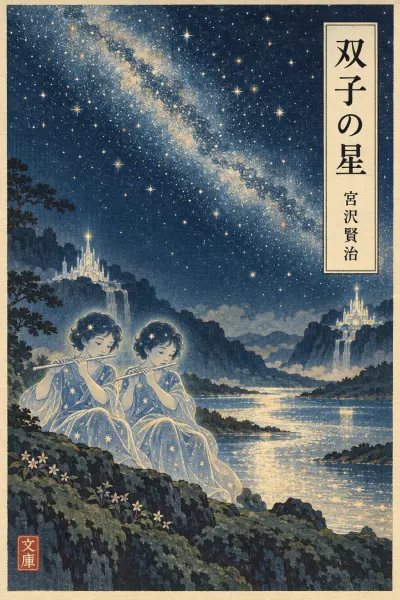
Each night Chunse and Pōse sit in their crystal shrines and play silver flutes to the star-circling song. On a cloudy, rainy night a rough comet arrives and boasts that the King has said the twins may travel with him. Pōse is ready to go, but Chunse wonders whether this can really be true.
AI translation · independently checked
「チュンセ童子、それでは支度をしましょう。」"Chunse Dōji, let us get ready, then."
「ポウセ童子、それでは支度をしましょう。」"Pōse Dōji, let us get ready, then."
二人はお宮にのぼり、向き合ってきちんと座り銀笛をとりあげました。The two went up into their shrines, sat down neatly facing each other, and took up their silver flutes.
丁度あちこちで星めぐりの歌がはじまりました。Just then, here and there, the star-circling song began.
「あかいめだまの さそり"The scorpion with its red eye,
ひろげた鷲の つばさthe eagle's outspread wings,
あおいめだまの 小いぬ、the little dog with its blue eye,
ひかりのへびの とぐろ。the coils of the serpent of light.
オリオンは高く うたいOrion sings on high
つゆとしもとを おとす、and lets fall the dew and frost;
アンドロメダの くもはthe cloud of Andromeda
さかなのくちの かたち。is shaped like a fish's mouth.
大ぐまのあしを きたにTake the Great Bear's feet and extend them to the north
五つのばした ところ。five lengths, and that is the spot.
小熊のひたいの うえはJust above the Little Bear's brow
そらのめぐりの めあて。」is the mark the whole sky circles round."
双子のお星様たちは笛を吹きはじめました。The twin stars began to play their flutes.
双子の星 二The Twin Stars, Part Two
(天の川の西の岸に小さな小さな二つの青い星が見えます。あれはチュンセ童子とポウセ童子という双子のお星様でめいめい水精でできた小さなお宮に住んでいます。(On the western bank of the Milky Way you can see two tiny, tiny blue stars. They are the twin stars called Chunse Dōji and Pōse Dōji, and each of them lives in a little shrine made of crystal.
二つのお宮はまっすぐに向い合っています。The two shrines stand directly facing each other.
夜は二人ともきっとお宮に帰ってきちんと座ってそらの星めぐりの歌に合せて一晩銀笛を吹くのです。At night the two of them always come back to their shrines, sit down neatly, and play their silver flutes all night long in time with the star-circling song of the sky.
それがこの双子のお星様たちの役目でした。That was the duty of these twin stars.
))
ある晩空の下の方が黒い雲で一杯に埋まり雲の下では雨がザアッザアッと降って居りました。One night the lower part of the sky was completely filled with black clouds, and beneath the clouds the rain came pouring down, splash, splash.
それでも二人はいつものようにめいめいのお宮にきちんと座って向いあって笛を吹いていますと突然大きな乱暴ものの彗星がやって来て二人のお宮にフッフッと青白い光の霧をふきかけて云いました。Even so, the two were sitting neatly in their own shrines as always, facing each other and playing their flutes, when suddenly a big, rowdy comet came along, puffed a mist of pale blue light over their shrines, whoosh, whoosh, and said:
「おい、双子の青星。すこし旅に出て見ないか。今夜なんかそんなにしなくてもいいんだ。"Hey, you twin blue stars. How about going off on a little trip? No need to bother with all that on a night like this.
いくら難船の船乗りが星で方角を定めようたって雲で見えはしない。天文台の星の係りも今日は休みであくびをしてる。However hard some shipwrecked sailor tries to find his bearings by the stars, he can't see a thing through the clouds. The star-keeper at the observatory has the day off too, and he's yawning away.
いつも星を見ているあの生意気な小学生も雨ですっかりへこたれてうちの中で絵なんか書いているんだ。Even that cheeky schoolboy who's always looking at the stars has given up altogether because of the rain, and he's inside drawing pictures or some such.
お前たちが笛なんか吹かなくたって星はみんなくるくるまわるさ。どうだ。一寸旅へ出よう。Even if you two don't play your flutes, the stars will all go spinning round just the same. What do you say? Let's go off on a little trip.
あしたの晩方までにはここに連れて来てやるぜ。」I'll bring you back here by tomorrow evening, I promise."
チュンセ童子が一寸笛をやめて云いました。Chunse Dōji stopped playing for a moment and said:
「それは曇った日は笛をやめてもいいと王様からお許しはあるとも。私らはただ面白くて吹いていたんだ。」"Well, of course the King has given us leave to stop playing on cloudy days. We were only playing because we enjoy it."
ポウセ童子も一寸笛をやめて云いました。Pōse Dōji also stopped playing for a moment and said:
「けれども旅に出るなんてそんな事はお許しがないはずだ。雲がいつはれるかもわからないんだから。」"But going off on a journey is surely something we have no leave to do. After all, we can't tell when the clouds will clear."
彗星が云いました。The comet said:
「心配するなよ。王様がこの前俺にそう云ったぜ。いつか曇った晩あの双子を少し旅させてやって呉れってな。"Don't you worry. The King told me so himself just the other day. 'Some cloudy night, take those twins on a little trip,' he said.
行こう。行こう。俺なんか面白いぞ。俺のあだ名は空の鯨と云うんだ。知ってるか。俺は鰯のようなヒョロヒョロの星やめだかのような黒い隕石はみんなパクパク呑んでしまうんだ。Come on, come on! I'm great fun, I am. My nickname's the Whale of the Sky. Did you know that? Scrawny little stars like sardines and black meteorites like killifish, I gobble them all right up, snap, snap.
それから一番痛快なのはまっすぐに行ってそのまままっすぐに戻る位ひどくカーブを切って廻るときだ。And the best thrill of all is when I shoot straight out and then swing round in a curve so sharp that I come straight back the way I went.
まるで身体が壊れそうになってミシミシ云うんだ。光の骨までカチカチ云うぜ。」My body creaks and groans as if it's about to fall to pieces. Even my bones of light rattle, I tell you."
ポウセ童子が云いました。Pōse Dōji said:
「チュンセさん。行きましょうか。王様がいいっておっしゃったそうですから。」"Chunse, shall we go? It seems the King said we may."
チュンセ童子が云いました。Chunse Dōji said:
「けれども王様がお許しになったなんて一体本当でしょうか。」"But can it really be true that the King gave his permission?"
彗星が云いました。The comet said:
「へん。偽なら俺の頭が裂けてしまうがいいさ。頭と胴と尾とばらばらになって海へ落ちて海鼠にでもなるだろうよ。偽なんか云うもんか。」"Hmph! If it's a lie, then let my head split open! My head and body and tail can fly apart and drop into the sea and turn into sea cucumbers, I dare say. As if I'd ever tell a lie!"
ポウセ童子が云いました。Pōse Dōji said:
Vocabulary
| Word | Meaning | JLPT |
|---|---|---|
| 支度したく | preparations; getting readyUsually used as 支度をする. A more everyday word than 準備. | N4 |
| 童子どうじ | boy, child (used as a title after a name)An old, dignified word, often used for divine or heavenly children. | — |
| めいめいめいめい | each (person); each one's ownAlso written 銘々. It means much the same as それぞれ. | N2 |
| 役目やくめ | duty; role; assigned task | N2 |
| 彗星ほうきぼし | cometLiterally a 'broom star'. The standard modern reading is すいせい. | — |
| 乱暴ものらんぼうもの | rough, violent fellow; ruffiandictionary form: 乱暴者 | — |
| 難船なんせん | shipwreck; a ship in distress | — |
| 方角ほうがく | direction; bearings方角を定める means to fix your direction or get your bearings. | N2 |
| 生意気なまいき | cheeky; impertinent; too clever for one's age | N2 |
| へこたれてへこたれる | to lose heart; to give updictionary form: へこたれるA colloquial word, often used in the negative: へこたれない, 'never say die'. | — |
| お許しゆるし | permission; leavedictionary form: 許しWith お it becomes respectful. Compare お許しになる in sentence 43, the honorific form of 許す. | — |
| あだ名あだな | nickname | — |
| 痛快つうかい | thrilling; exhilarating; delightfulUsed for an intensely satisfying excitement. | — |
| 裂けてさける | to split; to tear apartdictionary form: 裂ける | N1 |
Grammar
〜ようたって N2 even if (someone) tries to ~
The volitional form plus colloquial たって (= としても) means 'no matter how much one tries to'. The comet is saying that any attempt the sailors make is useless.
いくら難船の船乗りが星で方角を定めようたって雲で見えはしない。
However hard some shipwrecked sailor tries to find his bearings by the stars, he can't see a thing through the clouds.
〜なくたって N3 even if (you) don't ~
たって is a casual form of ても. Added to the negative なく, it means 'even without doing'. It fits the comet's rough, casual speech.
お前たちが笛なんか吹かなくたって星はみんなくるくるまわるさ。
Even if you two don't play your flutes, the stars will all go spinning round just the same.
〜させてやって呉れ N3 please let (someone) do ~ (for them)
The causative させる combines with てやる, doing something for someone below you, and くれ, a plain request. Here the King is quoted as asking the comet to let the twins travel.
いつか曇った晩あの双子を少し旅させてやって呉れってな。
'Some cloudy night, take those twins on a little trip,' he said.
〜そうです (hearsay) N4 I hear that ~; it seems that ~
When そうです follows a plain-form verb, it reports information heard from someone else. Pōse is relying only on the comet's word about what the King said.
王様がいいっておっしゃったそうですから。
It seems the King said we may.
〜がいい N1 let ~ happen; may as well ~
After a plain verb, がいい expresses a curse-like wish or a defiant 'so be it / let it happen'. The comet swears by his own head that he is telling the truth: if he is lying, let his head split open.
偽なら俺の頭が裂けてしまうがいいさ。
If it's a lie, then let my head split open!
〜もんか N3 as if I would ~; I'd never ~
もんか is a casual form of ものか. It is a rhetorical question that strongly denies the statement. It sounds rough and emphatic.
偽なんか云うもんか。
As if I'd ever tell a lie!