Part 1 of 5 · JLPT N1
外科室(上) Gekashitsu, part 1: Anxious Nobles and a Calm Surgeon
In this part
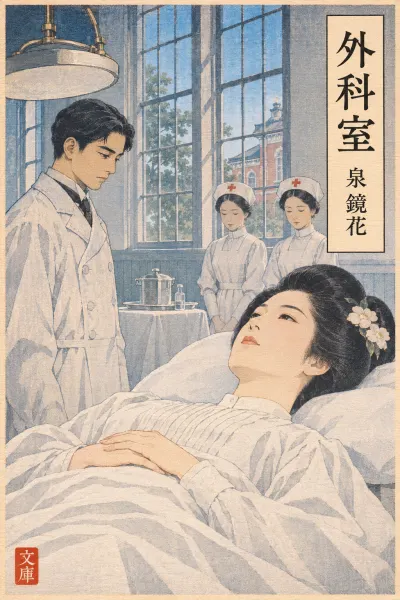
Out of curiosity, the painter-narrator presses his close friend, the surgeon Takamine, into letting him watch an operation on Countess Kifune. The hospital corridors are crowded with anxious aristocrats, officers and maids, and in the operating theatre the noble relatives, the Count and the nurses gather around the pale, beautiful Countess. Takamine alone sits calmly in a chair, and his composure strikes the narrator as almost galling.
AI translation · independently checked
実は好奇心のゆえに、しかれども予は予が画師たるを利器として、ともかくも口実を設けつつ、予と兄弟もただならざる医学士高峰をしいて、某の日東京府下の一病院において、渠が刀を下すべき、貴船伯爵夫人の手術をば予をして見せしむることを余儀なくしたり。In truth it was from curiosity; yet, using my calling as a painter as a convenient instrument and contriving one pretext or another, I pressed Takamine, a doctor of medicine whose bond with me was closer than that of brothers, and left him no choice but to let me watch the operation he was to perform upon the Countess Kifune on a certain day at a certain hospital in Tokyo Prefecture.
その日午前九時過ぐるころ家を出でて病院に腕車を飛ばしつ。That day, a little past nine in the morning, I left my house and sped to the hospital by rickshaw.
直ちに外科室の方に赴くとき、むこうより戸を排してすらすらと出で来たれる華族の小間使とも見ゆる容目よき婦人二、三人と、廊下の半ばに行き違えり。As I made straight for the operating theatre, two or three comely women, who looked to be ladies' maids of some noble house, pushed open a door ahead, glided smoothly out, and passed me halfway along the corridor.
見れば渠らの間には、被布着たる一個七、八歳の娘を擁しつ、見送るほどに見えずなれり。Looking, I saw that among them they were shielding a girl of seven or eight in a hifu coat, and as I watched them go, they passed out of sight.
これのみならず玄関より外科室、外科室より二階なる病室に通うあいだの長き廊下には、フロックコート着たる紳士、制服着けたる武官、あるいは羽織袴の扮装の人物、その他、貴婦人令嬢等いずれもただならず気高きが、あなたに行き違い、こなたに落ち合い、あるいは歩し、あるいは停し、往復あたかも織るがごとし。Nor was this all: along the long corridors that led from the entrance to the operating theatre, and from the operating theatre to the sickroom on the upper floor, gentlemen in frock coats, officers in uniform, persons attired in formal coat and divided skirt, and besides these, great ladies and young ladies of good family, every one of them of uncommonly noble bearing, passed one another here and met together there, some walking and some standing still, coming and going as though weaving a cloth.
予は今門前において見たる数台の馬車に思い合わせて、ひそかに心に頷けり。Recalling the several carriages I had just seen before the gate, I nodded quietly to myself.
渠らのある者は沈痛に、ある者は憂慮わしげに、はたある者はあわただしげに、いずれも顔色穏やかならで、忙しげなる小刻みの靴の音、草履の響き、一種寂寞たる病院の高き天井と、広き建具と、長き廊下との間にて、異様の跫音を響かしつつ、うたた陰惨の趣をなせり。Some of them were grave with sorrow, some full of anxiety, and others yet in agitation, yet none wore an untroubled face; the hurried, short-stepping click of shoes and the shuffle of sandals rang out with a strange echo between the lofty ceilings, the broad doors and the long corridors of that strangely desolate hospital, and lent the place an ever more sombre air.
予はしばらくして外科室に入りぬ。After a short while I entered the operating theatre.
ときに予と相目して、脣辺に微笑を浮かべたる医学士は、両手を組みてややあおむけに椅子に凭れり。The doctor, meeting my eyes just then with a faint smile upon his lips, was leaning back a little in his chair with his arms folded.
今にはじめぬことながら、ほとんどわが国の上流社会全体の喜憂に関すべき、この大いなる責任を荷える身の、あたかも晩餐の筵に望みたるごとく、平然としてひややかなること、おそらく渠のごときはまれなるべし。It was nothing new in him, and yet a man bearing so grave a responsibility, one bound up with the joy or grief of almost the whole of our nation's high society, who could remain as calm and cool as though he were taking his place at a dinner banquet, must surely be a rare man indeed.
助手三人と、立ち会いの医博士一人と、別に赤十字の看護婦五名あり。There were three assistants and one doctor of medicine in attendance as a witness, and in addition five nurses of the Red Cross.
看護婦その者にして、胸に勲章帯びたるも見受けたるが、あるやんごとなきあたりより特に下したまえるもありぞと思わる。Among the nurses themselves I noticed some who wore decorations upon their breasts, and it seemed that certain of these had been bestowed specially from a most exalted quarter.
他に女性とてはあらざりし。Apart from them there were no women present.
なにがし公と、なにがし侯と、なにがし伯と、みな立ち会いの親族なり。Prince So-and-so, Marquis So-and-so and Count So-and-so were all there as relatives in attendance.
しかして一種形容すべからざる面色にて、愁然として立ちたるこそ、病者の夫の伯爵なれ。And he who stood there in sorrow, with a countenance beyond all description, was none other than the Count, the patient's husband.
室内のこの人々に瞻られ、室外のあのかたがたに憂慮われて、塵をも数うべく、明るくして、しかもなんとなくすさまじく侵すべからざるごとき観あるところの外科室の中央に据えられたる、手術台なる伯爵夫人は、純潔なる白衣を絡いて、死骸のごとく横たわれる、顔の色あくまで白く、鼻高く、頤細りて手足は綾羅にだも堪えざるべし。Watched over by these people within the room and worried over by those persons outside it, the Countess lay upon the operating table set in the middle of the theatre, a room so bright that one might count every mote of dust, and which had somehow an awful, inviolable air; wrapped in a pure white gown, she lay like a corpse, her face utterly white, her nose high, her chin slender, and her limbs so delicate it seemed they could not bear even the weight of the finest silk.
脣の色少しく褪せたるに、玉のごとき前歯かすかに見え、眼は固く閉ざしたるが、眉は思いなしか顰みて見られつ。Her lips had lost a little of their colour, and between them her front teeth showed faintly like pearls; her eyes were firmly closed, yet her brows seemed, or perhaps I only imagined it, a little knitted.
わずかに束ねたる頭髪は、ふさふさと枕に乱れて、台の上にこぼれたり。Her hair, only loosely bound, lay thick and tumbled on the pillow and spilled over onto the table.
そのかよわげに、かつ気高く、清く、貴く、うるわしき病者の俤を一目見るより、予は慄然として寒さを感じぬ。At my first glimpse of the patient's form, so frail and yet so noble, so pure, so exalted and so lovely, I shuddered and felt a chill.
医学士はと、ふと見れば、渠は露ほどの感情をも動かしおらざるもののごとく、虚心に平然たる状露われて、椅子に坐りたるは室内にただ渠のみなり。Glancing then towards the doctor, I saw that he appeared not to be stirred by the slightest feeling; an air of calm, untroubled composure showed upon him, and of everyone in the room, he alone was sitting in a chair.
そのいたく落ち着きたる、これを頼もしと謂わば謂え、伯爵夫人の爾き容体を見たる予が眼よりはむしろ心憎きばかりなりしなり。That utter composure of his, call it reassuring if you will, but to my eyes, which had seen the Countess in such a state, it was rather nothing short of galling.
Vocabulary
| Word | Meaning | JLPT |
|---|---|---|
| 口実こうじつ | pretext, excuseOften used with 設ける or つける: 口実を設ける, to make up a pretext. | N2 |
| 余儀なくしたりよぎなくする | to force, to leave no choicedictionary form: 余儀なくするModern Japanese more often uses the passive 余儀なくされる, 'to be forced to'. | — |
| 腕車わんしゃ | rickshawOld Meiji word for 人力車 (じんりきしゃ). | — |
| 赴くおもむく | to go towards, to proceed toFormal, written word for 行く. | N1 |
| 小間使こまづかい | lady's maiddictionary form: 小間使いA maid who attends to her mistress's personal needs. | — |
| 気高きけだかい | noble, dignifieddictionary form: 気高い気高き is the classical attributive form of 気高い. | — |
| 沈痛ちんつう | grave, sorrowfulLiterally 'sunk in pain'; describes a heavy, grieving mood. | — |
| 陰惨いんさん | gloomy, grim, sombre | — |
| 平然へいぜん | calm, unperturbedUsed as 平然として or 平然たる: behaving as if nothing were wrong. | — |
| 勲章くんしょう | decoration, medal of honour | — |
| 俤おもかげ | appearance, look, imageNow usually written 面影. | — |
| 慄然りつぜん | shuddering with fear or awe | — |
| 容体ようだい | a patient's conditionAlso written 容態. | — |
| 心憎きこころにくい | galling, hatefuldictionary form: 心憎いHere it is used in its older sense. Today it usually means 'admirably skilful, enviably refined'. | — |
Grammar
AをしてBしむ N1 to make A do B (classical causative)
しむ is the classical causative auxiliary, and をして marks the person who is made to act. Here the narrator forces Takamine into making him (予をして) watch the operation.
貴船伯爵夫人の手術をば予をして見せしむることを余儀なくしたり。
I obliged him to let me watch the operation on the Countess Kifune.
〜たる N1 being ~, as ~
たる is the attributive form of the classical copula たり, the literary equivalent of である. 画師たるを means 'the fact that I am a painter'.
予は予が画師たるを利器として
using the fact that I was a painter as an instrument
〜のみならず N1 not only ~ (but also)
This is the written form of だけでなく. Placed after これ, it carries the narrative forward: the maids were not the only remarkable sight.
これのみならず玄関より外科室、
Nor was this all: from the entrance to the operating theatre,
〜がごとし/ごとく N1 like ~, as if ~
ごとし is the classical form of ようだ. ごとく is its adverbial form and is used like ように. Kyōka uses it repeatedly for vivid comparisons, such as weaving or a corpse.
往復あたかも織るがごとし。
coming and going as though weaving a cloth.
〜こそ〜なれ N1 it is precisely ~ that…
In classical grammar, こそ requires the sentence to end in the 已然形 form, so なり becomes なれ. The construction gives strong emphasis: the man standing in sorrow was the Count himself.
愁然として立ちたるこそ、病者の夫の伯爵なれ。
he who stood there in sorrow was none other than the Count, the patient's husband.
〜べからざる N1 must not ~, cannot be ~
べからず is the negative of the classical auxiliary べし, and べからざる is its attributive form. It means 'that cannot / must not be ~'. So 侵すべからざる means 'inviolable', and 形容すべからざる in an earlier sentence means 'indescribable'.
すさまじく侵すべからざるごとき観あるところの外科室
the operating theatre, which had an awful, inviolable air