Part 2 of 5 · JLPT N1
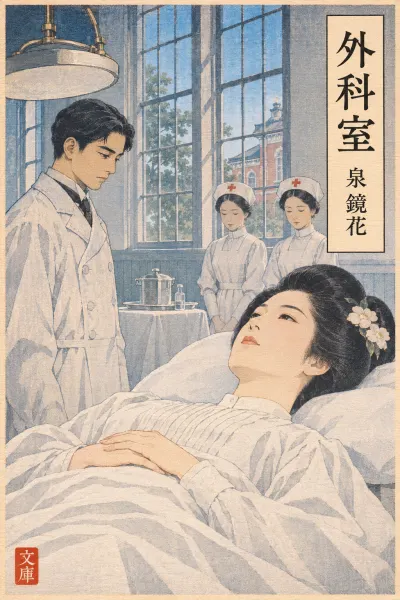
外科室(上(つづき)) Gekashitsu, part 2: The Countess Refuses the Anaesthetic
In this part
As the operation is about to begin, a lady's maid asks Countess Kifune to take the anaesthetic. The Countess refuses, even when her husband and the Marquis urge her. At last she admits that she has a secret, and she fears that under the drug she might reveal it in her delirium, so she would rather not be cured at all.
AI translation · independently checked
おりからしとやかに戸を排して、静かにここに入り来たれるは、先刻に廊下にて行き逢いたりし三人の腰元の中に、ひときわ目立ちし婦人なり。At that moment someone opened the door with quiet grace and came softly in: it was the woman who had stood out above the rest among the three lady's maids I had passed earlier in the corridor.
そと貴船伯に打ち向かいて、沈みたる音調もて、She turned gently towards Count Kifune and said in a subdued tone:
「御前、姫様はようようお泣き止みあそばして、別室におとなしゅういらっしゃいます」My lord, the young lady has at last stopped crying, and she is staying quietly in another room.
伯はものいわで頷けり。The Count nodded without a word.
看護婦はわが医学士の前に進みて、The nurse stepped up before my friend the doctor.
「それでは、あなた」"Then, sir, if you please."
「よろしい」"Very well."
と一言答えたる医学士の声は、このとき少しく震いを帯びてぞ予が耳には達したる。The doctor answered with that single word, and as his voice reached my ears it carried, at that moment, a slight tremor.
その顔色はいかにしけん、にわかに少しく変わりたり。For some reason his face suddenly changed colour a little.
さてはいかなる医学士も、驚破という場合に望みては、さすがに懸念のなからんやと、予は同情を表したりき。So even a man of medicine, I thought, faced with the decisive moment, cannot after all be free of misgivings, and I felt for him.
看護婦は医学士の旨を領してのち、かの腰元に立ち向かいて、Having understood the doctor's meaning, the nurse turned to the maid.
「もう、なんですから、あのことを、ちょっと、あなたから」"It's time now, so would you just mention that matter to her yourself?"
腰元はその意を得て、手術台に擦り寄りつ、優に膝のあたりまで両手を下げて、しとやかに立礼し、The maid understood, drew close to the operating table, let both hands fall gracefully as far as her knees, and bowed with quiet courtesy.
「夫人、ただいま、お薬を差し上げます。どうぞそれを、お聞きあそばして、いろはでも、数字でも、お算えあそばしますように」"My lady, we shall now give you the medicine. Please be so kind as to breathe it in, and count, whether the iroha syllables or numbers."
伯爵夫人は答なし。The Countess made no reply.
腰元は恐る恐る繰り返して、The maid timidly repeated herself.
「お聞き済みでございましょうか」"Have you understood, my lady?"
「ああ」とばかり答えたまう。"Yes," was all she answered.
念を推して、To make quite sure, the maid went on:
「それではよろしゅうございますね」"Then it will be all right, my lady?"
「何かい、痲酔剤をかい」"What is it? The sleeping drug?"
「はい、手術の済みますまで、ちょっとの間でございますが、御寝なりませんと、いけませんそうです」"Yes, my lady. It is only for a short while, until the operation is over, but they say you must be asleep for it."
夫人は黙して考えたるが、The Countess considered in silence.
「いや、よそうよ」と謂える声は判然として聞こえたり。Then her voice could be heard quite distinctly: "No, I'd rather not."
一同顔を見合わせぬ。Everyone exchanged glances.
腰元は、諭すがごとく、The maid said, as if reasoning with her:
「それでは夫人、御療治ができません」"But then, my lady, the treatment cannot be done."
「はあ、できなくってもいいよ」"Well, it doesn't matter if it can't be done."
腰元は言葉はなくて、顧みて伯爵の色を伺えり。The maid, without a word, looked round to read the Count's expression.
伯爵は前に進み、The Count stepped forward.
「奥、そんな無理を謂ってはいけません。できなくってもいいということがあるものか。わがままを謂ってはなりません」"My dear, you must not say such unreasonable things. How can it not matter if it cannot be done? You must not be wilful."
侯爵はまたかたわらより口を挟めり。The Marquis then put in a word from beside him.
「あまり、無理をお謂やったら、姫を連れて来て見せるがいいの。疾くよくならんでどうするものか」"If she keeps on being so unreasonable, you had better fetch the little girl and let her see her. What good can come of not getting well quickly?"
「はい」"Yes."
「それでは御得心でございますか」"Then you consent, my lady?"
腰元はその間に周旋せり。Meanwhile the maid acted as go-between.
夫人は重げなる頭を掉りぬ。The Countess shook her heavy head.
看護婦の一人は優しき声にて、One of the nurses said in a gentle voice:
「なぜ、そんなにおきらいあそばすの、ちっともいやなもんじゃございませんよ。うとうとあそばすと、すぐ済んでしまいます」"Why do you dislike it so, madam? It isn't unpleasant in the least. You'll just doze off, and it will all be over in no time."
このとき夫人の眉は動き、口は曲みて、瞬間苦痛に堪えざるごとくなりし。At this the Countess's brows moved and her mouth twisted, and for an instant she seemed unable to bear the pain.
半ば目を睜きて、Half opening her eyes, she said:
「そんなに強いるなら仕方がない。私はね、心に一つ秘密がある。痲酔剤は譫言を謂うと申すから、それがこわくってなりません。どうぞもう、眠らずにお療治ができないようなら、もうもう快らんでもいい、よしてください」"If you press me so, there is nothing for it. I have, you see, a secret in my heart. They say an anaesthetic makes one talk in delirium, and that frightens me terribly. Please, if the treatment cannot be done without my sleeping, then I do not care if I never get well. Stop, I beg you."
聞くがごとくんば、伯爵夫人は、意中の秘密を夢現の間に人に呟かんことを恐れて、死をもてこれを守ろうとするなり。If what we heard was true, the Countess feared that, between dreaming and waking, she might murmur the secret of her heart to others, and she meant to guard it even at the cost of her life.
良人たる者がこれを聞ける胸中いかん。What must he who was her husband have felt on hearing this?
この言をしてもし平生にあらしめば必ず一条の紛紜を惹き起こすに相違なきも、病者に対して看護の地位に立てる者はなんらのこともこれを不問に帰せざるべからず。Had these words been spoken in ordinary times, they would surely have stirred up some dispute; but those who stand as attendants to the sick must let any such thing pass without question.
しかもわが口よりして、あからさまに秘密ありて人に聞かしむることを得ずと、断乎として謂い出だせる、夫人の胸中を推すれば。Moreover, to imagine the heart of the lady who had declared so resolutely, from her own lips, that she had a secret and could not let anyone hear it!
伯爵は温乎として、The Count said mildly:
「わしにも、聞かされぬことなんか。え、奥」"Is it something you cannot tell even me? Eh, my dear?"
Vocabulary
| Word | Meaning | JLPT |
|---|---|---|
| 腰元こしもと | lady's maid, female attendant in a noble householdOld-fashioned word for a maid who personally waits on the lady of the house. | — |
| 先刻せんこく | a little while ago, earlierHere the author gives it the reading さき. In modern Japanese it is read せんこく and means "some time ago" or "already". | — |
| 驚破すわ | interjection of alarm ('Now!', 'Look out!'); in すわという場合, 'a critical moment, an emergency'すわ is an exclamation of alarm ("Now!"). The phrase すわという場合 means "the critical moment". The kanji spelling is an old ateji. | — |
| 懸念けねん | anxiety, misgivingStill used in formal Japanese and in news language: 懸念する, 懸念がある. | — |
| 痲酔剤ますいざい | anaestheticdictionary form: 麻酔剤The author glosses it as ねむりぐすり, "sleeping medicine". The modern spelling is 麻酔剤, and the everyday word is 麻酔. | — |
| 療治りょうじ | medical treatmentAn old-fashioned word. Modern Japanese would use 治療. | — |
| わがままわがまま | selfishness, wilfulnessわがままを言う means "to make selfish demands" or "to be difficult". | N3 |
| 得心とくしん | consent, being convincedA literary word. Compare the modern 納得. | — |
| 周旋しゅうせん | mediating, acting as go-between | — |
| 譫言うわごと | delirious talk, raving in sleep or feverUsually written in kana today. The set phrase is うわごとを言う. | — |
| 強いるしいる | to force, to press someone to do something | N1 |
| 夢現ゆめうつつ | half-asleep state, between dreaming and waking | — |
| 紛紜ふんうん | trouble, dispute, entanglementA rare literary word. 一条の紛紜 means "an affair of discord". | — |
| 不問ふもん | leaving unquestioned不問に付す and 不問に帰す both mean "to let something pass without inquiry". | — |
Grammar
お〜あそばす N1 very respectful honorific form of する and other verbs
The maid puts お plus the verb stem in front of あそばす to speak of her mistress's actions with the highest respect. In the Meiji period this form was typical of women serving in noble households.
お聞きあそばして、いろはでも、数字でも、お算えあそばしますように
If you would kindly take it, and then count, whether the iroha syllables or numbers
〜なくってもいい N4 it's fine even if not…
This is a colloquial form of 〜なくてもいい, with an extra っ. The Countess uses it to say she does not care whether the treatment happens.
はあ、できなくってもいいよ
Well, it doesn't matter if it can't be done.
〜ということがあるものか N2 how could it possibly be that…!
ものか at the end of a sentence turns it into a strong rhetorical denial. Here the Count flatly rejects the idea that it doesn't matter.
できなくってもいいということがあるものか
How can it not matter if it cannot be done?
〜てはなりません N3 must not…
A formal prohibition meaning 'must not…'. It is a stiffer, more formal and old-fashioned equivalent of 〜てはいけません. The Count uses it to address his wife firmly.
わがままを謂ってはなりません
You must not be wilful.
〜ごとく N1 as if, like
This is the literary equivalent of 〜ように. It follows the attributive form of a verb, here 堪えざる, "not able to endure".
瞬間苦痛に堪えざるごとくなりし
for an instant she seemed unable to bear the pain
〜ざるべからず N1 must, cannot but
This is a classical double negative: ざる means "not" and べからず means "must not", so together they mean "must not fail to", that is, "must". The narrator uses it to state that attendants are obliged to let the matter pass.
なんらのこともこれを不問に帰せざるべからず
must let any such thing pass without question