Advanced · JLPT N1
外科室Gekashitsu — The Operating Theatre
- JLPT N1
- 7,251 characters
- 5 parts
- about 60 minutes
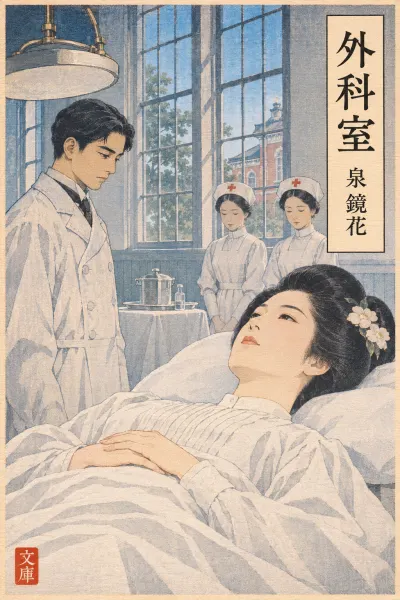
外科室 is a short, intense early work by Izumi Kyōka, first published in 1895. A painter persuades his friend, the surgeon Takamine, to let him watch an operation on the beautiful Countess Kifune. Aristocrats, officers and nurses crowd the hospital, but the Countess refuses the anaesthetic. She fears that under the drug she might speak a secret aloud. The story is less about medicine than about an unspoken bond, and it moves from tense ceremony to a startling climax before a final part that steps back in time. The tone is restrained, almost ritual, with sudden flashes of emotion. For learners this is a demanding text. The narration is in dense literary Japanese with kanbun-style constructions, so the 'Measured level: N1' is earned. The dialogue, however, is Meiji spoken Japanese, with many kinds of speech side by side: the Countess's refined aristocratic voice, the maids' elaborate honorifics, the old nobles' じゃ, and the cheeky slang of two young Tokyo tradesmen. The text is only about 7,000 characters long, so careful, note-assisted reading is realistic, and each of the five parts can be read as a single sitting.
Contents
Before you read
- Expect two languages in one story. The narration (予 = 'I') uses classical forms such as 〜たる, 〜ごとし/ごとく, 〜べからざる, 〜ざるべからず and 係り結び 〜こそ〜なれ. The dialogue is close to modern speech. Decode the narration slowly, and read the dialogue more quickly for its tone.
- Learn the causative pattern AをしてBしむ ('cause A to do B') and 〜のみならず ('not only'). Both recur in the narrator's descriptions and are easy to misread as ordinary を or のみ.
- Watch the honorific お〜あそばす (for example お眠りあそばす) in the maid's and nurses' speech toward the Countess. It shows who is speaking even when no name is given.
- In Part 5, the tradesmen speak rough shitamachi Tokyo slang: わっしゃ (わたしは), vowel mergers such as 〜らあ, and joking nicknames like 源吉 for 吉さん. Read these lines aloud, and treat them as comic relief rather than parsing every syllable.
- Before reading, learn a few key words: 麻酔剤 (anaesthetic), 伯爵 / 伯爵夫人 (Count / Countess), 侯爵 (Marquis), 看護婦 (nurse), 腰元 (lady's maid), メス (scalpel) and 秘密 (secret). Also note that 譫言 (うわごと, delirious talk) is central to the plot.
Words to know
The most useful words from the notes across the story.
| Word | Meaning | JLPT |
|---|---|---|
| 腰元こしもと | lady's maid, female attendant in a noble householdOld-fashioned word for a maid who personally waits on the lady of the house. | — |
| 痲酔剤ますいざい | anaestheticdictionary form: 麻酔剤The author glosses it as ねむりぐすり, "sleeping medicine". The modern spelling is 麻酔剤, and the everyday word is 麻酔. | — |
| 療治りょうじ | medical treatmentAn old-fashioned word. Modern Japanese would use 治療. | — |
| 譫言うわごと | delirious talk, raving in sleep or feverUsually written in kana today. The set phrase is うわごとを言う. | — |
| 自若じじゃく | calm, self-possessedLiterary; common in the set phrase 泰然自若 (perfectly composed). | — |
| 遁げるにげる | to run away, fleeOld-fashioned kanji for 逃げる. | N4 |
| わがままわがまま | selfishness, wilfulnessわがままを言う means "to make selfish demands" or "to be difficult". | N3 |
| 口実こうじつ | pretext, excuseOften used with 設ける or つける: 口実を設ける, to make up a pretext. | N2 |
| 消毒しょうどく | disinfection, sterilisation消毒する means 'to sterilise'. | N2 |
| 赴くおもむく | to go towards, to proceed toFormal, written word for 行く. | N1 |
| 強いるしいる | to force, to press someone to do something | N1 |
| 辛抱しんぼう | patience, endurance辛抱する = to put up with hardship or pain. | N1 |
| 見合わすみあわせる | to postpone, hold offdictionary form: 見合わせる見合わす is the older form. 運転見合わせ (service suspended) is common today. | N1 |
| おどおどおどおど | timidly, nervouslyA mimetic word for fearful, uncertain behaviour. | N1 |
| 室しつ | wifeClassical sense 'wife' (as in 正室, 'lawful wife'), not 'room'. | N1 |
Plot summary
Show the full summary (contains spoilers)
The painter-narrator watches as Countess Kifune, about to undergo surgery, refuses anaesthesia. She is afraid that in her delirium she will reveal a secret. Her husband, the Count, and a Marquis try to persuade her, without success. She tells Takamine to operate without the drug and promises not to move. He cuts calmly while the onlookers turn away. When the blade reaches the bone, she grips his arm and says it does not hurt, because it is him. She says he surely does not know her and then drives the scalpel deep beneath her breast. Takamine answers that he has not forgotten, and she dies smiling. The final part goes back nine years to the Koishikawa Botanical Garden, where the two young men once passed her. Takamine never marries, and he dies on the same day as she does. They are buried in different cemeteries, and the narrator asks whether they were sinners barred from Heaven.
About the author
Izumi Kyōka was born in Kanazawa. He went to Tokyo and became a disciple of the novelist Ozaki Kōyō, whom he revered throughout his life. He went on to develop a highly individual style that is ornate, sensuous and deeply rooted in Edo-period storytelling and language. His fiction often features beautiful, otherworldly women and the supernatural, as in 高野聖 (The Holy Man of Mount Kōya). He also wrote plays, including 夜叉ヶ池. The Izumi Kyōka Literary Prize is named after him.