Part 1 of 4 · JLPT N2
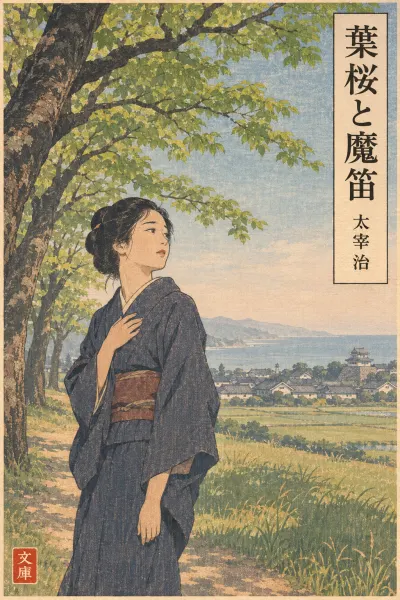
葉桜と魔笛 Hazakura to Mateki, part 1: A Dying Sister and Thunder from Below
In this part
An elderly woman recalls a spring thirty-five years earlier, when she lived with her scholarly father and her beautiful younger sister in a temple annex in a castle town in Shimane. Her sister was dying of kidney tuberculosis and had only a hundred days left. One day in mid-May, walking alone in the fields in despair, she heard a deep, endless booming from under the earth, thought she had gone mad, and collapsed weeping in the grass.
AI translation · independently checked
桜が散って、このように葉桜のころになれば、私は、きっと思い出します。Whenever the cherry blossoms have fallen and the trees come into leaf, as they are now, I always remember.
――と、その老夫人は物語る。—So the old lady tells her story.
――いまから三十五年まえ、父はその頃まだ存命中でございまして、私の一家、と言いましても、母はその七年まえ私が十三のときに、もう他界なされて、あとは、父と、私と妹と三人きりの家庭でございましたが、父は、私十八、妹十六のときに島根県の日本海に沿った人口二万余りの或るお城下まちに、中学校長として赴任して来て、恰好の借家もなかったので、町はずれの、もうすぐ山に近いところに一つ離れてぽつんと建って在るお寺の、離れ座敷、二部屋拝借して、そこに、ずっと、六年目に松江の中学校に転任になるまで、住んでいました。—Thirty-five years ago now, my father was still living. As for my family—though I say family, my mother had already passed away seven years before, when I was thirteen, so all that was left was a household of just the three of us: Father, my sister and me. When I was eighteen and my sister sixteen, Father came to take up a post as headmaster of the middle school in a certain castle town of a little over twenty thousand people on the Sea of Japan coast of Shimane Prefecture. Since there was no suitable house to rent, we were kindly lent two rooms in the detached wing of a temple that stood all alone at the edge of town, right up near the hills, and there we lived the whole while, until in the sixth year Father was transferred to the middle school in Matsue.
私が結婚致しましたのは、松江に来てからのことで、二十四の秋でございますから、当時としてはずいぶん遅い結婚でございました。It was only after we came to Matsue that I married, in the autumn of my twenty-fourth year, and for those days that was a very late marriage indeed.
早くから母に死なれ、父は頑固一徹の学者気質で、世俗のことには、とんと、うとく、私がいなくなれば、一家の切りまわしが、まるで駄目になることが、わかっていましたので、私も、それまでにいくらも話があったのでございますが、家を捨ててまで、よそへお嫁に行く気が起らなかったのでございます。We had lost Mother early, and Father was a stubborn, single-minded scholar who knew nothing whatever of worldly matters; I knew that if I were gone, the running of the household would fall apart completely. So although there had been any number of offers before then, I could never bring myself to abandon our home and go off to marry into another family.
せめて、妹さえ丈夫でございましたならば、私も、少し気楽だったのですけれども、妹は、私に似ないで、たいへん美しく、髪も長く、とてもよくできる、可愛い子でございましたが、からだが弱く、その城下まちへ赴任して、二年目の春、私二十、妹十八で、妹は、死にました。If only my sister had been in good health, I might have felt a little easier, but my sister, quite unlike me, was very beautiful, with long hair, a clever and lovable girl, yet her constitution was weak, and in the spring of our second year in that castle town, when I was twenty and she was eighteen, my sister died.
そのころの、これは、お話でございます。This is a story from that time.
妹は、もう、よほどまえから、いけなかったのでございます。My sister had already been beyond hope for a long while.
腎臓結核という、わるい病気でございまして、気のついたときには、両方の腎臓が、もう虫食われてしまっていたのだそうで、医者も、百日以内、とはっきり父に言いました。It was a terrible illness called tuberculosis of the kidneys, and by the time anyone noticed, both her kidneys had already been eaten away, it seems; the doctor told Father plainly: within a hundred days.
どうにも、手のほどこし様が無いのだそうでございます。There was nothing at all that could be done, so they said.
ひとつき経ち、ふたつき経って、そろそろ百日目がちかくなって来ても、私たちはだまって見ていなければいけません。One month passed, then two, and even as the hundredth day drew near, we had no choice but to look on in silence.
妹は、何も知らず、割に元気で、終日寝床に寝たきりなのでございますが、それでも、陽気に歌をうたったり、冗談言ったり、私に甘えたり、これがもう三、四十日経つと、死んでゆくのだ、はっきり、それにきまっているのだ、と思うと、胸が一ぱいになり、総身を縫針で突き刺されるように苦しく、私は、気が狂うようになってしまいます。My sister knew nothing of it; she was fairly cheerful, and though she lay in bed all day long, she would still sing merrily, make jokes, and cling to me like a little child. When I thought that in another thirty or forty days she would die, that it was certain, beyond all doubt, my heart would overflow, and it hurt as though my whole body were being stabbed with sewing needles, until I felt I was going out of my mind.
三月、四月、五月、そうです。March, April, May—yes.
五月のなかば、私は、あの日を忘れません。The middle of May—I shall never forget that day.
野も山も新緑で、はだかになってしまいたいほど温く、私には、新緑がまぶしく、眼にちかちか痛くって、ひとり、いろいろ考えごとをしながら帯の間に片手をそっと差しいれ、うなだれて野道を歩き、考えること、考えること、みんな苦しいことばかりで息ができなくなるくらい、私は、身悶えしながら歩きました。The fields and hills were all fresh green, and it was so warm I wanted to throw off my clothes. The new green was dazzling to me and stung my eyes with its glare. Alone, lost in all kinds of thoughts, I slipped one hand quietly into the fold of my kimono sash and walked along a path through the fields with my head bowed. Everything I thought, everything, was nothing but pain, until I could hardly breathe, and I walked on, writhing in anguish.
どおん、どおん、と春の土の底の底から、まるで十万億土から響いて来るように、幽かな、けれども、おそろしく幅のひろい、まるで地獄の底で大きな大きな太鼓でも打ち鳴らしているような、おどろおどろした物音が、絶え間なく響いて来て、私には、その恐しい物音が、なんであるか、わからず、ほんとうにもう自分が狂ってしまったのではないか、と思い、そのまま、からだが凝結して立ちすくみ、突然わあっ!Boom, boom—from the depths, the very depths of the spring earth, as though it were echoing all the way from that distant Paradise a hundred thousand million worlds away, came a sound, faint yet terribly broad, eerie and ominous, as if someone were beating a huge, huge drum at the bottom of Hell. It rumbled on without a pause, and I could not tell what that dreadful sound was. I thought I really had gone mad at last, and my body froze; I stood rooted to the spot, and suddenly—"Aaah!"
と大声が出て、立って居られずぺたんと草原に坐って、思い切って泣いてしまいました。A great cry burst out of me, and unable to stay on my feet, I sank down onto the grass and wept with all my heart.
Vocabulary
| Word | Meaning | JLPT |
|---|---|---|
| 葉桜はざくら | cherry tree in fresh leaf after the blossoms have fallenA seasonal word for late spring; it is also the first word of the story's title. | — |
| 存命ぞんめい | being alive, still livingFormal; 存命中 means 'while (he) was still alive'. | — |
| 他界たかいする | to pass awaydictionary form: 他界するPolite euphemism for dying, literally '(go to) the other world'. | — |
| 赴任ふにんする | to go and take up a new postdictionary form: 赴任するUsed for job transfers to another place; compare 転任 'transfer'. | — |
| 離れ座敷はなれざしき | detached tatami rooms, an annex離れ alone can also mean a separate outbuilding. | — |
| 頑固一徹がんこいってつ | stubborn and single-minded, obstinateFour-character compound often used to describe old-fashioned fathers. | — |
| うとくうとい | ignorant of, out of touch withdictionary form: 疎いUsually 〜に疎い: 世俗のことに疎い 'knows nothing of worldly matters'. | — |
| 切りまわしきりまわし | managing, running (a household)dictionary form: 切り回しFrom 切り回す 'to manage, keep things running'. | — |
| 手のほどこし様が無いてのほどこしようがない | nothing can be done; beyond helpdictionary form: 手の施しようがないCommon set phrase, often about illness; 様 here is the suffix よう 'way of doing'. | — |
| 甘えあまえる | to cling to someone affectionately, act like a pampered childdictionary form: 甘えるExpresses relying on someone's indulgence; no single English equivalent. | N1 |
| 身悶えみもだえ | writhing in agony身悶えする: to twist one's body from pain or anguish. | — |
| 十万億土じゅうまんおくど | the immeasurably distant Paradise; the world beyondBuddhist term: the Western Paradise lies a hundred thousand million Buddha-lands away. | — |
| おどろおどろしたおどろおどろしい | eerie, ominous, weirdly frighteningdictionary form: おどろおどろしいHere used in the form おどろおどろした before a noun. | — |
| 立ちすくみたちすくむ | to stand frozen, be rooted to the spotdictionary form: 立ちすくむUsually from fear or shock. | — |
Grammar
〜に〜(ら)れる (suffering passive) N3 to suffer from someone's action
With an intransitive verb like 死ぬ, the passive shows that the speaker was adversely affected. 母に死なれ means 'Mother died (and I was left to suffer for it)'.
早くから母に死なれ
We lost Mother early
〜てまで N2 going so far as to ~
Marks an extreme step taken to achieve something. Here she would not go so far as to abandon the household in order to marry.
家を捨ててまで、よそへお嫁に行く気が起らなかったのでございます
I could never bring myself to abandon our home to go and marry into another family
せめて〜さえ〜ば N2 if only at least ~
さえ〜ば states the one condition that would be enough, and せめて adds 'at the very least'. The past tense ending expresses regret over something that was not so.
せめて、妹さえ丈夫でございましたならば、私も、少し気楽だったのですけれども
If only my sister had been in good health, I might have felt a little easier
〜たきり N2 having done ~ and staying that way
Verb in た-form + きり shows that a state continues with no change. 寝たきり is a set expression for being bedridden.
終日寝床に寝たきりなのでございますが
though she lay in bed all day long
〜ほど N3 so ~ that; to the extent of ~
ほど after a clause gives the degree of the following adjective. Here it was so warm that she wanted to strip off.
はだかになってしまいたいほど温く
so warm I wanted to throw off my clothes
〜のではないか N3 might it be that ~; I fear that ~
Expresses a suspicion or fear that something is true. With と思う it shows her frightened guess that she has lost her mind.
ほんとうにもう自分が狂ってしまったのではないか、と思い
thinking that I really had gone mad at last