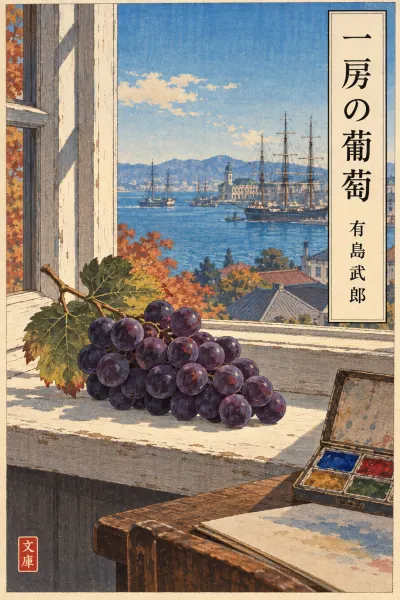
Part 1 of 5 · JLPT N3
一房の葡萄(一) Hitofusa no Budō, part 1: The Paints I Could Not Stop Wanting
In this part
The narrator remembers his childhood in Yokohama, where he loved painting the harbour but could never match its colours with his cheap paints. He begins to long desperately for the fine imported paints of Jim, an older Western classmate. One clear autumn day at lunch he becomes sure that Jim can read his thoughts, and this only makes him want the paints more.
AI translation · independently checked
僕は小さい時に絵を描くことが好きでした。When I was little, I loved to draw pictures.
僕の通っていた学校は横浜の山の手という所にありましたが、そこいらは西洋人ばかり住んでいる町で、僕の学校も教師は西洋人ばかりでした。The school I went to was in a part of Yokohama called Yamanote. It was a district where only Westerners lived, and at my school too the teachers were all Westerners.
そしてその学校の行きかえりにはいつでもホテルや西洋人の会社などがならんでいる海岸の通りを通るのでした。On my way to and from school I always walked along Kaigan-dōri, the seafront street lined with hotels, Western companies and the like.
通りの海添いに立って見ると、真青な海の上に軍艦だの商船だのが一ぱいならんでいて、煙突から煙の出ているのや、檣から檣へ万国旗をかけわたしたのやがあって、眼がいたいように綺麗でした。If you stood by the sea along that street and looked out, the deep blue water was crowded with warships and merchant ships. Some had smoke rising from their funnels, and some had flags of every nation strung from mast to mast. It was so beautiful that it almost hurt your eyes.
僕はよく岸に立ってその景色を見渡して、家に帰ると、覚えているだけを出来るだけ美しく絵に描いて見ようとしました。I often stood on the shore gazing out over that view, and when I got home I would try to paint as much of it as I could remember, as beautifully as I could.
けれどもあの透きとおるような海の藍色と、白い帆前船などの水際近くに塗ってある洋紅色とは、僕の持っている絵具ではどうしてもうまく出せませんでした。But the indigo of that sea, which seemed almost clear enough to see through, and the crimson painted near the waterline of the white sailing ships, I simply could not get right with the paints I had.
いくら描いても描いても本当の景色で見るような色には描けませんでした。However much I painted, and painted again, I could never get the colours to look the way they did in the real scene.
ふと僕は学校の友達の持っている西洋絵具を思い出しました。Then all of a sudden I remembered the Western paints that a friend at school had.
その友達は矢張西洋人で、しかも僕より二つ位齢が上でしたから、身長は見上げるように大きい子でした。That friend was a Westerner too, and besides, he was about two years older than me, so he was a boy so tall that I had to look up at him.
ジムというその子の持っている絵具は舶来の上等のもので、軽い木の箱の中に、十二種の絵具が小さな墨のように四角な形にかためられて、二列にならんでいました。The paints this boy, Jim, owned were fine ones from abroad. Inside a light wooden box, twelve colours were pressed into little square cakes, like small sticks of ink, and set out in two rows.
どの色も美しかったが、とりわけて藍と洋紅とは喫驚するほど美しいものでした。Every colour was lovely, but the indigo and the crimson above all were astonishingly beautiful.
ジムは僕より身長が高いくせに、絵はずっと下手でした。Jim was taller than me, yet he was far worse at drawing.
それでもその絵具をぬると、下手な絵さえがなんだか見ちがえるように美しく見えるのです。Even so, when he put on those paints, even his clumsy pictures somehow looked so beautiful you would hardly have known them.
僕はいつでもそれを羨しいと思っていました。I was always envious of that.
あんな絵具さえあれば僕だって海の景色を本当に海に見えるように描いて見せるのになあと、自分の悪い絵具を恨みながら考えました。"If only I had paints like those, even I could show that I can paint the sea so it really looks like the sea," I thought, resenting my own poor paints.
そうしたら、その日からジムの絵具がほしくってほしくってたまらなくなりました。And from that day on, I wanted Jim's paints so much, so very much, that I could hardly bear it.
けれども僕はなんだか臆病になってパパにもママにも買って下さいと願う気になれないので、毎日々々その絵具のことを心の中で思いつづけるばかりで幾日か日がたちました。But somehow I had grown timid, and I could not bring myself to ask Papa or Mama to buy me some. So day after day I did nothing but think about those paints in my heart, and several days went by.
今ではいつの頃だったか覚えてはいませんが秋だったのでしょう。I no longer remember exactly when it was, but it must have been autumn.
葡萄の実が熟していたのですから。For the grapes had grown ripe.
天気は冬が来る前の秋によくあるように空の奥の奥まで見すかされそうに霽れわたった日でした。The weather was the kind we often have in autumn just before winter comes: a day so perfectly clear that it seemed you could see right into the farthest depths of the sky.
僕達は先生と一緒に弁当をたべましたが、その楽しみな弁当の最中でも僕の心はなんだか落着かないで、その日の空とはうらはらに暗かったのです。We ate our lunch together with our teacher, but even in the middle of that happy lunchtime my heart was somehow restless, and it was dark, quite the opposite of the sky that day.
僕は自分一人で考えこんでいました。I sat alone, lost in my own thoughts.
誰かが気がついて見たら、顔も屹度青かったかも知れません。If anyone had noticed and looked at me, my face would probably have been pale too.
僕はジムの絵具がほしくってほしくってたまらなくなってしまったのです。I had come to want Jim's paints so much, so very much, that I could not bear it.
胸が痛むほどほしくなってしまったのです。I wanted them so badly that my chest ached.
ジムは僕の胸の中で考えていることを知っているにちがいないと思って、そっとその顔を見ると、ジムはなんにも知らないように、面白そうに笑ったりして、わきに坐っている生徒と話をしているのです。Thinking that Jim must surely know what was going on in my heart, I stole a glance at his face. But Jim, as if he knew nothing at all, was laughing merrily and chatting with the pupil sitting beside him.
でもその笑っているのが僕のことを知っていて笑っているようにも思えるし、何か話をしているのが、「いまに見ろ、あの日本人が僕の絵具を取るにちがいないから。」といっているようにも思えるのです。Yet it seemed to me that he was laughing because he knew about me, and that whatever he was talking about, he was really saying, "Just you watch. That Japanese boy is sure to take my paints."
僕はいやな気持ちになりました。I felt wretched.
けれどもジムが僕を疑っているように見えれば見えるほど、僕はその絵具がほしくてならなくなるのです。But the more it looked as though Jim suspected me, the more I wanted those paints, until I could hardly stand it.
Vocabulary
| Word | Meaning | JLPT |
|---|---|---|
| 通っていたかよう | to attend regularly (a school, etc.)dictionary form: 通うMeans going back and forth regularly. When the same kanji is read とおる, it means 'to pass through', as in the next sentence. | N4 |
| 軍艦ぐんかん | warship軍 'army' + 艦 'large ship'. | N1 |
| 見渡してみわたす | to look out over, survey (a wide view)dictionary form: 見渡す | N1 |
| 絵具えのぐ | paints, coloursThe key object of the story. Modern spelling is 絵の具. | N2 |
| 舶来はくらい | imported from abroadAn old-fashioned word that suggests high quality and prestige. | — |
| 喫驚びっくり | astonishment, surpriseAn old kanji spelling of びっくり, which today is usually written in kana. | N4 |
| 羨しいうらやましい | envious, enviabledictionary form: 羨ましいOld spelling. Modern Japanese adds ま: 羨ましい. | N2 |
| 恨みながらうらむ | to resent, bear a grudge againstdictionary form: 恨むHere it means resenting his own poor paints. | N2 |
| 臆病おくびょう | timid, cowardly | N1 |
| 熟してじゅくす | to ripendictionary form: 熟す | — |
| 霽れわたったはれわたる | to clear up completely (of the sky)dictionary form: 霽れわたる霽 is a rare literary kanji for 晴. The suffix 〜わたる means 'all over, throughout'. | — |
| うらはらうらはら | the very opposite, contrarydictionary form: 裏腹Used in the pattern AとはうらはらにB, meaning 'B, quite unlike A'. | — |
| 屹度きっと | surely, no doubtdictionary form: きっとAn old kanji spelling. Today it is written in kana. | N4 |
| 疑ってうたがう | to suspect, doubtdictionary form: 疑う | N3 |
Grammar
〜だの〜だの N2 things like A and B
This lists examples in a lively way, suggesting there are many more of the same kind. Here it conveys a crowded harbour full of all sorts of ships.
真青な海の上に軍艦だの商船だのが一ぱいならんでいて
the deep blue water was crowded with warships and merchant ships
〜くせに N3 even though, despite (with criticism)
〜くせに: even though, despite (usually with a critical or grudging tone). It joins two facts that clash. Here the narrator remarks that Jim is taller than him yet much worse at drawing, which leads into his envy of Jim's fine paints.
ジムは僕より身長が高いくせに、絵はずっと下手でした。
Jim was taller than me, yet he was far worse at drawing.
〜さえ〜ば N3 if only ~
This means that one condition alone would be enough. Adding のになあ at the end turns it into a regretful wish.
あんな絵具さえあれば僕だって海の景色を本当に海に見えるように描いて見せるのになあ
If only I had paints like those, I would show them I could paint the sea so it really looked like the sea
〜て(く)てたまらない N3 unbearably ~, so ~ one can't stand it
This follows the て-form of an adjective to express an overwhelming feeling. Here ほしくって is repeated for emphasis, and the small っ is a colloquial, childlike touch.
その日からジムの絵具がほしくってほしくってたまらなくなりました。
from that day on, I wanted Jim's paints so much, so very much, that I could hardly bear it.
〜にちがいない N3 must surely be ~
This expresses a strong conviction on the speaker's part. The boy is certain that Jim can read his guilty thoughts.
ジムは僕の胸の中で考えていることを知っているにちがいないと思って
Thinking that Jim must surely know what was going on in my heart
〜ば〜ほど N3 the more ~, the more ~
The same verb is repeated, first in the ば-form and then with ほど, and the second clause changes in step with the first. Here it is paired with 〜てならない, 'can't help ~'.
ジムが僕を疑っているように見えれば見えるほど、僕はその絵具がほしくてならなくなるのです。
the more it looked as though Jim suspected me, the more I wanted those paints, until I could hardly stand it.