Intermediate · JLPT N3
一房の葡萄Hitofusa no Budō — Grapes from the Teacher's Window
- JLPT N3
- 6,311 characters
- 5 parts
- about 53 minutes
- 2 easier versions
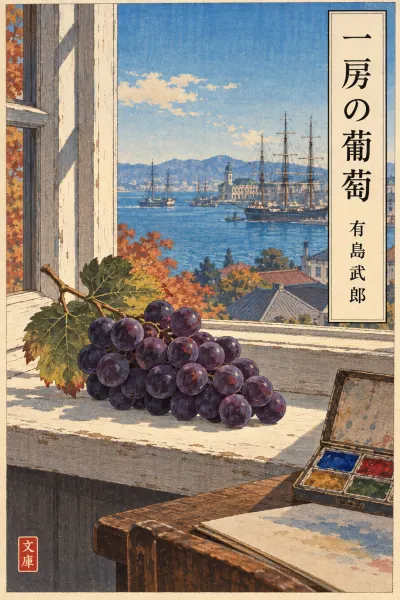
This is a short, first-person story in which an adult looks back on one autumn of his boyhood in Yokohama. He went to a school in the Yamanote district, where the teachers were all Westerners and the neighbourhood was home mostly to Westerners. On his walk along the seafront he loves to look at the harbour full of warships and merchant ships and wishes he could paint it. His own paints cannot capture the colours. His classmate Jim, an older and taller Western boy, owns a set of imported paints with a beautiful blue and crimson. The story follows what that longing leads the boy to do, and how the adults and children around him respond. The tone is quiet and confessional. The narrator is honest about his fear, shame and tears, and the young woman teacher treats him with great gentleness. For learners, the gentle です/ます narration and the short length make the story approachable at around N3. The challenges come from early-twentieth-century spellings and loanwords, the teacher's honorific speech, and the emotional detail packed into ordinary sentences.
Contents
Easier versions
This story is also retold in simpler Japanese. Reading an easier version first makes the original much more approachable.
Before you read
- Learn the older spellings before you start. The same words appear throughout: 這入る = 入る, 迚も = とても, 屹度 = きっと. Old-style loanwords include ポッケット (pocket), マーブル球 (marbles) and リンネル (linen).
- The narrator writes in polite です/ます past tense and often explains his feelings with 〜のです/〜んです. He also uses 〜てしまいました to express regret or something that can't be undone. Watch how these endings carry his guilt and embarrassment.
- The teacher's speech uses honorifics such as 仰る, 入らっしゃい and 〜なさい. The children speak bluntly in plain form. The contrast tells you who is speaking even when the quotes are short.
- Learn a few key words first: 絵具 (paints), 藍 (indigo/blue), 洋紅 (crimson), 葡萄 (grapes), 返す (to give back), 泣く (to cry). Colour words and the image of the grapes return at the most important moments.
Words to know
The most useful words from the notes across the story.
| Word | Meaning | JLPT |
|---|---|---|
| 絵具えのぐ | paints, coloursThe key object of the story. Modern spelling is 絵の具. | N2 |
| 教場きょうじょう | classroomOld-fashioned word. Modern Japanese uses 教室. | — |
| 通っていたかよう | to attend regularly (a school, etc.)dictionary form: 通うMeans going back and forth regularly. When the same kanji is read とおる, it means 'to pass through', as in the next sentence. | N4 |
| 喫驚びっくり | astonishment, surpriseAn old kanji spelling of びっくり, which today is usually written in kana. | N4 |
| 屹度きっと | surely, no doubtdictionary form: きっとAn old kanji spelling. Today it is written in kana. | N4 |
| 屹度きっと | surely; without failOld kanji spelling of きっと. Here, as 屹度ですよ, it asks for a promise. | N4 |
| 疑ってうたがう | to suspect, doubtdictionary form: 疑う | N3 |
| 質たち | nature, dispositionRead たち when it means someone's temperament. It is read しつ when it means quality. | N3 |
| 沈んでしずむ | to sink; (of the heart) to feel lowdictionary form: 沈む心が沈む means to feel depressed. | N3 |
| たまりませんたまらない | to be unbearable; unable to hold backdictionary form: たまらないHere it means his feelings overflowed and he could no longer control himself. | N3 |
| 書物しょもつ | booksA more formal, bookish word than 本. | N3 |
| 虫歯むしば | decayed tooth, cavityCounted with 本: 虫歯一本 means 'a single bad tooth'. | N3 |
| 羨しいうらやましい | envious, enviabledictionary form: 羨ましいOld spelling. Modern Japanese adds ま: 羨ましい. | N2 |
| 恨みながらうらむ | to resent, bear a grudge againstdictionary form: 恨むHere it means resenting his own poor paints. | N2 |
| 銘々めいめい | each, every oneSlightly formal. Similar to それぞれ. | N2 |
Plot summary
Show the full summary (contains spoilers)
Longing for the blue and crimson in Jim's Western paint set, the narrator takes the two paints during the lunch break while the others are outside. Afterwards, some classmates confront him, find the paints in his pocket and bring him to the young teacher he loves. She speaks to him gently rather than scolding him. She cuts a bunch of grapes from the vine outside her window, gives it to him and lets him stay in her room. There he cries until he falls asleep. The next day Jim greets him kindly and brings him to the teacher, who has the two boys make up. She cuts another bunch of grapes in two with silver scissors and gives them each half. The grown narrator ends by remembering the purple grapes resting in her beautiful white hand, and saying that he misses the teacher, whom he can no longer find.
About the author
Arishima Takeo was a Japanese novelist and essayist associated with the Shirakaba (White Birch) literary group. He studied at Sapporo Agricultural College and later in the United States, and for a time he was a committed Christian. His best-known works include the novel 或る女 (A Certain Woman) and the stories カインの末裔 and 生れ出づる悩み. Troubled by his inherited wealth, he gave his family's farm in Hokkaido to the tenant farmers who worked it.