Part 5 of 5 · JLPT N3
一房の葡萄(三) Hitofusa no Budō, part 5: Forgiveness and a Bunch of Grapes
In this part
Alone in the teacher's room, the narrator cries himself to sleep. The teacher sends him home with the grapes and asks him to come back the next day. Although he dreads it, he returns, and Jim warmly takes his hand and leads him to the teacher, who makes the two boys friends and gives them grapes from her window. The grown narrator still misses her every autumn.
AI translation · independently checked
一時がやがやとやかましかった生徒達はみんな教場に這入って、急にしんとするほどあたりが静かになりました。The pupils, who had been so noisy for a while, all went into the classrooms, and everything around grew so quiet that it suddenly fell completely still.
僕は淋しくって淋しくってしようがない程悲しくなりました。I became so sad that I felt unbearably, unbearably lonely.
あの位好きな先生を苦しめたかと思うと僕は本当に悪いことをしてしまったと思いました。When I thought that I had made a teacher I loved so much suffer, I felt that I had truly done a wicked thing.
葡萄などは迚も喰べる気になれないでいつまでも泣いていました。I could not bring myself to eat the grapes at all, and I went on crying and crying.
ふと僕は肩を軽くゆすぶられて眼をさましました。Suddenly I felt my shoulder being gently shaken, and I woke up.
僕は先生の部屋でいつの間にか泣寝入りをしていたと見えます。It seems that at some point I had cried myself to sleep in the teacher's room.
少し痩せて身長の高い先生は笑顔を見せて僕を見おろしていられました。The teacher, who was rather slender and tall, was smiling as she looked down at me.
僕は眠ったために気分がよくなって今まであったことは忘れてしまって、少し恥しそうに笑いかえしながら、慌てて膝の上から辷り落ちそうになっていた葡萄の房をつまみ上げましたが、すぐ悲しいことを思い出して笑いも何も引込んでしまいました。Sleep had made me feel better, and I forgot everything that had happened until then. Smiling back a little shyly, I hurriedly picked up the bunch of grapes that was about to slip off my lap, but at once I remembered the sad thing, and my smile and everything else vanished.
「そんなに悲しい顔をしないでもよろしい。もうみんなは帰ってしまいましたから、あなたはお帰りなさい。そして明日はどんなことがあっても学校に来なければいけませんよ。あなたの顔を見ないと私は悲しく思いますよ。屹度ですよ。」"You need not look so sad. Everyone has already gone home, so you should go home too. And tomorrow, whatever happens, you must come to school. If I do not see your face, I shall feel sad. Promise me, now."
そういって先生は僕のカバンの中にそっと葡萄の房を入れて下さいました。Saying this, the teacher quietly put the bunch of grapes into my school bag for me.
僕はいつものように海岸通りを、海を眺めたり船を眺めたりしながらつまらなく家に帰りました。As always, I walked home along Kaigan-dōri, gazing at the sea and gazing at the ships, but without any pleasure.
そして葡萄をおいしく喰べてしまいました。And I ate up the grapes, and they tasted delicious.
けれども次の日が来ると僕は中々学校に行く気にはなれませんでした。But when the next day came, I just could not make myself want to go to school.
お腹が痛くなればいいと思ったり、頭痛がすればいいと思ったりしたけれども、その日に限って虫歯一本痛みもしないのです。I wished I would get a stomach ache, and I wished I would get a headache, but that day of all days, not even one bad tooth hurt.
仕方なしにいやいやながら家は出ましたが、ぶらぶらと考えながら歩きました。I had no choice, so I left the house very unwillingly, but I dawdled along, thinking as I walked.
どうしても学校の門を這入ることは出来ないように思われたのです。It seemed to me that I could never, ever go in through the school gate.
けれども先生の別れの時の言葉を思い出すと、僕は先生の顔だけはなんといっても見たくてしかたがありませんでした。Yet when I remembered what the teacher had said as we parted, I wanted, more than anything, to see her face at least.
僕が行かなかったら先生は屹度悲しく思われるに違いない。If I did not go, the teacher would surely feel sad.
もう一度先生のやさしい眼で見られたい。I wanted to be looked at once more with the teacher's kind eyes.
ただその一事があるばかりで僕は学校の門をくぐりました。It was only for that one reason that I passed through the school gate.
そうしたらどうでしょう、先ず第一に待ち切っていたようにジムが飛んで来て、僕の手を握ってくれました。And what do you think happened? First of all, Jim came running up as if he had been waiting impatiently, and he took my hand.
そして昨日のことなんか忘れてしまったように、親切に僕の手をひいてどぎまぎしている僕を先生の部屋に連れて行くのです。And as if he had forgotten all about yesterday, he kindly led me by the hand, flustered as I was, to the teacher's room.
僕はなんだか訳がわかりませんでした。I could not make any sense of it.
学校に行ったらみんなが遠くの方から僕を見て「見ろ泥棒の譃つきの日本人が来た」とでも悪口をいうだろうと思っていたのにこんな風にされると気味が悪い程でした。I had thought that when I got to school, everyone would look at me from far away and say something nasty like, "Look, here comes the Japanese thief and liar!" So being treated like this almost frightened me.
二人の足音を聞きつけてか、先生はジムがノックしない前に、戸を開けて下さいました。Perhaps she had heard our footsteps, for the teacher opened the door for us before Jim could knock.
二人は部屋の中に這入りました。The two of us went into the room.
「ジム、あなたはいい子、よく私の言ったことがわかってくれましたね。ジムはもうあなたからあやまって貰わなくってもいいと言っています。二人は今からいいお友達になればそれでいいんです。二人とも上手に握手をなさい。」と先生はにこにこしながら僕達を向い合せました。"Jim, you are a good boy. You understood what I said very well, didn't you? Jim says that you need not apologise to him any more. All that matters is that from now on the two of you become good friends. Now both of you, shake hands nicely," said the teacher, smiling, as she turned us to face each other.
僕はでもあんまり勝手過ぎるようでもじもじしていますと、ジムはいそいそとぶら下げている僕の手を引張り出して堅く握ってくれました。But it seemed far too selfish of me to be forgiven so readily, and I stood there fidgeting. Then Jim eagerly pulled out my hand, which was hanging at my side, and held it tight.
僕はもうなんといってこの嬉しさを表せばいいのか分らないで、唯恥しく笑う外ありませんでした。I did not know how to express my happiness, and I could only smile shyly.
ジムも気持よさそうに、笑顔をしていました。Jim was smiling too, and he looked pleased.
先生はにこにこしながら僕に、Smiling, the teacher turned to me
「昨日の葡萄はおいしかったの。」と問われました。and asked, "Were yesterday's grapes nice?"
僕は顔を真赤にして「ええ」と白状するより仕方がありませんでした。I turned bright red, and I could do nothing but confess, "Yes."
「そんなら又あげましょうね。」"Then I shall give you some more, shall I?"
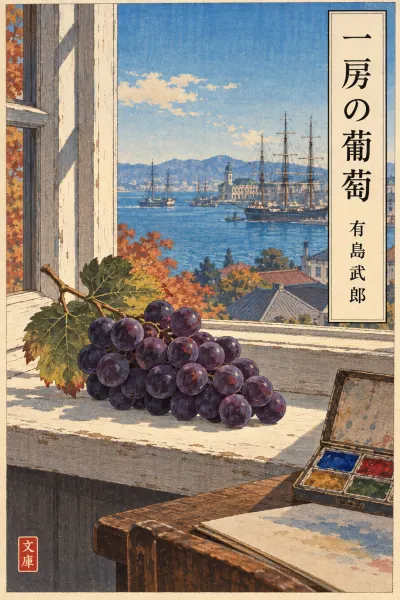
そういって、先生は真白なリンネルの着物につつまれた体を窓からのび出させて、葡萄の一房をもぎ取って、真白い左の手の上に粉のふいた紫色の房を乗せて、細長い銀色の鋏で真中からぷつりと二つに切って、ジムと僕とに下さいました。Saying this, the teacher leaned her body, clothed in pure white linen, out of the window and picked a bunch of grapes. She laid the purple bunch, dusted with its powdery bloom, on her pure white left hand, cut it neatly in two down the middle with long, thin silver scissors, and gave the halves to Jim and me.
真白い手の平に紫色の葡萄の粒が重って乗っていたその美しさを僕は今でもはっきりと思い出すことが出来ます。Even now I can clearly remember how beautiful the purple grapes looked, heaped on the palm of that pure white hand.
僕はその時から前より少しいい子になり、少しはにかみ屋でなくなったようです。From that time on, I think, I became a slightly better boy than before, and a little less shy.
それにしても僕の大好きなあのいい先生はどこに行かれたでしょう。Still, I wonder where that good teacher I loved so much has gone.
もう二度とは遇えないと知りながら、僕は今でもあの先生がいたらなあと思います。Though I know I can never meet her again, even now I still think, "If only that teacher were here."
秋になるといつでも葡萄の房は紫色に色づいて美しく粉をふきますけれども、それを受けた大理石のような白い美しい手はどこにも見つかりません。Every autumn the bunches of grapes turn purple and are beautifully dusted with bloom, but the lovely white hand, like marble, that once held them is nowhere to be found.
Vocabulary
| Word | Meaning | JLPT |
|---|---|---|
| 泣寝入りなきねいり | crying oneself to sleepdictionary form: 泣き寝入りToday it more often means 'giving up and putting up with an injustice'. | — |
| 辷り落ちすべりおちる | to slip off, slide downdictionary form: 辷り落ちる辷 is an old kanji for すべる; modern texts write 滑り落ちる. | — |
| 屹度きっと | surely; without failOld kanji spelling of きっと. Here, as 屹度ですよ, it asks for a promise. | N4 |
| 虫歯むしば | decayed tooth, cavityCounted with 本: 虫歯一本 means 'a single bad tooth'. | N3 |
| いやいやながらいやいやながら | reluctantly, against one's will | — |
| くぐりくぐる | to pass through (a gate or opening)dictionary form: 潜るUsed for going through a gate, a doorway or under something. | N1 |
| どぎまぎどぎまぎ | flustered, confusedOnomatopoeic word for being thrown off balance by something unexpected. | — |
| 気味が悪いきみがわるい | eerie, unsettlingUsed for a feeling of unease, not only for things that are frightening. | — |
| もじもじもじもじ | fidgeting shyly, hesitating | — |
| いそいそいそいそ | eagerly, cheerfully and willingly | — |
| 白状はくじょうする | to confess, own updictionary form: 白状する | — |
| もぎ取ってもぎとる | to pluck off, pick (fruit)dictionary form: もぎ取る | — |
| はにかみ屋はにかみや | shy person〜屋 attached to a trait means 'a person who tends to be ~', as in 恥ずかしがり屋. | — |
| 大理石だいりせき | marble | — |
Grammar
〜てしようがない N3 unbearably ~, so ~ that one can't help it
Attached to the て-form of an emotion or sensation, it expresses a feeling too strong to control. しようがない is the older full form of しょうがない. Here 淋しくって is repeated for emphasis.
僕は淋しくって淋しくってしようがない程悲しくなりました。
I became so sad that I felt unbearably, unbearably lonely.
〜と見える N2 it seems that ~ (judging from evidence)
The speaker draws a conclusion from what can be observed. Here the narrator only realises afterwards that he must have fallen asleep.
僕は先生の部屋でいつの間にか泣寝入りをしていたと見えます。
It seems that at some point I had cried myself to sleep in the teacher's room.
〜に限って N2 on that particular ~ of all times
This pattern stresses that something unwelcome, or contrary to what was hoped, happens on exactly that occasion. The boy wanted an excuse to stay home, but on that day of all days nothing hurt.
その日に限って虫歯一本痛みもしないのです。
That day of all days, not even one bad tooth hurt.
〜に違いない N3 must surely ~, there is no doubt that ~
This pattern shows strong conviction. Together with 屹度, it doubles the narrator's certainty that the teacher would be sad.
僕が行かなかったら先生は屹度悲しく思われるに違いない。
If I did not go, the teacher would surely feel sad.
〜(より)外(ほか)ない N2 have no choice but to ~
Dictionary form + 外ない means that this is the only thing one can do. 外 is an older spelling of ほか.
唯恥しく笑う外ありませんでした。
I could only smile shyly.
〜より仕方がない N3 can do nothing but ~
It is close in meaning to 〜外ない and expresses that there is no alternative. Here the boy has no way to avoid admitting that he ate the grapes.
僕は顔を真赤にして「ええ」と白状するより仕方がありませんでした。
I turned bright red, and I could do nothing but confess, "Yes."