Part 4 of 5 · JLPT N3
一房の葡萄(二(つづき)) Hitofusa no Budō, part 4: Tears and a Bunch of Grapes
In this part
The teacher gently asks whether the boy has given back the paints and whether he thinks what he did was wrong, and he breaks down in tears. She tells him to stop crying and to stay quietly in her room until she returns, instead of going to the next lesson. When the bell rings, she picks a bunch of grapes from the vine climbing up to her second-floor window, places it on his lap, and quietly leaves for class.
AI translation · independently checked
先生は少しの間なんとも言わずに、僕の方も向かずに自分の手の爪を見つめていましたが、やがて静かに立って来て、僕の肩の所を抱きすくめるようにして「絵具はもう返しましたか。」と小さな声で仰いました。For a little while the teacher said nothing. She did not even look my way, but only gazed at the nails of her own hands. Then at last she rose quietly, came over, put her arms around my shoulders as if to hug me tight, and said in a small voice, "Have you given the paints back yet?"
僕は返したことをしっかり先生に知ってもらいたいので深々と頷いて見せました。I wanted her to know for certain that I had given them back, so I nodded deeply to show her.
「あなたは自分のしたことをいやなことだったと思っていますか。」"Do you think that what you did was a bad thing?"
もう一度そう先生が静かに仰った時には、僕はもうたまりませんでした。When the teacher said this quietly once more, I could not bear it any longer.
ぶるぶると震えてしかたがない唇を、噛みしめても噛みしめても泣声が出て、眼からは涙がむやみに流れて来るのです。My lips would not stop trembling, and however hard I bit down on them, sobs still came out, and tears poured helplessly from my eyes.
もう先生に抱かれたまま死んでしまいたいような心持ちになってしまいました。I came to feel as though I wanted to die right there, just as I was, held in my teacher's arms.
「あなたはもう泣くんじゃない。よく解ったらそれでいいから泣くのをやめましょう、ね。"You mustn't cry any more. If you truly understand, then that is enough, so let us stop crying, shall we?
次ぎの時間には教場に出ないでもよろしいから、私のこのお部屋に入らっしゃい。静かにしてここに入らっしゃい。You need not go to the classroom for the next lesson. Please stay here in this room of mine. Stay here and be quiet.
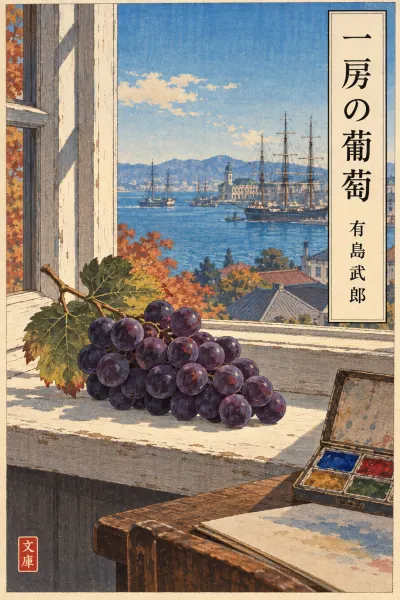
私が教場から帰るまでここに入らっしゃいよ。いい。」と仰りながら僕を長椅子に坐らせて、その時また勉強の鐘がなったので、机の上の書物を取り上げて、僕の方を見ていられましたが、二階の窓まで高く這い上った葡萄蔓から、一房の西洋葡萄をもぎって、しくしくと泣きつづけていた僕の膝の上にそれをおいて静かに部屋を出て行きなさいました。Please stay here until I come back from the classroom. All right?" As she said this, she sat me down on the sofa. Just then the bell for lessons rang again, so she picked up the books from her desk and stood looking at me for a moment. Then, from the grapevine that had climbed high up to the second-floor window, she plucked a bunch of Western grapes, laid it on my lap as I went on quietly sobbing, and softly left the room.
Vocabulary
| Word | Meaning | JLPT |
|---|---|---|
| 爪つめ | nail (fingernail)Staring at one's nails suggests the teacher is thinking carefully before she speaks. | N2 |
| 抱きすくめるだきすくめる | to hug tightly; to hold close in one's arms抱く (to hold) + すくめる (to draw in tight). | — |
| 頷いてうなずく | to noddictionary form: 頷くOften written in kana: うなずく. | — |
| たまりませんたまらない | to be unbearable; unable to hold backdictionary form: たまらないHere it means his feelings overflowed and he could no longer control himself. | N3 |
| 噛みしめてかみしめる | to bite down hard ondictionary form: 噛みしめるAlso used figuratively: to reflect deeply on something. | — |
| むやみにむやみに | uncontrollably; excessively; without restraintdictionary form: 無闇に | N1 |
| 心持ちこころもち | feeling; state of mindSlightly old-fashioned; today 気持ち is more common. | — |
| 教場きょうじょう | classroomOld-fashioned word for 教室. | — |
| 長椅子ながいす | sofa; long benchLiterally 'long chair'. | — |
| 鐘かね | bellHere it is the school bell that marks the start of lessons. | N2 |
| 書物しょもつ | booksA more formal, bookish word than 本. | N3 |
| 葡萄蔓ぶどうづる | grapevine葡萄 + 蔓 (つる, vine); つる becomes づる through rendaku. | — |
| もぎってもぎる | to pluck; to pick (fruit)dictionary form: もぎる | — |
| しくしくしくしく | (crying) softly, in quiet sobsOnomatopoeia for quiet, continuous weeping. | — |
Grammar
〜ずに N3 without doing ~
〜ずに means 'without doing ~'. It is a slightly formal equivalent of 〜ないで, and it is common in writing but also used in speech. It attaches to the negative (ない-form) stem of the verb: 言う→言わずに, 向く→向かずに. (Irregular: する→せずに.)
なんとも言わずに、僕の方も向かずに
without saying anything, without even looking my way
〜てもらいたい N4 want someone to do ~ (for me)
Vて + もらいたい expresses the speaker's wish for someone else to do something. Here the boy badly wants the teacher to know that he returned the paints.
返したことをしっかり先生に知ってもらいたいので
because I wanted the teacher to know for certain that I had given them back
〜ても〜ても N3 no matter how many times / however much ~
Repeating the て-form + も stresses that an action is done over and over without success. He keeps biting his lips, but the sobs still come.
噛みしめても噛みしめても泣声が出て
however hard I bit down, sobs still came out
〜たまま N4 while still in the state of ~; just as it is
Vた + まま means that a state continues unchanged. Here the boy is still being held in his teacher's arms.
先生に抱かれたまま死んでしまいたい
I wanted to die just as I was, held by my teacher
〜んじゃない N3 don't ~ (gentle command)
The plain form + んじゃない, said with a falling tone, works as a prohibition. It is often used by adults speaking to children, and here it sounds firm but kind.
あなたはもう泣くんじゃない。
You mustn't cry any more.
〜ないでもよろしい N4 you don't have to ~
This is a polite, slightly old-fashioned version of 〜なくてもいい. It gives permission not to do something, so here the boy may skip the next class.
次ぎの時間には教場に出ないでもよろしいから
You need not go to the classroom for the next lesson