Upper intermediate · JLPT N2
一人二役Hitoriniyaku — A Man of Two Parts
- JLPT N2
- 6,702 characters
- 5 parts
- about 56 minutes
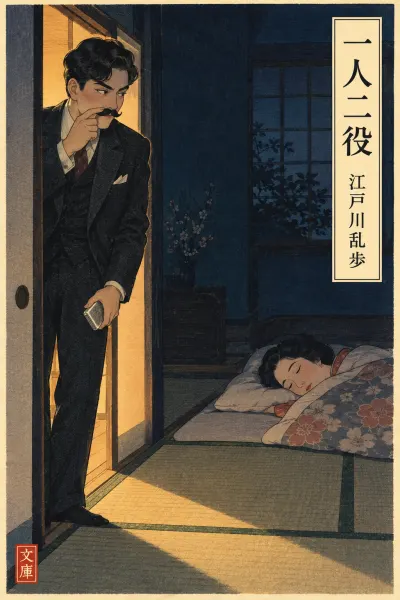
一人二役 is a short comic tale by Edogawa Ranpo, a writer best known for detective and mystery fiction. There is no murder here. It is a playful domestic story about deception and jealousy. The narrator tells it aloud to a listener, describing an acquaintance called T. T is an idle man who is not especially rich but never has to worry about earning a living. He is married to a beautiful wife, yet out of sheer boredom he keeps chasing other women. One night, curious to see how his wife would behave with another man, he puts on new clothes and a false moustache and slips into their dark bedroom as a stranger. The plan starts as a prank and slowly turns against him. The tone is light, wry and a little risqué, and the narrator's chatty asides keep it moving. For learners, the casual spoken style is approachable, but the prewar spelling and kanji (丈け, 相, 鹽梅) and the literary grammar of conjecture (〜に相違ない, 〜か知れたものではない) make it a solid N2-level challenge.
Contents
Before you read
- The narrator speaks to a listener in casual plain style. Sentence-final ね, よ and だよ mark asides and comments, not plot events, so read them as the voice of someone telling an anecdote.
- Learn the grammar of guessing and certainty early, because the narrator constantly speculates about what T and his wife are thinking: 〜に相違ない (must be), 〜か知れたものではない (who knows what), 〜(よ)う筈もない (cannot possibly), 〜ないでもあるまい (it is not impossible that).
- Expect old spellings and kanji: 丈け for だけ, 相 in 相違, 鹽梅 (あんばい, 'state of things'). The colloquial negative 〜やしない (= 〜はしない) also appears often.
- Speech styles help you tell the speakers apart. The wife uses soft, polite feminine forms such as 妾 (わたし), いらっしった and お帰りなすった. T speaks casually to her, but in the last part he switches to polite です/ます with the narrator.
- Narrative 〜たものだ describes T's habitual behaviour ('he would often…'), and 〜ようものなら introduces a feared consequence ('if he were to…, then…'). Recognising both makes the repeated night-time visits in Parts 2–3 much easier to follow.
Words to know
The most useful words from the notes across the story.
| Word | Meaning | JLPT |
|---|---|---|
| 細君さいくん | wife (someone's wife)Old-fashioned, slightly jocular; used here alongside 女房 and 妻. | — |
| 空鼾そらいびき | fake snoring空〜 = feigned (空寝 'pretending to sleep'); 鼾をかく = to snore. | — |
| 一伍一什いちぶしじゅう | the whole story from beginning to enddictionary form: 一部始終Normally written 一部始終. | — |
| 狂言きょうげん | sham, play-acting, staged actOriginally a kind of comic stage play; also used for faked events, as in 狂言強盗 (a staged robbery). | — |
| 逢瀬おうせ | lovers' meeting, trystLiterary word, often used of secret meetings. | — |
| 焼くやく | to be jealousColloquial; also written 妬く. Compare やきもちを焼く. | N4 |
| 退屈たいくつ | boredom; being boredThe key motive of the whole story; 退屈する = to get bored. | N3 |
| 暢気のんき | easygoing, carefreeNow usually written 呑気. | N2 |
| 拵えるこしらえる | to make, create, fabricateOlder, more colloquial than 作る; often suggests making something up. | N2 |
| 担いだかつぐ | to fool, to play a trick ondictionary form: 担ぐLiterally 'to carry on one's shoulder'; the passive 担がれる = to be taken in. | N2 |
| おつなおつ | piquant; stylish in an unusual waydictionary form: 乙おつな味 / おつな楽しみ: something with a special, refined charm. | N1 |
| 懲りてこりる | to learn one's lesson, to be put off by a bad experiencedictionary form: 懲りる | N1 |
| 手筈てはず | arrangement, plan of action手筈にする / 手筈を整える = to arrange how something will be done. | N1 |
| 目論見もくろみ | scheme, plan, design | N1 |
| 円満えんまん | harmonious, peaceful (of a family or relationship)家庭円満 = a happy, harmonious home. | N1 |
Plot summary
Show the full summary (contains spoilers)
Bored with his beautiful wife, T comes home at night in a false moustache. He leaves a strange silver cigarette case by her pillow and slips away. The next morning he feigns ignorance, produces an alibi and teases her with talk of a ghostly 'soul-splitting sickness'. He repeats the masquerade until she believes in a real secret lover, hides his tokens and whispers endearments to him. T becomes jealous of a rival who is only himself. Unable to confess or to give up the role, he decides to become that man for good. He alters his face, sends a separation letter from Kyūshū and returns as a stranger, whom his wife accepts. The two move house and live as a new couple, and T reforms. When the narrator later meets them, T cheerfully admits that his wife saw through the disguise from the start.
About the author
His pen name is a Japanese rendering of the name of Edgar Allan Poe, whom he admired. He began with detective stories such as 二銭銅貨 and went on to create the detective Akechi Kogorō. He also wrote many tales of the grotesque and the perverse, of which 人間椅子 is a famous example. Later he wrote the popular Boy Detectives series for young readers and promoted the mystery genre as an editor and critic. Japan's Edogawa Rampo Prize for mystery fiction is named after him.