Part 2 of 5 · JLPT N2
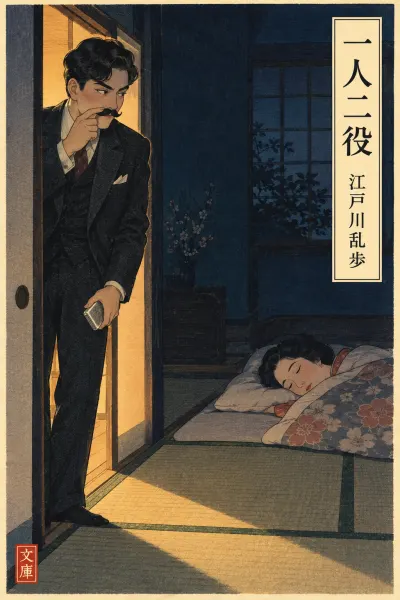
一人二役 Hitoriniyaku, part 2: A Cigarette Case and a Missing Husband
In this part
T slips out of bed while his wife sleeps, leaves the strange silver cigarette case by her pillow, and climbs over the garden wall to spend the night at a teahouse. The next morning his wife finds the case and remembers the moustache from the night before, and when T comes home looking sheepish, he pretends to know nothing about it. He coaxes her into telling him everything, cites a drinking companion as his alibi, and enjoys frightening her with talk of a ghostly 'soul-splitting sickness' and hints that she has a secret lover.
AI translation · independently checked
ここで、細君が怪しんで、あくまで穿鑿をしようものなら、Tの計画は、すっかりオジャンだ。Now, if at this point his wife had grown suspicious and insisted on getting to the bottom of it, T's whole scheme would have gone up in smoke.
空鼾をかきながら、彼はもうビクビクものだったというね。He was snoring away, pretending to be asleep, and all the while, so he says, he was quaking in his boots.
ところが、細君、案外暢気なもので、何か感違いしたとでも思ったのか、そのままじっとしている。But his wife turned out to be surprisingly easygoing. Perhaps she thought she'd simply got something muddled, because she just lay there quietly.
暫く待っていると、スウスウと優しい鼾が聞えて来た。After he had waited a while, he heard gentle snoring, soft and even.
もうしめたものだ。That settled it. He was home free.
そこで、Tは、細君が十分寝込んだ折を見すまして、ソッと床の中から這い出した、手早く着物を着ると、例の銀のシガレット・ケース丈を枕許へ残して、音のしない様に、家から抜け出し、それも、まともな入口からでなくて、庭の塀をのり越したのだ。So T watched for the moment when his wife was sound asleep, then crept quietly out of the bedding. He dressed quickly, left only that silver cigarette case beside her pillow, and slipped out of the house without a sound. And he didn't go out by the proper door, either: he climbed over the garden wall.
もうその時分車なんかありやしない、テクテクと、十何町の道を、行きつけの待合へ歩いた。At that hour there were no rickshaws or anything of the kind, of course, so he trudged on foot the dozen-odd blocks to the teahouse he always went to.
酔狂な男もあったものだ。There are some odd fellows in this world, aren't there?
さて、翌朝だ。Well then, the next morning.
細君、目を醒して見ると、一緒に寝ていた筈の夫が、も抜けのからだから、少なからず驚いた。The wife woke up to find that the husband who was supposed to be sleeping beside her had left nothing but an empty bed, and she was more than a little startled.
家中探して見たが、どこにもいない。She searched the whole house, but he was nowhere to be found.
寝坊の夫が、この早朝外出する筈もなし、妙だなと思いながら、ふっと気がついたのは、枕許のシガレット・ケースだ。Her husband was a late riser, and there was no way he would have gone out so early in the morning. As she was thinking how strange it was, her eye suddenly fell on the cigarette case beside the pillow.
一向見慣れぬ品だ。It was a thing she had never seen before.
夫が始終持っているのとは違う。It wasn't the one her husband always carried.
で、手にとって調べて見ると、まるで心当りのないイニシアルが刻んである。So she picked it up and looked it over, and found it engraved with initials that meant nothing to her at all.
中の巻煙草まで、夫の常用のものとは違っている。Even the cigarettes inside were different from the kind her husband usually smoked.
夫がどこかで取違えて来たのかとも考えて見たが、さて、何とやら腑に落ちぬ。She wondered whether her husband had picked it up by mistake somewhere, but somehow it still didn't make sense to her.
と、思出すのは、昨夜の髭の一件だ。And then what came back to her was that business with the moustache the night before.
さあ、細君どれ程か心配したことであろう。Well, you can imagine how worried his wife must have been.
そこへ、Tが、昨夜家を明けたのがきまりが悪いという様な、殊勝気な顔つきで帰って来た。Just then T came home, wearing a meek, contrite expression, as though he were embarrassed at having stayed out all night.
無論服装は、前日家を出た時のとおり換えているし、つけ髭もとってある。Naturally he had changed back into the clothes he'd left the house in the day before, and he had taken off the false moustache.
いつもなら、細君、ただは置かないのだけれど、今日はそれどころではない。Ordinarily his wife would never have let him get away with that, but today she had far more pressing things on her mind.
彼女の方に、途方もない心配があるのだ。She had a tremendous worry of her own, you see.
妙な工合で、だんまりで、Tは茶の間へ通る、細君は青い顔をしてあとからついて来る、といった鹽梅だ。It was a strange state of affairs: without a word, T went through to the sitting room, and his wife followed behind him, pale in the face. That's how things stood.
暫くすると、細君がおずおずしながら聞くんだね。After a while, his wife asks him, very timidly, you know.
「この煙草入れ、どっかで取りかえていらっしったのじゃなくって」"Didn't you perhaps get this cigarette case mixed up with someone else's somewhere?"
いうまでもなく、例の銀製のシガレット・ケース。It was, needless to say, that silver cigarette case.
「いいえ、それ、どうかしたのかい」"No. Why, is something the matter with it?"
と、Tがとぼけて見せると、When T played the innocent like this,
「だって」と少しあまえて、「ゆうべ、あなたがもってお帰りなすったのじゃありませんか」"But," she said, a little coaxingly, "didn't you bring it home with you last night?"
「へええ」と更にとぼけて「だが、僕のはちゃんと、これ、ここに持っているよ。それに、第一僕がゆうべ帰ったって?」ここで少し調子を高める。"Really?" he said, playing even more innocent. "But I've got mine right here, look. And besides, what do you mean, I came home last night?" Here he raises his voice a little.
この一言で、細君をハッとさせる訳だね。That one remark is meant to give his wife a jolt, you see.
などと、落語家みたいに、会話入りでやっちゃ、際限がないから、それはよすとして、よろしく一問一答を繰りかえしたのち、とど、細君が昨夜の一伍一什を、打開けて了うところまでこぎつけた。But if I go on telling it with all the dialogue like a comic storyteller, there'll be no end to it, so I'll leave that out. Suffice it to say that after a good deal of question and answer, he finally managed to get his wife to confess the whole story of the night before.
そこで、Tはさも不思議相な顔をして見せ、そんな馬鹿なことのあろう道理がない。Then T put on a look of utter bewilderment and said there was no reason on earth such a foolish thing could have happened.
自分はゆうべ××家で、何の誰と一晩呑みあかしたのだから、何ならあの男に聞いて見るがいい、と、これがつまり、探偵小説の言葉で云えばアリバイだね。He had spent the whole night drinking with so-and-so at the such-and-such house, he said, and if she liked she could go and ask the man herself. That, in other words, is what you'd call an alibi in the language of detective stories.
それは前以ってちゃんと頼み込んであるのだ。He had duly arranged all that with the man beforehand.
エ、お前がそのアリバイを勤めたのかって、イヤ、違う違う。Eh? Was it you who played the alibi, you ask? No, no, not at all.
「お前夢でも見たのではないか。いいえ、決して夢ではありません。夢でなかった証拠には、ちゃんと煙草入れが残っているのだ。"Weren't you perhaps dreaming?" "No, it most certainly was not a dream." And the proof that it wasn't a dream was the cigarette case lying right there.
はてな、昔の書物に、離魂病というものが見えているが、まさか今の時節、そんなこともあるまい。"Hmm, now let me think. In the old books there's mention of something called the soul-splitting sickness, but surely such a thing couldn't happen in this day and age.
その離魂病というのはね、一人の人間の姿が、二つに分れて、同時に、違った場所で、違った行をするというのだ。This soul-splitting sickness, you see, is when a single person's form splits in two, and the two of them do different things in different places at the same time.
などと、一寸怪談めいて見たり、お前そんなことを云って、実はソッとどこかの男を引入れているのではないか」などと脅しつけて見たり、それが又、Tには、何とも愉快でたまらないというのだから、因果さ。So he'd make it sound a bit like a ghost story, or he'd try scaring her with, "Saying such things, aren't you really sneaking some man into the house on the quiet?" And T found all this more fun than anything. Some people are just made that way.
Vocabulary
| Word | Meaning | JLPT |
|---|---|---|
| 細君さいくん | wife (someone's wife; the wife)Old-fashioned, slightly humorous word for a wife, used here by the narrator throughout. | — |
| 穿鑿せんさく | prying, digging into detailsUsually written 詮索 today. 穿鑿をする means to probe insistently. | — |
| オジャンおじゃん | ruined, come to nothingdictionary form: おじゃんColloquial. おじゃんになる means to fall through. | — |
| 空鼾そらいびき | fake snoring空 (そら) as a prefix means 'false' or 'feigned', as in 空寝 (pretending to sleep). | — |
| 暢気のんき | easygoing, carefreeNow usually written 呑気. | N2 |
| しめたものしめたもの | just what one hoped for; success is assuredFrom しめた! ('Got it!'), said when things go your way. | — |
| 待合まちあい | teahouse of assignationA prewar establishment where patrons met geisha. Not the modern 待合室 (waiting room). | — |
| 酔狂すいきょう | eccentric, whimsicalDescribes someone who does odd things for fun. | — |
| も抜けのからもぬけのから | empty (bed, room); the person has gonedictionary form: もぬけの殻Literally 'a shed skin', like the skin a cicada or snake leaves behind. | — |
| 腑に落ちぬふにおちない | doesn't make sense; unconvincingdictionary form: 腑に落ちない腑 means 'innards'. ぬ is the literary form of ない. | — |
| 殊勝気しゅしょうげ | seemingly meek, contrite-lookingdictionary form: 殊勝げ〜げ means 'seeming, appearing'. | — |
| とぼけてとぼける | to feign ignorance, play dumbdictionary form: とぼけるHere it is combined with 見せる: to put on a show of innocence. | — |
| 一伍一什いちぶしじゅう | the whole story from beginning to enddictionary form: 一部始終Normally written 一部始終. | — |
| 離魂病りこんびょう | 'soul-splitting sickness', a legendary illness in which a person appears in two places at onceFrom 離 (separate) + 魂 (soul) + 病 (illness). | — |
Grammar
〜ようものなら N1 if (by any chance) … then (something bad)
This pattern attaches to the volitional form and introduces a condition that would lead to a bad outcome. Here, if the wife had kept prying, the plan would have been ruined.
あくまで穿鑿をしようものなら、Tの計画は、すっかりオジャンだ。
if she had insisted on getting to the bottom of it, T's whole scheme would have gone up in smoke.
〜やしない N2 certainly not; not at all
This is a colloquial, emphatic negative made from the stem plus やしない (from は + しない). ありやしない is a strong way of saying ない: there simply were none.
もうその時分車なんかありやしない
At that hour there were no rickshaws or anything of the kind.
〜もあったものだ N2 exclamation of surprise or wry amazement
The pattern 〜もあるものだ / 〜もあったものだ expresses the speaker's wonder that such a thing or person exists. It is often used ironically.
酔狂な男もあったものだ。
There are some odd fellows in this world, aren't there?
〜筈 N4 supposed to; there's no way that
筈 (はず) marks an expectation. In 寝ていた筈の夫 it means 'the husband who should have been sleeping', and 〜筈もなし means 'there was no way he would'.
一緒に寝ていた筈の夫が、も抜けのからだから、少なからず驚いた。
the husband who was supposed to be sleeping beside her had left nothing but an empty bed, and she was more than a little startled.
まさか〜まい N2 surely not; it can't be that
まい is a literary negative of conjecture ('probably not'). Combined with まさか, it strongly denies a possibility.
まさか今の時節、そんなこともあるまい。
surely such a thing couldn't happen in this day and age.
〜てたまらない N3 extremely, unbearably (a feeling)
This pattern follows a te-form adjective or verb and expresses a feeling so strong the person can't contain it. Here, T finds the whole charade irresistibly fun.
Tには、何とも愉快でたまらないというのだから、因果さ。
T found all this more fun than anything. Some people are just made that way.