Part 3 of 5 · JLPT N2
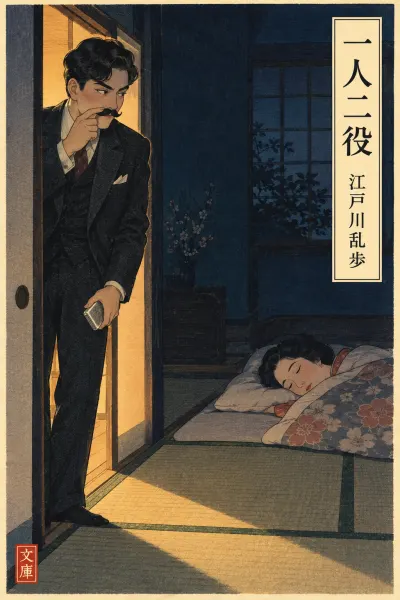
一人二役 Hitoriniyaku, part 3: The Wife Falls for the Phantom Lover
In this part
T repeats his night-time masquerade again and again. His wife comes to believe the mysterious moustached visitor is a real man, starts hiding his tokens from her husband and whispers guilty endearments to him. T has got exactly what he planned, yet he finds himself truly jealous of a rival who is nobody but himself.
AI translation · independently checked
が、兎も角も、その日は有耶無耶で済んで了った。But anyway, that day the whole business was left hazy and unresolved.
無論、一度位では駄目だ。Naturally, once wasn't going to do it.
Tの計画では、幾度も、幾度もそれを続けてやって見る積りだった。T's plan was to keep it up and try it again and again, as many times as it took.
二回目は、少々心配した。The second time, he was a little uneasy.
細君、前に懲りているから、うっかり変装して行こうものなら騒ぎ出しやしないかというのだ。His wife had been burnt once already, you see, so if he were careless enough to turn up in disguise, mightn't she start raising the alarm? That was his worry.
で、今度は、家に這入る時には、変装もせず、髭もつけずに行って、さて、電燈も消して、床につき、細君がもう寝入るという頃を見計らって、夢現の間に、ほんの瞬間、例の髭の感触を与え、そして、寝入って了ったのを見すまして、やっぱり前通りのイニシャルを縫いつけたハンカチを残して、家を抜け出す手筈にしたが、なんと、それが再びうまく成功したではないか。So this time he arranged things differently: he came into the house without any disguise and without the moustache, turned off the electric light and went to bed; then, choosing the moment when his wife was just dropping off, while she lay between dreaming and waking, he let her feel that moustache for the briefest instant; and once he had made sure she was fast asleep, he left behind a handkerchief with the same initials sewn on it as before and slipped out of the house. And would you believe it, it worked perfectly a second time!
翌朝の模様は、前の時と似たり寄ったりで、ただ、細君の顔が、一層青ざめ、Tの狂言嫉妬が、更に手強くなった位の相違だった。The next morning went much as it had the time before; the only difference was that his wife's face was paler still, and T's feigned jealousy had grown even more formidable.
そうして、三度となり、四度と重なって行くに従って、Tのお芝居は益々上達し、今では、細君にとっては、煙草入れや、ハンカチのイニシアルの男が、はっきりした、実在の人物になって来たが、それと同時に、ここに妙な事が起って来たのだ。And so it happened a third time, then a fourth, and as they piled up, T's acting got better and better, until by now the man of the tobacco pouch and the initialled handkerchief had become, for his wife, a definite, real person. But at the same time, something strange began to happen.
これまでの所はね、まあ謂わば笑話にすぎないけれど、これから先は、話が少し固くなって来るのだよ。Up to this point, you know, it's really no more than a funny story, but from here on the tale turns a little more serious.
人間の心が、如何にたよりない、そして又不思議なものだといった風の、一寸考えさせられるものを含んでいるのだよ。It holds something that makes you stop and think, about how unreliable, and how mysterious, the human heart can be.
第一に起った変化は、細君の側にあった。The first change came on the wife's side.
その貞女を以て聞えた細君がね、女なんて実際分らないものだ、変装した方のTに対して、明かにTの外の男だと信じつつ、ある好意を見せ始めたのだ。That wife, so well known for her faithfulness—women really are beyond understanding—began to show a certain fondness for the disguised T, while clearly believing him to be a man other than T.
この辺の心理は可也不思議なものだが、併し、昔の物の本などによく例がある、つまり、それは、何人とも分らぬ男との、夜毎の逢瀬は、恐らく、彼女にとって、一つのお伽噺であったのであろうか。The psychology here is rather mysterious, but then old books are full of examples of it. Perhaps, in short, those nightly trysts with a man whose identity she did not know were, for her, a kind of fairy tale.
一方に於て、彼女は、変装のTがその都度残して行く、証拠品を、夫であるTに隠す様になった。On the one hand, she began hiding from T, her husband, the tokens that the disguised T left behind each time.
そればかりか、他の一方に於ては、変装のTに対して、夫とは別人であると意識した上の、罪の囁きを囁く様になった。Not only that, but on the other hand she began to whisper guilty whispers to the disguised T, fully aware that he was someone other than her husband.
「あなたが、どこの何というお方だか、その見知らぬあなたが、どうして妾の所へ通って下さるのか、妾には少しも分らない。"Who you are, or where you come from, and why you, a stranger, should keep visiting me—I don't understand it in the least.
でも、あなたの御深切が、今ではもう、妾には忘れ難いものになって了った。あなたのお出でなさらぬ夜が淋しく感ぜられさえする。And yet by now your kindness has become something I cannot forget. I even feel lonely on the nights you don't come.
この次は、いつ来て下さるのでしょうか」そうした細君の変心(というには少し変だけど)を知った時の、Tの心持は、実際何とも形容の出来ぬ変てこなものであったに相違ない。When will you come to me next?" When T learned of this change of heart in his wife (though it's a little odd to call it that), what he felt must truly have been something peculiar, beyond any description.
一方から見れば、これは、Tの最初の目論見が完全に果された訳であった。Looked at one way, this meant that T's original scheme had been completely fulfilled.
こうして、細君の方に大きな弱味が出来て了えば、彼の放蕩は五分五分だ。Now that his wife had acquired such a great weakness of her own, his dissipation was evened out: they were fifty-fifty.
決して細君に対して引け目を感じる必要はない。He had no need at all to feel inferior to his wife.
だから、彼の計画から云えば、この辺で、この妙な遊戯を打切って、変装した彼自身を、永久にこの世から葬って了えばよいのだ、そうすれば、元々実在しない人物のことだから、あとに煩いの残る筈はない、とTは考えていた。So, according to his plan, all he had to do now was call a halt to this strange game and bury his disguised self from this world for good. Then, since the man had never existed in the first place, there could be no trouble left behind—so T had reckoned.
ところが、今彼の心は、最初は全然予想しなかった、極度の混乱に陥って了ったのだ。But now his mind had fallen into an extreme turmoil that he had never foreseen at the start.
仮令、仮想の人物にもせよ、細君が彼以外の男を愛し始めたという、この恐しい事実が彼を撃った。Imaginary person though it might be, the dreadful fact that his wife had begun to love a man other than himself struck him hard.
始めは狂言であった嫉妬が、真剣なものに変って来た。The jealousy that had begun as play-acting turned into the real thing.
若しこういう心持が嫉妬といえるならばだ。That is, if a feeling like this can be called jealousy at all.
そこには相手がないのだ。There was no rival there, you see.
一体全体、誰に向って嫉妬をするのだ。Who on earth was he supposed to be jealous of?
細君は決してT以外の男に肌身を許した訳ではない。His wife had certainly never given herself to any man but T.
つまり、彼の恋敵は、とりも直さず彼自身に外ならぬのだ。In other words, his rival in love was none other than himself.
Vocabulary
| Word | Meaning | JLPT |
|---|---|---|
| 有耶無耶うやむや | vague, unresolved, left hangingUsually written in kana today; うやむやになる / うやむやで済む = to end without being settled. | — |
| 細君さいくん | wife (one's own or someone else's)Old-fashioned, slightly humorous word used by men. | — |
| 懲りてこりる | to learn one's lesson, to be put off by a bad experiencedictionary form: 懲りる | N1 |
| 夢現ゆめうつつ | half asleep, between dreaming and wakingLiterally 'dream and reality'. | — |
| 見計らってみはからう | to choose the right moment, to judge the timingdictionary form: 見計らう | — |
| 手筈てはず | arrangement, plan of action手筈にする / 手筈を整える = to arrange how something will be done. | N1 |
| 似たり寄ったりにたりよったり | much the same, hardly any different | — |
| 狂言きょうげん | sham, play-acting, staged actOriginally a kind of comic stage play; also used for faked events, as in 狂言強盗 (a staged robbery). | — |
| 貞女ていじょ | faithful, virtuous wifeOld-fashioned; 〜を以て聞こえる = to be famous for 〜. | — |
| 逢瀬おうせ | lovers' meeting, trystLiterary word, often used of secret meetings. | — |
| 変心へんしん | change of heart (in feelings or loyalty) | — |
| 目論見もくろみ | scheme, plan, design | N1 |
| 引け目ひけめ | sense of inferiority, feeling of being in the wrongUsually 引け目を感じる. | — |
| 恋敵こいがたき | rival in love敵 is voiced to がたき in this compound. | — |
Grammar
〜(よ)うものなら N1 if (someone) were to…, (something bad would happen)
The volitional form plus ものなら describes a risky hypothetical action that would lead to bad results. Here T imagines what might happen if he were careless enough to arrive in disguise.
うっかり変装して行こうものなら騒ぎ出しやしないかというのだ
if he were careless enough to go in disguise, mightn't she start making a fuss? That was the idea
〜ではないか N3 and what do you know…! (surprised emphasis)
In narration, ending a statement with ではないか presents the outcome as surprising and invites the listener to share the narrator's amazement. It is not really a question.
なんと、それが再びうまく成功したではないか。
And would you believe it, it worked perfectly a second time!
〜に従って N3 as…, in step with…
Attached to a verb, it shows that one change happens together with another. Here, as the visits pile up, T's acting improves.
四度と重なって行くに従って、Tのお芝居は益々上達し
as it piled up to a fourth time, T's acting got better and better
〜にすぎない N3 is no more than…, merely…
It plays something down as only that much and nothing more. The narrator calls the story so far merely a funny tale before turning serious.
まあ謂わば笑話にすぎないけれど
it's really no more than a funny story, so to speak, but
仮令〜にもせよ N1 even if…, granted that…
にもせよ is a literary form of にしても/にせよ. With 仮令 (たとえ) it concedes a point, here that the lover is imaginary, before stating that the fact still hurts.
仮令、仮想の人物にもせよ
even if he was an imaginary person
〜に外ならぬ N2 is nothing other than…, is none other than…
This is the old-fashioned form of にほかならない, with ぬ in place of ない. It strongly asserts that X is exactly Y and nothing else. とりも直さず (that is to say) adds to the emphasis.
彼の恋敵は、とりも直さず彼自身に外ならぬのだ
his rival in love was, in fact, none other than himself