Part 1 of 5 · JLPT N2
一人二役 Hitoriniyaku, part 1: A Bored Husband's Strange Disguise
In this part
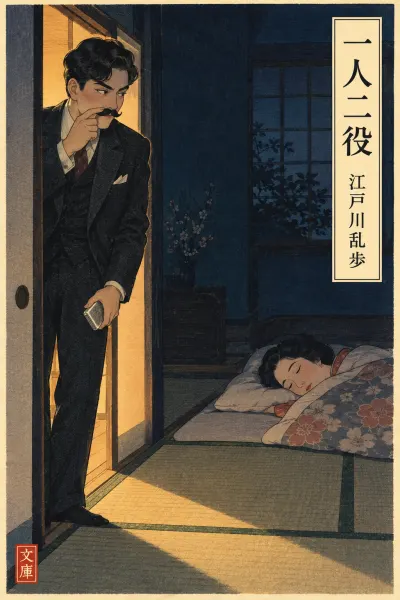
The narrator introduces T, an idle man of leisure who, though married to a beautiful wife, keeps chasing other women out of sheer boredom. Curious to see how his wife would behave with another man, T comes home one night in new clothes and a false moustache. In the dark of their bed, the wife feels the moustache and cries out, and T turns away and pretends to snore.
AI translation · independently checked
人間、退屈すると、何を始めるか知れたものではないね。You know, there's no telling what a man will start doing once he gets bored.
僕の知人にTという男があった。There was a fellow I knew, a man called T.
型の如く無職の遊民だ。He was the usual sort: no occupation, a man of idle leisure.
大して金がある訳ではないが、まず食うには困らない。He didn't have a great deal of money, but at least he never had to worry about putting food on the table.
ピアノと、蓄音器と、ダンスと、芝居と、活動写真と、そして遊里の巷、その辺をグルグル廻って暮している様な男だった。He was the kind of man who lived by going round and round the same circuit: the piano, the gramophone, dancing, the theatre, the moving pictures, and then the pleasure quarters.
ところで、不幸なことに、この男、細君があった。Now, unfortunately, this man had a wife.
そうした種類の人間に、宿の妻という奴は、いや笑いごとじゃない。For a man of that sort, the creature known as a wife at home is, well, no laughing matter.
正に不幸といッつべきだよ。I'd call it a real misfortune, I would.
いや、まったく。No, truly.
別に嫌っていたという程ではないが、といって、無論女房丈けで満足しているTではない。It wasn't that he actually disliked her, but then, of course, T was not one to be content with his wife alone.
あちらこちら、箸まめにあさり歩く。He went sniffing around here, there and everywhere, eager to sample whatever he could find.
いうまでもなく、女房は焼くね。Needless to say, his wife was jealous, you see.
それが又、Tには一寸捨て難い、おつな楽みでもあったのだ。And that, in turn, was a rather piquant pleasure that T found hard to give up.
一体Tの女房というのが、なかなかどうして、Tなんかに、勿体ない様な美人でね。The thing is, T's wife was really quite a beauty, you know, far too good for the likes of T.
その女房に満足しない程のTだから、その辺にざらにある売女などに、これはという相手の見つかろう筈もないのだが、そこがそれ、退屈だ。Since T wasn't even satisfied with a wife like that, he could hardly expect to find anyone worth having among the common streetwalkers you come across everywhere, but that's just it: he was bored.
精力の過剰に困っているのでもなければ、恋を求める訳でもない。It wasn't that he was troubled by an excess of vigour, nor that he was looking for love.
ただ退屈だ。He was simply bored.
次々と違った女に接して行けば、そこにいくらか変った味がある。If you go from one woman to the next, each one different, there's a bit of a novel flavour in that.
又、どうした拍子で、非常な掘出し物がないでもあるまい。And besides, by some stroke of luck, you might just turn up a remarkable find.
Tの遊びは、大体そんな様な意味合のものだった。That, roughly speaking, was what T's amusements amounted to.
さて、そのTがね、変なことを始めた話だよ。Well, this is the story of how that same T started doing something very odd.
それが実に奇想天外なんだ。And it was truly fantastic, the wildest idea you ever heard.
遊戯もここまで来ると、一寸凄くなるね。When a game goes this far, it gets a bit frightening, doesn't it?
誰しも感じることだろうが、自分の女房がね、自分以外の男に、つまり間男にだね、接しる時の様子をすき見したら、さぞ変な味がするだろう、……いや、実際にやられては耐らないが、ただふっとそんな好奇心の起ることがある。Anyone might feel this, I suppose: if you could steal a peek at your own wife with a man other than yourself, a lover, that is, it would surely be a very strange sensation... Oh, you couldn't bear it if it really happened, of course, but now and then a curiosity like that just pops into your head.
Tのあの奇行の動機も、恐らく大部分はそうした好奇心だったに相違ない。No doubt it was mostly that sort of curiosity that drove T to his eccentric behaviour as well.
T自身では、彼の放蕩三昧に対する細君の嫉妬を封ずる手段だと称していたがね。T himself, mind you, claimed it was a way of putting a stop to his wife's jealousy over his life of debauchery.
で、彼は何をしたかというと、ある夜のこと、頭から足の先まで、すっかり外で調えた新しい服装で、鼻の下へはチョッピリ附髭までして、つまり手軽な変装をしたんだね。So what did he do? One night, dressed from head to toe in a brand-new outfit he had put together away from home, and even sporting a little false moustache under his nose, he put on, in short, a simple disguise.
そして、自分のでない、出鱈目のイニシアルを彫らせた銀のシガレット・ケースを袂にしのばせて、何気ない風で自宅へ帰ったものだ。Then, with a silver cigarette case engraved with made-up initials that weren't his own tucked into his sleeve, he strolled back into his house as if nothing were the matter.
細君は、Tがいつもの通り、どっかで夜更かしをして帰宅したのだと信じ切っている。His wife was quite convinced that T had come home after staying out late somewhere, as usual.
いや、それは当然のことだが、つまりTの変装に少しも気がつかなかった。Well, naturally she would be, but the point is she didn't notice his disguise one bit.
夜更けに寝惚け眼で見たのだからそれも無理ではない。She was seeing him late at night with sleepy eyes, so that was hardly surprising.
Tの方でも十分用心をして、新しい着物の縞柄なども、以前からあるのとまぎらわしい様なものを選んでいたし、附髭は床に這入るまで、掌や、ハンカチなどで隠す様にした。T, for his part, had been very careful: he had chosen a kimono with a striped pattern easily confused with ones he already owned, and until he got into bed he kept his false moustache hidden with his palm or a handkerchief.
で、結局、Tのこの奇妙な計画はまんまと首尾よく成功したんだ。And so, in the end, this peculiar scheme of T's came off perfectly.
床の中でね、彼等は電燈を消して寝る習慣だったから、真暗な床の中でだね、Tはやっと髭を押えていた手を離した。In bed, you see, they always slept with the electric light off, so there in the pitch-dark bed, T at last took away the hand that had been covering his moustache.
で、つまり、当然だね、その異様な毛髪の感触が、細君を驚かせた。And so, naturally enough, the strange feel of that hair gave his wife a start.
「アラ、…………」"Oh, my..."
細君が、可愛らしい悲鳴を上げたのは、こりゃ決して無理はない。It was no wonder at all that his wife let out a sweet little shriek.
同時にTとしては、ここが最も難しい所だ。At the same time, for T, this was the trickiest part of all.
彼は細君が髭の存在を認めたことが分ると、早速向きを転えて、二度と髭に触らせない様に、蒲団を被って、グウグウ空鼾をかき出したものだ。As soon as he realised his wife had noticed the moustache, he promptly turned over, pulled the quilt over his head so she couldn't touch it again, and started snoring loudly, pretending to be asleep.
Vocabulary
| Word | Meaning | JLPT |
|---|---|---|
| 退屈たいくつ | boredom; being boredThe key motive of the whole story; 退屈する = to get bored. | N3 |
| 遊民ゆうみん | idler; person of leisure with no occupationLiterary word for someone who lives without working. | — |
| 細君さいくん | wife (someone's wife)Old-fashioned, slightly jocular; used here alongside 女房 and 妻. | — |
| 箸まめはしまめ | eager to eat anything; here, eager to try any womanLiterally 'diligent with chopsticks'; used figuratively for a womaniser. | — |
| 焼くやく | to be jealousColloquial; also written 妬く. Compare やきもちを焼く. | N4 |
| おつなおつ | piquant; stylish in an unusual waydictionary form: 乙おつな味 / おつな楽しみ: something with a special, refined charm. | N1 |
| ざらにざら | commonly; found everywheredictionary form: ざらざらにある = a dime a dozen. | — |
| 掘出し物ほりだしもの | lucky find; treasuredictionary form: 掘り出し物Literally 'something dug up'; a bargain or rare find. | — |
| 間男まおとこ | a wife's lover; adultererOld word for a man having an affair with a married woman. | — |
| 奇行きこう | eccentric behaviour奇 = strange (as in 奇妙, 奇想天外). | — |
| 放蕩三昧ほうとうざんまい | a life of utter debauchery〜三昧 = complete absorption in something (読書三昧, 贅沢三昧). | — |
| 変装へんそう | disguise変装する = to disguise oneself. | — |
| 首尾よくしゅびよく | successfully; without a hitchOften paired with まんまと, 'cleverly, just as planned'. | — |
| 空鼾そらいびき | fake snoring空〜 = feigned (空寝 'pretending to sleep'); 鼾をかく = to snore. | — |
Grammar
〜か知れたものではない N1 there's no telling ...
Attached to a question clause, it means nobody can predict what will happen, often with a negative or alarming nuance. Here the question is 何を始めるか, what a bored person might start doing.
人間、退屈すると、何を始めるか知れたものではないね。
You know, there's no telling what a man will start doing once he gets bored.
〜(よ)う筈もない N1 there's no way that ...; hardly likely
The volitional form plus 筈もない is a literary way of saying something can't possibly be expected. 見つかろう筈もない means 'he could hardly expect to find'.
これはという相手の見つかろう筈もないのだが
he could hardly expect to find anyone worth having
〜ないでもあるまい N1 it's not impossible that ...; there may well be
A double negative: ないでもない ('not entirely not') plus the literary negative guess まい. Together they mean 'surely there might be'.
非常な掘出し物がないでもあるまい。
you might just turn up a remarkable find.
〜に相違ない N2 must be; without a doubt
A formal equivalent of 〜に違いない, expressing the speaker's strong conviction. Here the narrator is sure curiosity was T's main motive.
恐らく大部分はそうした好奇心だったに相違ない。
No doubt it was mostly that sort of curiosity.
〜たものだ (narrative) N2 and so he did ... (with a storyteller's emphasis)
In storytelling, 〜たものだ after a past action adds a tone of vivid recollection or mild admiration at what someone did. It does not mean 'used to' here.
何気ない風で自宅へ帰ったものだ。
he strolled back into his house as if nothing were the matter.
〜様にする N4 to make sure to ...; to try to ...
様にする after a verb shows a deliberate effort to bring about a state. T made a point of keeping the moustache hidden.
附髭は床に這入るまで、掌や、ハンカチなどで隠す様にした。
until he got into bed he kept his false moustache hidden with his palm or a handkerchief.