Part 4 of 5 · JLPT N2
一人二役 Hitoriniyaku, part 4: Caught in His Own Trap
In this part
T, who now finds his wife irreplaceable, grows jealous of the imaginary lover he played and for whom she now longs. Unwilling to confess or to kill off his invented rival, he resolves to become that other man for good. He alters his face, sends a separation letter from Kyūshū, and returns as a stranger, whom his bewildered wife comes to accept as someone quite different from her husband.
AI translation · independently checked
さあ、そうなると、以前はさ程でもなかった細君が、この世に二人とないものに思われて来る。Well, once things came to that, the wife, who had never meant all that much to him before, began to seem like the one woman in all the world.
その細君を、他人に(正しく云えば自分自身にだが)奪われたかと思うと、くやしさは一通りではない。And when he thought that this wife of his had been stolen by another man (or, strictly speaking, by himself), his chagrin was beyond anything ordinary.
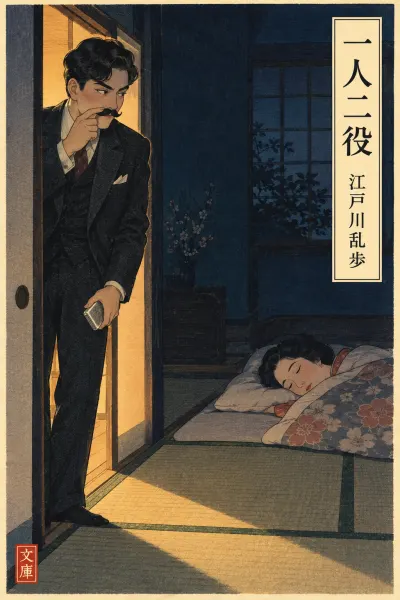
細君がぼんやり物思いに耽っている。His wife would sit vacantly, lost in thought.
アア、彼女は今、もう一人の男のことを思っているのだな。Ah, she's thinking about that other man right now, isn't she.
そう考えると、もうたまらない。Once that thought struck him, it was simply unbearable.
Tは実に取返しのつかぬことをやって了ったのだ。T had truly done something that could never be undone.
彼は自分自身の仕掛けた罠にかかったのだ。He had been caught in a trap of his own setting.
慌てて、仮装を中止して見たところで、今更ら何の甲斐もなかった。Even if he hurried to give up the disguise, it was far too late now to do any good.
夫婦の間には、いつの間にか妙な隔意を生じていた。Before they knew it, a strange distance had grown up between husband and wife.
細君はともすれば憂欝になった。The wife was all too often sunk in gloom.
恐らく彼女は姿を見せぬ男のことを、諦め兼ねているのに相違ない。No doubt she could not bring herself to give up the man who no longer showed himself.
Tはそれを見るのがつらかった。It was painful for T to watch.
と同時に、それ程心にかけている男というのが、実はもう一人の自分であることを考えると、それは満更嬉しくないこともなかった。At the same time, when he reflected that the man she cared for so deeply was in fact his own other self, it was not altogether unwelcome to him.
一層一伍一什を打開けて了おうか、だがそうすることは、何となくいやだった。Should he simply confess the whole thing from start to finish? But somehow he didn't want to do that.
一つは余りに馬鹿馬鹿しい自分の行為が恥しくもあったし、それに、もう一つは、実はこれが最大の原因なのだが、生れて始めて経験した、忍ぶ恋路の身も世もあらぬ楽しさを、Tはどうにも忘れ兼ねた。For one thing, he was ashamed of how utterly ridiculous his conduct had been; and for another, and this was really the chief reason, T could not for the life of him forget the all-consuming delight of a secret love, which he had tasted for the first time in his life.
彼は、そこに、本当の恋を見出した様に思った。He felt that he had found true love there.
本来のTに対しては、世間並の女房に過ぎなかった彼女が、その心の奥底にあの様な情熱を隠していようとは。To think that she, who to the real T had been nothing more than an ordinary wife, should be hiding such passion in the depths of her heart!
Tは全く意外であった。It came as a complete surprise to T.
そして逢瀬が重なれば重なる程、そのことは明かになって行った。And the more often they met, the plainer this became.
今更ら、あれは狂言だったなどとどうして云えるものか。How could he possibly tell her now that it had all been a play-act?
併し、この二重生活をいつまでも続けることは、煩わしいばかりでなく、細君に真相を悟られる虞があった。Still, to keep up this double life forever was not only a nuisance; there was also the danger that his wife would see through to the truth.
これまでは、いつも夜更けを選んで、暗い電燈の下や、多くはその電燈さえもない闇の中で逢っていたのだし、一方明白なアリバイが用意してあったから、まず安全であったけれど、そんな異常な会合がそうそう続けられるものではない。Until now they had always chosen the dead of night and met under dim electric lights or, more often, in darkness without even that much light, and on top of that he always had a clear alibi ready, so he had been fairly safe; but such peculiar meetings could hardly go on for very long.
とするとそこには三つの方法しかない。That being so, there were only three courses open to him.
第一は仮想の人物を葬って了うこと、第二はトリックの一伍一什を打明けること、そして第三は、実に変なことだけれど、彼が、細君に愛想をつかされた、いわばこの世に用のないTという人物を辞職して、その代りに一方の仮想の男になり切って了うこと。The first was to bury the imaginary man for good; the second was to confess the trick from start to finish; and the third, odd as it sounds, was to resign from being T, a man whose wife had grown tired of him and who, you might say, had no further use in this world, and instead to become that imaginary man completely.
今も云う通り、仮想の人物としての、細君との、謂わば初恋を発見した彼は、どうにも、第一第二の道を選ぶ気にはなれなかった。As I've said, having discovered with his wife what you might call a first love, in the person of the imaginary man, he simply couldn't bring himself to choose the first or the second road.
そこで非常に難しいことだとは思ったが、遂に、第三の方法を採ることに決心した。So, though he knew it would be extremely difficult, he finally made up his mind to take the third course.
つまり、Aという男が、ABの二役を勤め、それから今度は、始めのAをすてて、まるで違ったBの方にばけて了うのだ。That is to say, a man called A plays the two parts of A and B, and then this time he throws away the original A and turns himself entirely into B, who is quite a different man.
嘗てこの世に存在しなかった一人の人間を拵えるのだ。He would be creating a person who had never before existed in this world.
そう決心すると、Tはまず旅行と称して、一ヶ月ばかり家をあけ、その間に、出来る丈け顔形を変えようとした。Having decided on this, T first went away from home for a month or so on the pretext of a journey, and in the meantime he tried to change his looks as much as he could.
頭髪の刈り方を違え、口髭を生し、眼鏡をかけ、医者の手術を受けて、一重眼瞼を二重にし、その上顔面の一部に、小さい傷さえ拵えた。He had his hair cut a different way, grew a moustache, put on glasses, underwent an operation by a doctor to turn his single eyelids into double ones, and on top of all that he even gave himself a small scar on part of his face.
そして、髭が伸びた頃に、態々九州の方まで出掛けて行って、そこから、細君の所へ一通の絶縁状を送ったものだ。Then, once his moustache had grown in, he went all the way down to Kyūshū on purpose and from there sent his wife a letter breaking off their marriage.
細君は途方に暮れた。His wife was at her wits' end.
相談を持込む親戚とてもないのだ。She hadn't so much as a relative she could turn to for advice.
幸い、夫が多額の金を残して行ったので、その方の不自由は感じなかったが、そうかといって、じっとして居る訳には行かぬ。Luckily her husband had left her a large sum of money, so she felt no hardship on that score, but even so, she couldn't just sit still and do nothing.
こんな時、あの方が来て下すったら。If only he would come to me at a time like this.
きっと彼女はそう思ったに相違ない。She must surely have thought so.
丁度そこへ、仮想の男になり済したTが、ヒョッコリとやって来た、最初は、細君、その男をTだといって聞かなんだが、Tの友人が訪ねて来ても、まるで話が合わなかったり、(それはTが予め頼んだこの芝居の脇役なのだ)仮装の男の身許が明かになったりしたので(これもTが拵えて置いたのだ)つい、彼等が全く別人であることを信ずる様になった。Just then, along came T, now fully turned into the imaginary man, popping up out of the blue. At first the wife insisted the man was T, but when T's friends came to call and couldn't hold a conversation with him at all (they were supporting players T had engaged beforehand for this little drama), and when the disguised man's background was clearly established (this too T had arranged in advance), she came, almost in spite of herself, to believe that they were entirely different people.
これが、何かそうする理由でもあったのなら、いくら何でもだまされはしないのだろうが、T自身の心持を外にしては、まるで理由というものがないのだ。If there had been some reason for doing such a thing, she would surely never have been fooled, however things stood; but apart from T's own feelings, there was no reason for it whatsoever.
まさか、こんな馬鹿馬鹿しいお芝居が演じられようとは、誰にしたって、思いも寄らないからね。After all, nobody in the world would ever dream that such an absurd play would be put on, you know.
Tの細君は案外易々とだまされたのも、これは無理もないよ。So it's really no wonder that T's wife was taken in more easily than you'd expect.
Vocabulary
| Word | Meaning | JLPT |
|---|---|---|
| 細君さいくん | (one's / someone's) wifeOld-fashioned, slightly humorous word used by men, mostly for other men's wives. | — |
| 耽ってふける | to be absorbed in, lost indictionary form: 耽るCommon in 物思いに耽る 'to be lost in thought'. | — |
| 取返しのつかぬとりかえしがつかない | irreversible, beyond repairdictionary form: 取り返しがつかない〜ぬ is the literary form of 〜ない. | — |
| 罠わな | trap, snare罠にかかる 'to be caught in a trap'; 罠を仕掛ける 'to set a trap'. | — |
| 甲斐かい | use, worth, effect何の甲斐もない 'no use at all'. As a suffix it becomes がい: 生き甲斐. | — |
| 隔意かくい | reserve, emotional distanceLiterary; literally 'a separating mind'. | — |
| 満更まんざら | (not) altogetherUsed with a negative: 満更でもない 'not entirely displeased'. | — |
| 一伍一什いちぶしじゅう | the whole story, every detaildictionary form: 一部始終Old spelling of 一部始終, now the usual form. | — |
| 逢瀬おうせ | lovers' secret meeting, trystLiterary and romantic; 逢う is the kanji for meeting a loved one. | — |
| 狂言きょうげん | sham, staged pretenceAlso the name of the classical comic theatre; 狂言強盗 means a faked robbery. | — |
| 愛想をつかされたあいそをつかす | to be fed up with, give up on (someone)dictionary form: 愛想を尽かすHere passive: T is the one given up on. | — |
| 拵えるこしらえる | to make, create, fabricateOlder, more colloquial than 作る; often suggests making something up. | N2 |
| 絶縁状ぜつえんじょう | letter breaking off a relationship絶縁 'cutting ties' + 状 'letter'. | — |
| 途方に暮れたとほうにくれる | to be at a loss, at one's wits' enddictionary form: 途方に暮れるFixed expression. | — |
Grammar
〜たところで N2 even if (one does), it's no use
Attached to a past-tense verb, it sets up an action and then says it will not change anything. A negative result such as 何の甲斐もない usually follows.
慌てて、仮装を中止して見たところで、今更ら何の甲斐もなかった。
Even if he hurried to give up the disguise, it was far too late now to do any good.
〜に相違ない N2 must be, no doubt
A formal, written equivalent of 〜に違いない, expressing the speaker's strong conviction. Here it combines with 〜兼ねる (cannot quite bring oneself to).
恐らく彼女は姿を見せぬ男のことを、諦め兼ねているのに相違ない。
No doubt she could not bring herself to give up the man who no longer showed himself.
満更〜ないこともない N1 not altogether not ~
A double negative that admits a feeling grudgingly. 嬉しくないこともない means 'not exactly unhappy', and 満更 strengthens the 'not entirely' sense.
それは満更嬉しくないこともなかった。
It was not altogether unwelcome to him.
〜ようとは N1 to think that ~ (surprise)
The volitional form plus とは, often with the rest of the sentence left unsaid, expresses astonishment that something should be the case. The omitted part is something like 思わなかった.
その心の奥底にあの様な情熱を隠していようとは。
To think that she should be hiding such passion in the depths of her heart!
〜ば〜ほど N3 the more ~, the more ~
The same verb is repeated in the ば conditional and the plain form plus ほど, so that the second clause grows along with the first.
そして逢瀬が重なれば重なる程、そのことは明かになって行った。
And the more often they met, the plainer this became.
〜とても(ない) N1 not even ~
A literary emphatic particle like 〜さえ or 〜も, used with a negative. Here it stresses that she had not even a relative to turn to.
相談を持込む親戚とてもないのだ。
She hadn't so much as a relative she could turn to for advice.