 N4 · easy
Simplified retelling · JLPT N4
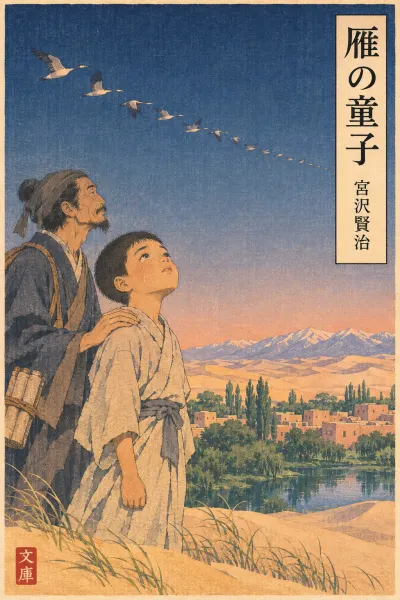
雁の童子 Kari no Dōji in easy Japanese (N4)
This is our own simplified retelling of The Child Who Came with the Wild Geese, written for N4 learners and checked word by word against the N4 vocabulary list. A few story words and grammar patterns go beyond N4; the notes below give each one's level. It keeps the characters, events and ending of the original. When it feels easy, move on to the N3 version or the original text.
The story in brief
At a small spring in the south, the narrator meets an old man, who tells the story behind a small shrine. Wild geese shot down by Suriya's cousin turn out to be people from the sky, and Suriya takes in the grandson who cannot yet go home. The gentle, strange boy grows up in Suriya's family until, in front of an old wall painting, he says Suriya once painted it, and he falls smiling as his grandfather comes to take him home.
AI translation · independently checked
南の小さないずみで、私は一人で昼の食事をしていました。At a small spring in the south, I was eating my midday meal alone.
そこへ、道を歩いているおじいさんが来ました。Just then, an old man who was walking along the road came by.
私たちは何も話さないで、少しあたまを下げました。Without saying a word, we each bowed our heads a little.
いずみの後ろに、小さなおどうがありました。Behind the spring stood a small shrine.
新しくて、きいろと赤の色がぬってありました。It was new, and it was painted yellow and red.
私は聞きました。I asked him about it.
「あのおどうは、どなたのですか。」おじいさんは答えました。"Whose shrine is that?" The old man answered.
「がんの子どものです。空の国から来た子どもだそうです。」そして、話を始めました。"It belongs to the Wild Goose Child. They say he was a child who came from the country in the sky." Then he began his tale.
「むかし、スリヤという人がいました。おくさんと二人で、しずかに住んでいました。ある朝、スリヤさんはいとこと外を歩いていました。いとこはてっぽうを持っていました。スリヤさんは「どんな鳥も、死ぬのはかなしいことだ。もうやめなさい。」と話しました。でも、いとこは聞かないで、空のがんをうちました。"Long ago there lived a man named Suriya. He lived quietly with his wife, just the two of them. One morning, Suriya was walking outdoors with his cousin. The cousin was carrying a gun. Suriya said to him, 'For any bird, dying is a sad thing. Stop this now.' But the cousin would not listen, and he shot at the wild geese in the sky.
がんはつぎつぎに火につつまれて、おちてきました。One after another, the geese were wrapped in flames and came falling down.
でも、ほかのがんはにげないで、なきながらついて来ました。Yet the other geese did not flee. Crying out, they followed after them.
いちばん小さいがんだけが、けがをしませんでした。Only the very smallest goose was not hurt.
見ると、がんはみんな人のかたちになっていました。When Suriya looked, he saw that the geese had all taken human form.
白いひげのおじいさんが、火の中でスリヤさんにたのみました。An old man with a white beard, standing in the flames, made a request of Suriya.
「私たちは空の国の者です。悪いことをして、がんになっていました。今、やっと帰れます。でも、まごはまだ帰れません。どうか、あなたの子どもにしてください。」スリヤさんは「わかった。安心してくれ。」と答えました。'We are people of the country in the sky. We did wrong, and so we had become wild geese. Now at last we can go back. But my grandson cannot go back yet. I beg you, please make him your child.' Suriya answered, 'I understand. Set your mind at rest.'
おじいさんは火の中にきえました。The old man vanished into the fire.
そこには、小さな男の子が一人立っていました。And there stood a single small boy.
町の人たちは、その子を「がんの子ども」とよびました。The people of the town called that child 'the Wild Goose Child.'
子どもが六つの年の春、町の子どもたちが歌いながら、まわりに集まりました。In the spring of the year the boy turned six, the children of the town gathered around him, singing.
だれかがいしをなげて、子どものかおにあたりました。Someone threw a stone, and it struck the boy in the face.
スリヤさんがおこると、子どもたちはあやまりました。When Suriya grew angry, the children apologized.
がんの子どもは、さいごまでわらっていました。The Wild Goose Child kept smiling to the very end.
帰りながら、子どもは話しました。On the way home, the boy spoke.
「お父さん、前のおじいさんは、体に七つのたまを持っていたよ。」'Father, the old man from before had seven jewels in his body, you know.'
ある夜、子どもはねられませんでした。One night, the boy could not sleep.
スリヤさんは子どもをつれて外に出ました。Suriya took the boy and went outside.
水の音が聞こえました。They could hear the sound of water.
「お父さん、水は夜もながれるの。」「夜も昼も、いつまでもながれるよ。」子どもは心がしずかになって、家に帰ってねました。'Father, does water flow at night too?' 'Night and day, it flows on forever.' The boy's heart grew calm, and he went home and slept.
ある日、お母さんが子どもの魚を小さく切ってくれました。One day, his mother cut the boy's fish into small pieces for him.
子どもはお母さんのかおを見て、急に外へ走って行きました。The boy looked at his mother's face, and suddenly ran outside.
そして、空を見て、大きなこえでなきました。Then he looked up at the sky and wept aloud.
お母さんが行くと、もうわらっていました。When his mother went out to him, he was already smiling.
また、町で男の人が、子どものうまを、お母さんのうまのそばからつれて行きました。Another time, in the town, a man led a young foal away from its mother's side.
子どもはなきました。The boy wept.
「あとで重いにもつを持たせて、食べ物がなくなったら、食べてしまうんでしょう。」スリヤさんは、この子が少しこわいと思いました。'Later they will make it carry heavy loads, and when the food runs out, they will eat it, won't they?' Suriya felt that this child was a little frightening.
十二になって、子どもは遠い町の学校に入りました。When he turned twelve, the boy entered a school in a distant town.
お母さんは毎日ぬのを作って、お金を送りました。Every day his mother wove cloth and sent him money.
冬が近いある日、子どもが急に帰ってきました。One day, when winter was near, the boy suddenly came home.
「お母さんといっしょにはたらきたいです。お母さんの手は、こんなにかたいです。」お母さんは「早く帰って勉強しなさい。」と話して、小さなふえを作ってわたしました。'I want to work together with you, Mother. Your hands are so hard.' His mother said, 'Go back quickly and study,' and she made a little flute and gave it to him.
子どもはやっと歩き出しました。At last the boy set off on his way.
空をがんが飛んで行くのを見て、スリヤさんはなんだかこわくなりました。Seeing wild geese flying across the sky, Suriya somehow grew afraid.
つぎの夏、町の外で古いかべが見つかりました。The next summer, an old wall was found outside the town.
三人の空の子どものえがかいてありました。On it were painted three children of the sky.
スリヤさんは子どもとそれを見に行きました。Suriya went with the boy to see it.
行く道で、子どもは「お父さん、私はどこへも行きたくありません。」と話しました。On the way there, the boy said, 'Father, I don't want to go anywhere.'
かべの前で、スリヤさんは「このえの子は、お前ににているね。」と話しました。In front of the wall, Suriya said, 'The child in this picture looks like you, doesn't he?'
見ると、子どもはわらいながらたおれました。When Suriya looked, the boy was smiling as he fell to the ground.
「おじいさんが、私をむかえに来ました。お父さん、すみません。このえは、むかし、お父さんがかいたのです。私はあなたの子どもです。」人々が集まって「がんの子どもだ。」と大きなこえで話しました。'Grandfather has come to take me home. Father, I'm sorry. Long ago, it was you who painted this picture, Father. I am your child.' People gathered and cried out, 'It's the Wild Goose Child!'
子どもはまた何か話しましたが、スリヤさんにはもう聞こえませんでした。」The boy said something more, but Suriya could no longer hear it."
おじいさんの話は、これでぜんぶでした。That was the whole of the old man's tale.
私は「ありがとうございました。ここで会えたのは、きっと大切なことです。では、お元気で。」と話しました。I said, "Thank you very much. Meeting you here must surely mean something important. Well then, take care."
おじいさんは何も話さないで、私が来た方へ歩いて行きました。Without a word, the old man walked off in the direction I had come from.
私も、はんたいの方へ歩いて行きました。I, too, walked away in the opposite direction.
Vocabulary
| Word | Meaning | JLPT |
|---|---|---|
| いずみいずみ | spring (of water)dictionary form: 泉In the desert, a spring is a precious resting place for travellers. | N3 |
| おどうおどう | small shrine; temple halldictionary form: お堂A building where a sacred figure or memory is honoured. 堂 is also used in 食堂 (dining hall). | — |
| ぬってぬる | to paint; to coat (with colour)dictionary form: 塗る | N4 |
| がんがん | wild goosedictionary form: 雁Also read かり, as in the original title 雁の童子 (かりのどうじ). | — |
| てっぽうてっぽう | gundictionary form: 鉄砲A slightly old-fashioned word for a gun. うつ (撃つ) means to shoot. | N2 |
| つつまれてつつむ | to wrap; (passive) to be wrapped in, engulfed bydictionary form: 包む火につつまれる: to be engulfed in flames. | N4 |
| にげないでにげる | to run away; to fleedictionary form: 逃げる | N4 |
| まごまご | grandchild; grandsondictionary form: 孫 | N3 |
| あやまりましたあやまる | to apologizedictionary form: 謝る | N4 |
| たまたま | jewel; precious balldictionary form: 玉Here it is a sign that the old man was a holy being. | N3 |
| にもつにもつ | load; baggagedictionary form: 荷物 | N5 |
| ぬのぬの | clothdictionary form: 布ぬのを作る here means weaving cloth to sell. | N3 |
| ふえふえ | flute; whistledictionary form: 笛 | N3 |
| むかえむかえる | to come for someone; to welcomedictionary form: 迎えるむかえに来る means to come to pick someone up. Here it hints that the boy is being taken back to the sky. | N4 |
Grammar
〜てある N4 something has been done (and the result remains)
A transitive verb in the te-form plus ある describes a state that someone has deliberately created. The focus is on the result, the painted colours, not on who painted them.
新しくて、きいろと赤の色がぬってありました。
It was new, and it was painted yellow and red.
〜そうです (hearsay) N4 I hear that…; they say that…
The plain form plus そうです reports something the speaker has heard from others. It gives the old man's words the feel of a legend.
空の国から来た子どもだそうです。
They say he was a child who came from the country in the sky.
〜ないで N4 without doing…; instead of doing…
The negative form plus で links to the next action and shows that it happens without the first action. Here it means bowing without speaking.
私たちは何も話さないで、少しあたまを下げました。
Without saying a word, we each bowed our heads a little.
〜ながら N4 while doing…
The verb stem plus ながら shows two actions happening at the same time by the same subject. The geese cry out as they follow.
なきながらついて来ました。
Crying out, they followed after them.
〜てしまう N4 to do completely; to end up doing (with regret)
The te-form plus しまう adds a sense of finality or regret. The boy's sadness at the horse's fate comes through in 食べてしまう.
食べ物がなくなったら、食べてしまうんでしょう。
When the food runs out, they will eat it, won't they?
〜に行く/〜に来る (purpose) N5 go/come in order to…
The verb stem (or an action noun) plus に before a verb of motion states the purpose of the movement. Compare むかえに来ました, 'came to fetch me'.
スリヤさんは子どもとそれを見に行きました。
Suriya went with the boy to see it.