 N4 · easy
Simplified retelling · JLPT N4
黄いろのトマト Kiiro no Tomato in easy Japanese (N4)
This is our own simplified retelling of The Tomato That Shone Like Gold, written for N4 learners and checked word by word against the N4 vocabulary list. A few story words and grammar patterns go beyond N4; the notes below give each one's level. It keeps the characters, events and ending of the original. When it feels easy, move on to the N3 version or the original text.
The story in brief
Early one morning in the museum of the narrator's hometown, the narrator hears a stuffed hummingbird begin to speak. It tells of Pemperu and his little sister Neri, two children who lived alone and grew tomatoes; one of their plants bore shining yellow fruit. They followed music to a circus in a big town. Pemperu tried to pay with the golden tomatoes, but the doorman threw one, hitting Neri, and drove them away, and they walked home in silence.
AI translation · independently checked
私の町のはくぶつかんには、大きなガラスのたながあります。In the museum of my town, there is a large glass case.
その中に、四わの小さなハチドリがいます。Inside it are four little hummingbirds.
もう生きていませんが、とてもかわいい鳥です。They are no longer alive, but they are very lovely birds.
私は、いちばん上のえだにいる鳥が、とくにすきでした。I was especially fond of the bird on the topmost branch.
目が赤くて、きれいな青い鳥です。It is a beautiful blue bird with red eyes.
私が小さかったときの話です。This is a story from when I was small.
ある朝早く、私は学校へ行く前に、ガラスの前に立ちました。Early one morning, before going to school, I stood in front of the glass.
すると、そのハチドリが、ほそいきれいな声で、私に話しかけました。Then that hummingbird spoke to me in a thin, pretty voice.
「ペムペルという子は、本当にいい子だったのに、かわいそうなことをした。妹のネリも、かわいい子だったのに。」"That boy called Pemperu was such a good boy, and yet—oh, what a pity it was. His little sister Neri was a sweet child too, and yet..."
「どうしたの。話してよ。」"What happened? Tell me!"
「じゃあ、かばんの上にすわりなさい。」"Well then, sit down on your satchel."
私はかばんの上にすわりました。I sat down on my satchel.
ハチドリは話し始めました。The hummingbird began to speak.
「ペムペルとネリは、ガラスの家に住んでいた。近くに大人はいなかった。二人だけで、毎日はたらいたり、あそんだり、歌を歌ったりして、とても楽しくしていたよ。」"Pemperu and Neri lived in a glass house. There were no grown-ups anywhere nearby. Just the two of them, every day they worked, and played, and sang songs, and they were very happy, you know."
そこで、ハチドリは何も話さなくなりました。At that point, the hummingbird stopped saying anything at all.
私はもう一度、もう一度、聞きました。I asked again, and then again.
でも、ハチドリは答えません。But the hummingbird did not answer.
目は黒いガラスのようで、ほかの鳥を見ているだけです。Its eyes were like black glass, and it only gazed at the other birds.
私はとうとうなきました。At last I began to cry.
すると、ばんにんのおじいさんが来て、私のせなかに手をおきました。Then the old guard came over and laid his hand on my back.
「どうしてないているの。」"Now then, what are you crying for?"
「ハチドリが、もう話してくれないんだ。」"The hummingbird won't talk to me anymore!"
おじいさんは大きな声でわらいました。The old man laughed loudly.
「ああ、この鳥はよくこんなことをして、人を困らせるんだ。よし、しかってやろう。」"Ah, this bird's always up to tricks like that, giving folks trouble. Right then, I'll give it a good scolding."
おじいさんはハチドリをしかって、ハンカチで私のかおをきれいにしてくれました。The old man scolded the hummingbird and wiped my face clean with his handkerchief.
それから、となりのへやへ行きました。Then he went off into the next room.
すると、ハチドリがまた話しました。And then the hummingbird spoke again.
「さっきは悪かったね。つかれていたんだ。」"Sorry about before. I was tired, you see."
「だいじょうぶだよ。つづきを話して。」"That's all right. Tell me the rest."
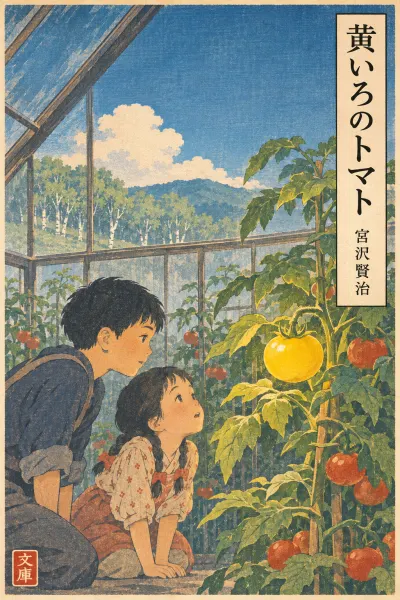
「二人はにわにトマトを十本うえていた。その中に一本だけ、きいろいトマトがなる木があった。そのトマトは、とてもきれいにひかっていた。"The two of them had planted ten tomato plants in their garden. Among them was just one plant that bore yellow tomatoes. Those tomatoes shone ever so beautifully.
『兄さん、あのトマトはどうしてひかるの。』'Brother, why do those tomatoes shine?'
『きんだよ。きんだからひかるんだ。』'They're gold. They shine because they're gold.'
二人は、そのトマトをとらないで、見ているだけだった。The two of them never picked those tomatoes; they only looked at them.
ある夕方、とおくから、とてもいい音が聞こえてきた。One evening, a lovely sound came drifting from far away.
二人は手をとって、その音の方へ走って行った。The two of them took each other's hands and ran off toward the sound.
小さな山や川を通って、ずいぶん走った。They ran a long way, over little hills and across streams.
大きな道に出ると、うまにのった人が七人来た。When they came out onto a big road, seven people on horseback came along.
みんな赤いシャツを着ていた。They were all wearing red shirts.
いちばん後ろのかわいい男の子が、ペムペルに小さなあいさつをした。A sweet little boy at the very back gave Pemperu a small greeting.
つぎに、白い大きなはこのような物が来た。Next came something like a big white box.
下から、はいいろの大きな足が四本見えた。Underneath it, four big grey legs could be seen.
それはぞうだった。It was an elephant.
二人はこわかったけれど、後ろからついて行った。The two of them were frightened, but they followed along behind.
夜になると、大きな町が見えた。When night fell, a big town came into view.
そこにはサーカスがあって、人がたくさん集まっていた。There was a circus there, and lots of people had gathered.
いい音は、サーカスの音楽だったんだ。The lovely sound had been the circus music, you see.
みんなは入口で、ばんにんに何かをわたして入って行った。At the entrance, everyone handed something to the doorman and went in.
ペムペルはよく見た。Pemperu looked closely.
それはきんのような物だった。It was something that looked like gold.
『ネリ、ここで待っていて。すぐ帰ってくるから。』'Neri, wait here. I'll be right back.'
ペムペルは月の下を走って家に帰り、きいろいトマトを四つとった。Pemperu ran home under the moon and picked four of the yellow tomatoes.
そして、また走ってもどった。Then he ran all the way back again.
『さあ、入ろう。』'Come on, let's go in.'
入口で、ペムペルはトマトを二つ出した。At the entrance, Pemperu held out two tomatoes.
ばんにんはトマトを見て、急にこわいかおになった。The doorman looked at the tomatoes, and suddenly his face turned fierce.
『何だ。トマト二つで入れると思うのか。帰れ。』'What's this? You think two tomatoes'll get you in? Clear off!'
ばんにんはトマトをなげた。The doorman threw the tomatoes.
トマトはネリのみみを強く打った。A tomato struck Neri hard on the ear.
ネリはなき出して、みんなは大きな声でわらった。Neri burst into tears, and everyone laughed out loud.
ペムペルはネリをつれて、にげた。Pemperu took Neri and ran away.
くらい山の中で、ペムペルもなき出した。In the dark hills, Pemperu began to cry too.
二人は何も話さないで、昼に来た道を歩いて、家に帰ったんだ。Without saying a word, the two of them walked back along the road they had come by that day, and went home.
本当にかわいそうだ。Oh, it's such a pity.
じゃあね。Well, goodbye.
もう話せないよ。」I can't talk anymore."
ハチドリはまた何も話さなくなって、ほかの鳥を見ているだけになりました。Once again the hummingbird fell silent and did nothing but gaze at the other birds.
私もとてもかなしくなりました。I became very sad too.
「どうも、ハチドリ。また来るよ。」と話して、かばんを持って、しずかにろうかへ出ました。Saying, "Thank you, Hummingbird. I'll come again," I picked up my satchel and quietly went out into the corridor.
外の光がとても強くて、二人がかわいそうで、私はまたなきました。The light outside was so strong, and I felt so sorry for the two children, that I cried again.
Vocabulary
| Word | Meaning | JLPT |
|---|---|---|
| はくぶつかんはくぶつかん | museumdictionary form: 博物館Usually written in kanji: 博物館. | N3 |
| ハチドリはちどり | hummingbirdLiterally 'bee bird' (蜂鳥). | — |
| とくにとくに | especially, in particulardictionary form: 特に | N4 |
| 話しかけましたはなしかける | to speak to someone, to start talking todictionary form: 話しかける〜かける here means 'to direct an action at someone'. | N2 |
| とうとうとうとう | at last, finally (after a long time or effort) | N4 |
| ばんにんばんにん | guard, watchman; doormandictionary form: 番人Used both for the museum guard and the circus doorman. | — |
| しかってしかる | to scolddictionary form: 叱る | N3 |
| つづきつづき | the rest, continuation (of a story)dictionary form: 続きNoun from 続く (to continue). | N3 |
| うえていたうえる | to plantdictionary form: 植える | N4 |
| なるなる | (of fruit) to grow, to be bornedictionary form: 生るDifferent from なる 'to become'; used as 実がなる, トマトがなる. | N2 |
| ぞうぞう | elephantdictionary form: 象 | N3 |
| わたしてわたす | to hand over, to givedictionary form: 渡す | N5 |
| なげたなげる | to throwdictionary form: 投げる | N4 |
| にげたにげる | to run away, to fleedictionary form: 逃げる | N4 |
Grammar
〜のに N4 even though, and yet (with regret)
のに links a fact with an unexpected or unfortunate outcome. Here the bird says Pemperu was a good boy, yet something sad happened; ending a sentence with のに leaves the regret hanging.
ペムペルという子は、本当にいい子だったのに、かわいそうなことをした。
That boy called Pemperu was such a good boy, and yet—oh, what a pity it was.
〜たり〜たりする N4 doing things like A and B
The た-form plus り lists example activities without giving every one. Here it describes the children's everyday life.
毎日はたらいたり、あそんだり、歌を歌ったりして
every day they worked, and played, and sang songs
〜なくなる N4 to stop doing; to no longer do
The ない-form plus なる shows a change from doing something to not doing it. The bird was talking, then stopped.
そこで、ハチドリは何も話さなくなりました。
At that point, the hummingbird stopped saying anything at all.
〜てくれる N4 someone does something for me
The て-form plus くれる shows that someone does a kind action for the speaker or the speaker's side. The old man cleaned the narrator's face for him.
ハンカチで私のかおをきれいにしてくれました。
He wiped my face clean with his handkerchief.
〜ないで N4 without doing; instead of doing
The ない-form plus で means doing the next action without doing the first one. The children only looked at the tomatoes and never picked them.
二人は、そのトマトをとらないで、見ているだけだった。
The two of them never picked those tomatoes; they only looked at them.
Nのような N4 like N, resembling N
のような before a noun describes something by comparing it to something else. The children can't yet tell what the white shape is, so it is 'something like a box'.
つぎに、白い大きなはこのような物が来た。
Next came something like a big white box.