 N3 · easy
Simplified retelling · JLPT N3
雁の童子 Kari no Dōji in easy Japanese (N3)
This is our own simplified retelling of The Child Who Came with the Wild Geese, written for N3 learners and checked word by word against the N3 vocabulary list. A few story words and grammar patterns go beyond N3; the notes below give each one's level. It keeps the characters, events and ending of the original. When it feels easy, move on to the original text.
The story in brief
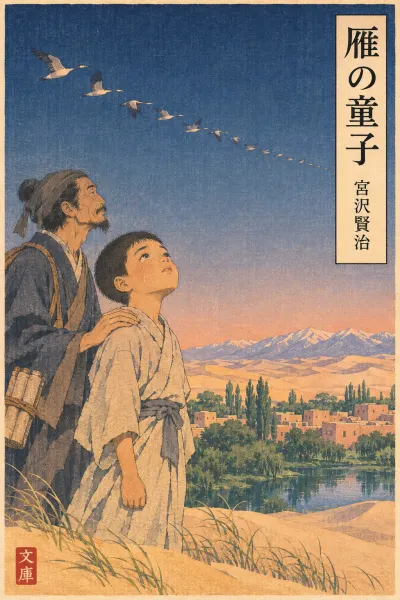
Beside a desert spring, a traveller meets an old pilgrim, who tells the story of the shrine nearby. Long ago in Sasha, the poor man Suriya saw his cousin shoot down a flock of wild geese, who were really heavenly beings, and he promised to raise the one small goose that survived, which had become a gentle, strange child. Years later, when an ancient temple wall painted with three heavenly children was dug from the sand, the boy told Suriya that his grandfather had sent for him, and he died in Suriya's arms.
AI translation · independently checked
さばくの南の小さないずみで、私は昼ご飯を食べていました。I was eating my lunch at a small spring to the south of the desert.
そこへ、年をとったじゅんれいが来ました。An aged pilgrim came along to that very spot.
私たちはだまって、あいさつをしました。We greeted each other without a word.
いずみのうしろに、新しい小さなお堂がありました。Behind the spring stood a small, new shrine.
「あれはどなたのお堂ですか。」と聞くと、老人はひくい声で答えました。When I asked, "Whose shrine is that?", the old man answered in a low voice.
「がんのどうじのお堂です。私が聞いた話をしましょう。」"It is the shrine of the Wild Goose Child. Let me tell you the story as it was told to me."
昔、サシャの町に、スリヤという人がいました。Long ago, in the town of Sasha, there lived a man named Suriya.
お金はありませんでしたが、おくさんと二人で静かに暮らしていました。He had no money, but he lived quietly with his wife, the two of them together.
ある朝、スリヤはてっぽうを持ったいとこと、野原を歩いていました。One morning, Suriya was walking across the fields with his cousin, who carried a gun.
「楽しみのために命を殺すのは、もうやめなさい。」でも、いとこは「やめられないよ。」と言いました。"You must stop killing living things for your own amusement." But his cousin said, "I can't give it up."
そして、がんの列のほうへ走って行きました。And he ran off toward a line of wild geese.
たまが空に上がって、一番前のがんに当たりました。A bullet rose into the sky and struck the goose at the very front.
がんは火につつまれて、悲しく鳴きながら落ちてきました。The goose was wrapped in flames, and it came falling down, crying mournfully.
たまは次々に上がりました。Bullet after bullet went up into the sky.
でも、ほかのがんは逃げないで、落ちるがんについて行きました。Yet the other geese did not flee; they followed the falling goose down.
けがをしなかったのは、一番後ろの小さながんだけでした。The only one left unhurt was the small goose at the very back.
そのとき、がんはみんな人の形に変わりました。At that moment, all the geese changed into human form.
白いひげの老人が、もえながら手を合わせて言いました。An old man with a white beard, still burning, pressed his palms together and spoke.
「スリヤさま、私たちは天の者です。罪があってがんになっていましたが、今、天に帰ります。でも、まごはまだ帰れません。あなたと関係のある子です。どうか育ててください。」「分かった。安心しなさい。」とスリヤが答えると、老人は消えてしまいました。"Master Suriya, we are beings of Heaven. Because of a sin we had become geese, but now we are returning to Heaven. My grandson, however, cannot return yet. He is a child with a connection to you. I beg you, please raise him." "I understand. Set your mind at rest," Suriya answered, and with that the old man vanished.
夢のようでしたが、てっぽうはまだ熱く、たまはへっていました。It was like a dream, yet the gun was still hot, and there were fewer bullets than before.
そして、そこには小さな子どもが立っていました。And there, standing before him, was a small child.
町の人はみんな、その子を「がんのどうじ」と呼びました。Everyone in the town called that child "the Wild Goose Child."
どうじが六才になった春の夕方、町の子どもたちが二人をかこんで歌いました。One spring evening, when the boy had turned six, the town children gathered around the two of them and sang.
一人がじょうだんに「がんのすてご。」と言うと、小さな石が飛んできて、どうじのほおに当たりました。When one of them called out as a joke, "Goose foundling!", a small stone came flying and struck the boy on the cheek.
でも、どうじはずっとにこにこしていました。But the boy went on smiling the whole time.
帰り道で、どうじは言いました。On the way home, the boy spoke.
「お父さん、前のおじいさんは、体にたまを七つ持っていたよ。」"Father, that old man from before had seven bullets in his body."
ある晩、どうじは頭が熱くて眠れませんでした。One night, the boy's head was so hot that he could not sleep.
スリヤが外へ連れて行くと、水の流れる音がしました。When Suriya took him outside, they heard the sound of flowing water.
「お父さん、水は夜でも流れるのですか。」「夜でも昼でも、いつまでも流れるのだよ。」すると、どうじの頭は静かになりました。"Father, does water flow even at night?" "Night or day, it flows on forever." At that, the boy's head grew calm.
家に帰ると、すぐにぐっすり眠りました。As soon as they got home, he fell fast asleep.
また、お母さんが魚を小さくしてくれたとき、どうじはその横顔を見て、急に悲しくなりました。Another time, when his mother cut up a fish into small pieces for him, the boy looked at her face from the side and suddenly grew sad.
そして外へ走って出て、空に向かって大きな声で泣きました。Then he ran outside and wept loudly, facing the sky.
馬の市場では、ちちを飲んでいた子どもの馬が、お母さんの馬から連れて行かれました。At the horse market, a foal that had been drinking its mother's milk was led away from the mare.
どうじは泣いて言いました。The boy wept and said:
「後で重いにもつをつけて、食べ物がなくなったら殺して食べるんだろう。」スリヤは「大人のようなことを言うな。」と言いました。"Later they'll load it with heavy packs, and when the food runs out they'll kill it and eat it, won't they?" Suriya said, "Don't talk like a grown-up."
でも本当は、この天の子どもが少しこわいと思いました。But in truth, he felt a little afraid of this child of Heaven.
十二才のとき、どうじは都の学校に入りました。When he was twelve, the boy entered a school in the capital.
お母さんは一生けんめいぬのをおって、お金を送りました。His mother wove cloth with all her might and sent him money.
冬が近いある日、どうじが急に帰ってきました。One day, as winter drew near, the boy suddenly came home.
「お母さんの手はがさがさなのに、私の手はきれいです。私もいっしょに働きます。」「お前がりっぱになることが、私の楽しみなのです。早く帰って勉強しなさい。」お母さんは草で小さなふえを作って、どうじに持たせました。"Mother, your hands are rough and cracked, yet my hands are smooth. I will work alongside you." "Seeing you become a fine man is my joy. Go back quickly and study." His mother made a little whistle from a blade of grass and gave it to him to take with him.
どうじが見えなくなったとき、空をがんの列が通りました。Just as the boy passed out of sight, a line of wild geese flew across the sky.
スリヤは窓からそれを見て、どきっとしました。Suriya saw it from the window, and his heart gave a jolt.
次の夏、町の外のすなの中から、古いてらのかべが見つかりました。The next summer, the wall of an old temple was found in the sand outside the town.
三人の天の子どもがかいてありました。On it were painted three children of Heaven.
スリヤは都へ行って、どうじと歩きました。Suriya went to the capital and walked there with the boy.
「お父さん、だれも一人でどこへも行かなくていいのでしょうか。」「うん、いいだろう。」とスリヤは深く考えないで答えました。"Father, I wonder if it will be all right for no one ever to have to go anywhere alone." "Yes, I suppose it will," Suriya answered, without thinking deeply.
かべの絵を見たとき、スリヤは何か重いものが空から落ちてきたように感じました。When he saw the painting on the wall, Suriya felt as though something heavy had fallen from the sky.
「この天の子どもは、お前に似ているな。」ふりかえると、どうじは笑ったまま倒れそうでした。"This child of Heaven looks like you, doesn't he?" When he turned around, the boy, still smiling, was about to fall.
スリヤはだきとめました。Suriya caught him in his arms.
「おじいさんが迎えをよこしたのです。お父さん、許してください。この絵は、前にお父さんがかいたのです。」どうじはもう一度何か言いましたが、スリヤには聞こえませんでした。"Grandfather has sent for me. Father, please forgive me. You painted this picture yourself, Father, long ago." The boy said something once more, but Suriya could not hear it.
「私が知っているのは、これだけです。」老人はもう行かなければなりませんでした。"This is all that I know." The old man had to be on his way.
私は手を合わせて言いました。I pressed my palms together and said:
「ありがとうございました。少しの時間いっしょにいただけですが、ただの出会いではないと思います。いつか、いっしょに光の道を進みましょう。さようなら。」"Thank you very much. We were together for only a short while, but I do not think this was an ordinary meeting. Someday, let us walk the road of light together. Farewell."
老人はだまって礼を返し、私が来た方へ歩いて行きました。The old man silently returned my bow and walked off in the direction I had come from.
私も手を合わせたまま、反対の方へ進みました。I too, my palms still pressed together, went on my way in the opposite direction.
Vocabulary
| Word | Meaning | JLPT |
|---|---|---|
| さばくさばく | desertdictionary form: 砂漠Kanji: 砂 'sand' + 漠 'vast, empty'. | N3 |
| じゅんれいじゅんれい | pilgrim; pilgrimagedictionary form: 巡礼Can mean both the journey and the person making it. | — |
| お堂どう | small temple hall; shrinedictionary form: 堂Usually said with the polite お. Often a small Buddhist building for an image or a memorial. | — |
| てっぽうてっぽう | gun, rifledictionary form: 鉄砲Slightly old-fashioned word for a firearm; 鉄 means 'iron'. | N2 |
| 命いのち | life; a living being命を殺す means 'to take a life'. | N3 |
| 列れつ | line, row (here, a flying formation) | N3 |
| つつまれてつつむ | to wrap; (passive) to be wrapped or engulfeddictionary form: 包む火につつまれる = 'to be engulfed in flames'. | N4 |
| 罪つみ | sin; crimeIn a religious context like this one, 'sin' is the better translation. | N3 |
| 育ててそだてる | to raise, bring up (a child)dictionary form: 育てるTransitive. The intransitive form is 育つ, 'to grow up'. | N4 |
| すてごすてご | abandoned child, foundlingdictionary form: 捨て子From 捨てる 'to throw away' + 子. The sound changes from こ to ご (rendaku). | — |
| 横顔よこがお | profile; face seen from the side | — |
| がさがさがさがさ | rough, dry and cracked (of skin)A sound-symbolic word. Its opposite here is きれい, 'smooth, clean'. | — |
| だきとめましただきとめる | to catch someone in one's armsdictionary form: 抱き止める抱く 'to hold' + 止める 'to stop'. | — |
| 迎えむかえ | someone sent to fetch a person迎えをよこす means 'to send someone to fetch'. Here it hints at death. | N3 |
Grammar
〜ながら N4 while doing
The verb stem plus ながら shows two actions happening at the same time, done by the same subject. Here the goose cries and falls at once.
がんは火につつまれて、悲しく鳴きながら落ちてきました。
The goose was wrapped in flames, and it came falling down, crying mournfully.
〜てしまう N4 to end up doing; to do completely
The て-form plus しまう shows that an action is finished and cannot be undone. It often carries a feeling of finality or regret. The old man vanishes completely.
老人は消えてしまいました。
The old man vanished.
Passive 〜られる N4 to be done (to someone)
連れて行く becomes 連れて行かれる, 'to be taken away'. The foal is the subject, and the one it is separated from is marked with から.
子どもの馬が、お母さんの馬から連れて行かれました。
A foal was led away from the mare.
Verb + な (prohibition) N4 don't …!
The plain dictionary form plus な makes a blunt negative command. It is typical of a father speaking firmly to a child.
大人のようなことを言うな。
Don't talk like a grown-up.
〜ように感じる N3 to feel as if …
ように after a clause compares a feeling to something that is not literally happening. Suriya feels as though something heavy had fallen from the sky.
スリヤは何か重いものが空から落ちてきたように感じました。
Suriya felt as though something heavy had fallen from the sky.
〜たまま / 〜そうだ N3 while still in a state; looking about to …
The た-form plus まま means a state continues unchanged: the boy is still smiling. The verb stem plus そう means 'looks as if it will …', so 倒れそう means 'about to collapse'.
どうじは笑ったまま倒れそうでした。
The boy, still smiling, was about to fall.