Upper intermediate · JLPT N2
虫の生命Mushi no Seimei — The Charcoal Burner's First Dream
- JLPT N2
- 2,828 characters
- 2 parts
- about 24 minutes
- 3 easier versions
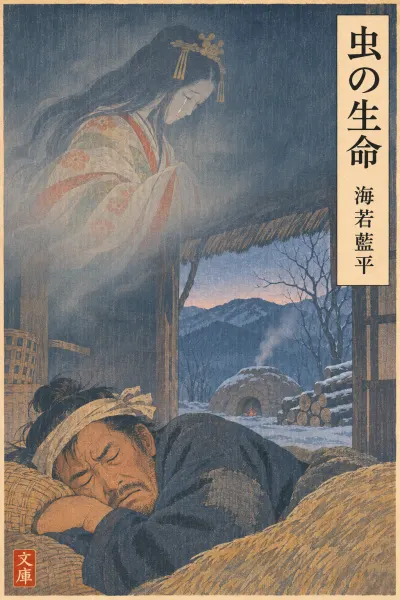
This is a short fairy tale in two parts about Kantarō, a lonely charcoal burner who lives alone deep in the mountains. On the morning of the second day of the New Year, the time of the traditional 'first dream', he dreams of a weeping princess. She sings that the insects living inside his oak logs will burn along with the wood in his kiln. The dream troubles him enough that he breaks open his own kiln, and that one act of mercy sets off a strange chain of events. The narrator tells the story gently, in polite です/ます style, which makes the prose easy to follow. The story is also a little uncanny, and it plays with the line between dreaming and waking. Two passages are sung in 7-5 verse and use archaic forms such as たれ, 助くる and 申せよ. These will be the hardest parts for most learners. Near the end, one character speaks in rough, colloquial Japanese, so you also get a sharp contrast in register. At about 2,800 characters, the story is a manageable N2-level read.
Contents
Easier versions
This story is also retold in simpler Japanese. Reading an easier version first makes the original much more approachable.
Before you read
- Learn the charcoal-making words before you start: 炭焼き (charcoal burning), 炭竈 or 竈 (kiln), 樫 (oak), and 虫の穴 (insect hole). The plot turns on these words, and they come up again in both parts.
- Read the two sung passages slowly and in 7-5 beats. The archaic forms map onto modern Japanese: たれ is 誰 (who), 助くる is 助ける, 救うても is 救っても, and 申せよ is a command form of 申す (say). Once you see this, the verses are short and repetitive.
- The narration uses polite past forms such as 〜ました and the humble 〜ておりました throughout. Treat them like 〜ていました. The double's closing speech switches to rough colloquial forms such as おりゃあ (おれは), もんか (ものか, 'no way…') and おれ. The change in tone is part of the point.
- Watch for the expressions of certainty and doubt that drive Kantarō's thinking: 〜に違いない (must be), 〜筈はない (can't be), and 〜という事はない (there's no such thing as…). They track how sure he is about the dream from one moment to the next.
- Several patterns describe repeated or desperate effort, especially in Part 2: 〜ても〜ても (no matter how much…), 〜たり〜たりする, 〜やら〜やら, 〜ようとする and 〜甲斐がない (it's no use). Spotting them will help you follow his long wandering through the mountains.
Words to know
The most useful words from the notes across the story.
| Word | Meaning | JLPT |
|---|---|---|
| あわれあわれ | pitiful; something to pitydictionary form: 哀れあわれと思う means 'to feel pity for'. | N3 |
| 折角せっかく | with great effort; speciallyHints that the effort is wasted or not rewarded. | N2 |
| 飢えうえる | to starve, go hungrydictionary form: 飢えるOften paired with 凍える (to freeze): 飢え凍える, 'starving and freezing'. | N2 |
| 口惜しいくやしい | bitter, mortified, frustratingOlder spelling of 悔しい. | N2 |
| 荷いてになう | to carry on the shoulderdictionary form: 荷うNow usually written 担う. | N1 |
| 介抱かいほう | nursing, looking after (a sick or injured person) | N1 |
| 炭焼きすみやき | charcoal burning; charcoal burnerCan mean the work or the person who does it. | — |
| 独身者ひとりもの | single person; someone living aloneNormally read どくしんしゃ; the reading ひとりもの (usually 独り者) stresses being alone. | — |
| 竈へっつい | kiln; cooking stoveOld word; the same kanji is also read かまど or かま. | — |
| 初夢はつゆめ | first dream of the New YearTraditionally the dream on the night of the 1st or 2nd of January, thought to foretell the year. | — |
| 冬ごもりふゆごもり | staying shut in for the winter; hibernationFrom こもる 'to shut oneself in'. | — |
| 夜すがらよすがら | all night longPoetic and old-fashioned; the ordinary word is 一晩中. | — |
| さめざめとさめざめと | (weeping) bitterly, quietly and at lengthUsed almost only with 泣く. | — |
| ありありとありありと | vividly; clearly | — |
| 丸太まるた | log | — |
Plot summary
Show the full summary (contains spoilers)
On the second morning of the New Year, Kantarō dreams of a weeping princess who sings that the insects in his kiln will burn with the oak logs. Troubled, he opens the kiln and finds a single tiny insect hole in a great oak log. He carries the log deep into the mountains so the insect can live. Afterwards he no longer wants to burn charcoal, and while wondering what to do, he gets lost. He wanders, starving, until he collapses. He wakes to heavenly singing and finds himself white-haired and godlike, cared for by celestial maidens and the princess from his dream. Their palace turns out to be the tiny insect hole in the log he spared. Flying back to his hut, he sees a man exactly like his former self. The man scoffs at dreams and lights the kiln, and Kantarō can no longer tell whether he is dreaming or awake.
About the author
Kaijaku Ranpei is a pen name of Sugiyama Taidō, who is far better known as Yumeno Kyūsaku. He came from Fukuoka and was the son of the political activist Sugiyama Shigemaru. As Yumeno Kyūsaku he became famous for strange, dark detective and fantasy fiction, above all the novel Dogra Magra. Before that reputation was established, he wrote a large number of short children's stories for a Fukuoka newspaper under several pen names, including Kaijaku Ranpei. These tales are usually gentle and moralising, quite unlike his later adult fiction, and they often feature talking animals, insects and small magical events.