 N5 · easy
Simplified retelling · JLPT N5
キキリツツリ Kikiritsutsuri in easy Japanese (N5)
This is our own simplified retelling of Kikiri-Tsutsuri: The Insect on the Shutter Rail, written for N5 learners and checked word by word against the N5 vocabulary list. A few story words and grammar patterns go beyond N5; the notes below give each one's level. It keeps the characters, events and ending of the original. When it feels easy, move on to the N4 version or the original text.
The story in brief
Tsuyuko is a hard-working girl who is bullied by her stepmother, and her stepmother will not let her go to girls' school. One night a small, polite insect appears above the door and promises to help. The next day the principal visits, gains permission for her to attend girls' school, and offers her extra evening study, but Tsuyuko kindly declines for her stepmother's sake. Her answer moves the principal, and when he tells her stepmother, she weeps. Tsuyuko goes on to girls' school, though the insect never comes back.
AI translation · independently checked
つゆこさんは学校の四年生の女の子です。Tsuyuko was a girl in the fourth year at school.
お母さんは本当のお母さんではありません。Her mother was not her real mother.
お母さんはいつもつゆこさんをいじめます。Her mother always bullied Tsuyuko.
つゆこさんは毎日なきました。Tsuyuko cried every day.
つゆこさんは毎ばんおそくまではたらきます。Every evening Tsuyuko worked until late.
よるは寒いだいどころで、一人でねます。At night she slept all alone in the cold kitchen.
つゆこさんはべんきょうがとてもよくできます。Tsuyuko was very good at her studies.
来年、女学校に入りたいです。Next year she wanted to enter girls' school.
お父さんは「いいですよ。」といいました。Her father said, "That's fine."
でも、お母さんは「いけません。」といいました。But her mother said, "You may not."
「テストの前にべんきょうして入っても、本当ではありません。」"Even if you study just before the exam and get in, it is not the real thing."
そのよる、つゆこさんはふとんの中でなきました。That night Tsuyuko cried under her quilt.
すると、戸の上から小さな音が来ました。Then a small sound came from above the door.
「キキリツツリ。」"Kikiri-tsutsuri."
つゆこさんはおきて、電気をつけました。Tsuyuko got up and turned on the light.
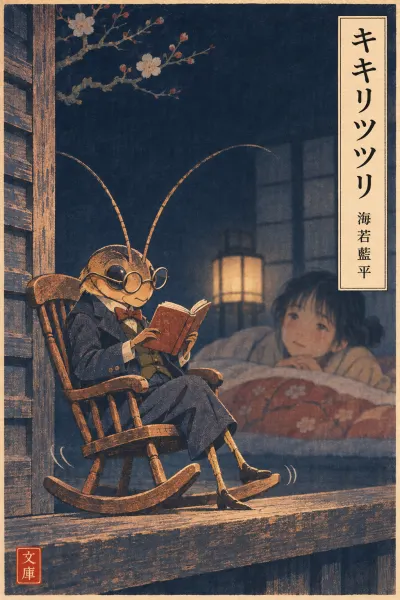
戸の上に小さなむしがいました。Above the door was a tiny insect.
むしはようふくをきて、めがねをかけていました。The insect was wearing Western clothes and a pair of spectacles.
いすにすわって、本を読んでいました。It was sitting on a chair, reading a book.
音はそのいすの音でした。The sound was the sound of that chair.
むしは小さなあかいぼうしをとって、おじぎをしました。The insect took off its little red hat and bowed.
つゆこさんもおじぎをしました。Tsuyuko bowed too.
「わたしのうちはここです。」むしは小さなあなを見せました。"This is my home," said the insect, and it showed her a tiny hole.
「あなたは毎日よくはたらいていますね。わたしはよく知っています。なぜないていましたか。」"You work very hard every day, don't you? I know it well. Why were you crying?"
つゆこさんは何もいいませんでした。Tsuyuko said nothing.
「大じょうぶです。わたしはよくわかっています。あなたは女学校に入れますよ。わたしがたすけます。キキリツツリ。」そして、むしはきえました。"All will be well. I understand perfectly. You shall get into girls' school. I will help you. Kikiri-tsutsuri." And then the insect vanished.
つぎの朝、校長先生がつゆこさんのいえに来ました。The next morning the principal came to Tsuyuko's house.
学校の後で、校長先生がつゆこさんをよびました。After school the principal called Tsuyuko to him.
「今日、あなたのごりょうしんに会いました。女学校に行ってもいいですよ。それから、毎ばん九時から十時まで、べんきょうの時間があります。」"Today I met your parents. You may go to girls' school. And every evening, from nine o'clock to ten o'clock, you will have time to study."
つゆこさんはなきました。Tsuyuko cried.
でも、つゆこさんはいいました。But Tsuyuko said,
「先生、よるのべんきょうはいりません。お母さんは『テストの前のべんきょうは本当ではありません』といいました。わたしもおなじです。毎日のじゅぎょうで、もっとよく先生の話を聞きます。お母さんがこまりますから。」"Sir, I do not need the evening study. Mother said, 'Studying before the exam is not the real thing.' I feel the same. In our lessons every day, I will listen to you even more carefully, because Mother would be troubled."
校長先生はつゆこさんのてをとって、なきました。The principal took Tsuyuko's hand and wept.
「今日のそのことばを、いつまでもわすれないでください。」"Please never forget the words you spoke today."
校長先生とつゆこさんは、いえへ行きました。The principal and Tsuyuko went to her house.
校長先生が話すと、お母さんはなきました。When the principal told her, the mother cried.
そして「わたしがわるかったです。」といいました。And she said, "I was in the wrong."
つゆこさんは学校をいちばんで出て、女学校に入りました。Tsuyuko finished school at the top of her class and entered girls' school.
あのむしが校長先生に話したのでしょうか。Could it be that the insect had spoken to the principal?
つゆこさんはむしに会って、おれいをいいたかったです。Tsuyuko wanted to meet the insect and thank it.
毎ばんまちました。She waited every night.
でも、むしはもう来ませんでした。But the insect never came again.
戸の上には、小さなあながいつまでもありました。Above the door, the little hole stayed there for ever after.
Vocabulary
| Word | Meaning | JLPT |
|---|---|---|
| いじめますいじめる | to treat cruelly, to bullydictionary form: いじめるUsed for ongoing unkindness toward someone weaker. | N4 |
| はたらきますはたらく | to workdictionary form: 働くKanji 働 = person 亻 + move 動. | N5 |
| だいどころだいどころ | kitchendictionary form: 台所 | N5 |
| 女学校じょがっこう | girls' school (old-style secondary school for girls)Under the old system, girls went on to this after elementary school. | — |
| めがねをかけてめがねをかける | to wear glassesdictionary form: めがねをかけるGlasses take かける, not きる. | — |
| ぼうしぼうし | hat, capdictionary form: 帽子 | N5 |
| おじぎおじぎ | a bowdictionary form: お辞儀Used with する: おじぎをする, to bow. | N2 |
| あなあな | holedictionary form: 穴 | N3 |
| きえましたきえる | to vanish, to disappeardictionary form: 消えるAlso used for lights going out. | N5 |
| 校長こうちょう | school principal, headmasterUsually followed by 先生 as a title. | N4 |
| よびましたよぶ | to call (someone to come)dictionary form: 呼ぶ | N5 |
| ごりょうしんりょうしん | (your) parents — the honorific ご marks someone else's parentsdictionary form: 両親ご makes it polite when speaking of someone else's parents. | N5 |
| おれいおれい | thanks, gratitudedictionary form: お礼おれいをいう = to say thank you. | N4 |
Grammar
〜たい N5 want to do
Attach たい to the verb's ます-stem to say what someone wants to do. It changes like an い-adjective, so the past is 〜たかった.
来年、女学校に入りたいです。
Next year she wanted to enter girls' school.
〜ていました N5 was doing / was in a state
The て-form + いました describes an action in progress or a state at a past moment. Here it describes what the insect was doing when Tsuyuko saw it.
いすにすわって、本を読んでいました。
It was sitting on a chair, reading a book.
〜てもいいです N5 may, it is all right to
The て-form + もいいです gives permission. The principal tells Tsuyuko she is allowed to go.
女学校に行ってもいいですよ。
You may go to girls' school.
〜ないでください N5 please don't
The ない-form + でください is a polite request not to do something. With いつまでも it means "please never forget".
今日のそのことばを、いつまでもわすれないでください。
Please never forget the words you spoke today.
〜と (when) N4 when A happens, B follows
The dictionary form + と links two events: as soon as the first happens, the second follows. Here the principal speaks, and the mother cries as a result.
校長先生が話すと、お母さんはなきました。
When the principal told her, the mother cried.
〜のでしょうか N4 I wonder if…; could it be that…?
This softens a question into a wondering guess. The narrator does not know the answer and invites the reader to wonder too.
あのむしが校長先生に話したのでしょうか。
Could it be that the insect had spoken to the principal?