Part 2 of 5 · JLPT N2
魔術 Majutsu, part 2: Flowers, a Spinning Lamp, and Flying Books
In this part
Misra plucks a woven flower out of the tablecloth, which gives off a real scent before turning back into a pattern. He sets the lamp spinning like a top without harm, then makes the books fly off the shelves like bats, pile into a pyramid and fly back, returning a French novel the narrator had lent him. Dazed, the narrator remembers Misra's claim that anyone could learn this magic.
AI translation · independently checked
ミスラ君は手を挙げて、二三度私の眼の前へ三角形のようなものを描きましたが、やがてその手をテエブルの上へやると、縁へ赤く織り出した模様の花をつまみ上げました。Misra raised his hand and traced something like a triangle before my eyes two or three times. Then he brought that hand down to the table and plucked up one of the flowers in the pattern woven in red along its border.
私はびっくりして、思わず椅子をずりよせながら、よくよくその花を眺めましたが、確かにそれは今の今まで、テエブル掛の中にあった花模様の一つに違いありません。I was astonished. Without thinking I drew my chair closer and looked hard at the flower, and there was no doubt that it was one of the flowers in the pattern that had been part of the tablecloth until that very moment.
が、ミスラ君がその花を私の鼻の先へ持って来ると、ちょうど麝香か何かのように重苦しい匀さえするのです。And when Misra brought the flower up to the tip of my nose, it even gave off a heavy scent, rather like musk or something of the kind.
私はあまりの不思議さに、何度も感嘆の声を洩しますと、ミスラ君はやはり微笑したまま、また無造作にその花をテエブル掛の上へ落しました。So marvellous did it seem that I let out cry after cry of wonder, whereupon Misra, still smiling, dropped the flower back onto the tablecloth as casually as before.
勿論落すともとの通り花は織り出した模様になって、つまみ上げること所か、花びら一つ自由には動かせなくなってしまうのです。Of course, the moment he dropped it, the flower became a woven pattern just as it had been. Far from being picked up, not a single petal could be moved at all.
「どうです。訳はないでしょう。今度は、このランプを御覧なさい。」"There you are. Nothing to it, is there? Now, look at this lamp."
ミスラ君はこう言いながら、ちょいとテエブルの上のランプを置き直しましたが、その拍子にどういう訳か、ランプはまるで独楽のように、ぐるぐる廻り始めました。As he said this, Misra casually shifted the lamp on the table a little, and at that, for some reason, the lamp began to spin round and round like a top.
それもちゃんと一所に止ったまま、ホヤを心棒のようにして、勢いよく廻り始めたのです。What is more, it stayed neatly in one spot and spun briskly, with its glass chimney as its spindle.
初の内は私も胆をつぶして、万一火事にでもなっては大変だと、何度もひやひやしましたが、ミスラ君は静に紅茶を飲みながら、一向騒ぐ容子もありません。At first I was aghast, and again and again my heart was in my mouth at the thought of how dreadful it would be if a fire broke out. But Misra calmly sipped his tea and showed not the least sign of alarm.
そこで私もしまいには、すっかり度胸が据ってしまって、だんだん早くなるランプの運動を、眼も離さず眺めていました。So in the end my nerve steadied completely, and I watched the lamp spin faster and faster without once taking my eyes off it.
また実際ランプの蓋が風を起して廻る中に、黄いろい焔がたった一つ、瞬きもせずにともっているのは、何とも言えず美しい、不思議な見物だったのです。And indeed, the lampshade stirred up a wind as it whirled, while inside it a single yellow flame burned without the slightest flicker. It was a beautiful and uncanny sight beyond words.
が、その内にランプの廻るのが、いよいよ速になって行って、とうとう廻っているとは見えないほど、澄み渡ったと思いますと、いつの間にか、前のようにホヤ一つ歪んだ気色もなく、テエブルの上に据っていました。But the lamp went on turning faster and faster, until at last it grew so clear and still that it no longer seemed to be turning at all. Then, before I knew it, there it stood on the table as before, its chimney not even slightly askew.
「驚きましたか。こんなことはほんの子供瞞しですよ。それともあなたが御望みなら、もう一つ何か御覧に入れましょう。」"Were you surprised? Things like this are mere tricks to fool children. Or, if you wish, I shall show you one more thing."
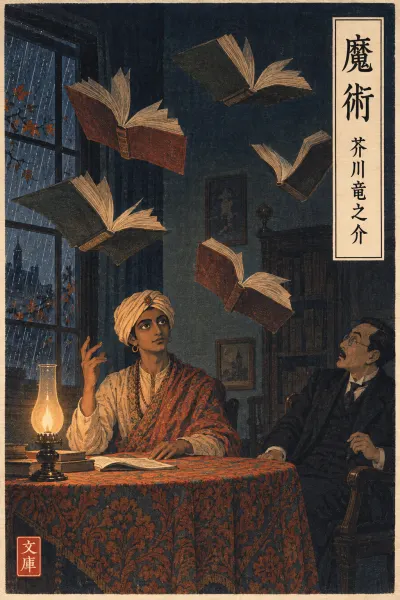
ミスラ君は後を振返って、壁側の書棚を眺めましたが、やがてその方へ手をさし伸ばして、招くように指を動かすと、今度は書棚に並んでいた書物が一冊ずつ動き出して、自然にテエブルの上まで飛んで来ました。Misra turned round and looked at the bookcase by the wall. Presently he stretched out his hand towards it and moved his fingers as if beckoning, and this time the books standing in rows on the shelves began to move one by one and came flying to the table of their own accord.
そのまた飛び方が両方へ表紙を開いて、夏の夕方に飛び交う蝙蝠のように、ひらひらと宙へ舞上るのです。And the way they flew! Spreading their covers open on either side, they fluttered up into the air like bats darting to and fro on a summer evening.
私は葉巻を口へ啣えたまま、呆気にとられて見ていましたが、書物はうす暗いランプの光の中に何冊も自由に飛び廻って、一々行儀よくテエブルの上へピラミッド形に積み上りました。I watched dumbfounded, my cigar still between my lips. Book after book flew freely about in the dim lamplight, and one by one they stacked themselves neatly on the table in the shape of a pyramid.
しかも残らずこちらへ移ってしまったと思うと、すぐに最初来たのから動き出して、もとの書棚へ順々に飛び還って行くじゃありませんか。And no sooner had every last one come over than, starting with the one that had arrived first, they began to move again and flew back to the bookcase in turn. Imagine that!
が、中でも一番面白かったのは、うすい仮綴じの書物が一冊、やはり翼のように表紙を開いて、ふわりと空へ上りましたが、しばらくテエブルの上で輪を描いてから、急に頁をざわつかせると、逆落しに私の膝へさっと下りて来たことです。But the most delightful of all was a thin paper-bound book. It too spread its covers like wings and floated softly up into the air, and after circling above the table for a while it suddenly rustled its pages and swooped headlong down into my lap.
どうしたのかと思って手にとって見ると、これは私が一週間ばかり前にミスラ君へ貸した覚えがある、仏蘭西の新しい小説でした。Wondering what had happened, I picked it up and found that it was a new French novel which I remembered lending Misra about a week before.
「永々御本を難有う。」"Thank you for the loan of your book all this time."
ミスラ君はまだ微笑を含んだ声で、こう私に礼を言いました。So Misra thanked me, a smile still in his voice.
勿論その時はもう多くの書物が、みんなテエブルの上から書棚の中へ舞い戻ってしまっていたのです。By then, of course, the many books had all already flown back from the table into the bookcase.
私は夢からさめたような心もちで、暫時は挨拶さえ出来ませんでしたが、その内にさっきミスラ君の言った、「私の魔術などというものは、あなたでも使おうと思えば使えるのです。」という言葉を思い出しましたから、I felt as though I had just woken from a dream, and for a while I could not even find a word of reply. But presently I recalled what Misra had said a little earlier, "My magic is something that even you could use, if you wished to," and so,
Vocabulary
| Word | Meaning | JLPT |
|---|---|---|
| 織り出したおりだす | to weave (a pattern) into clothdictionary form: 織り出す織る 'weave' + 出す 'bring out': the pattern is woven so that it stands out. | — |
| 無造作むぞうさ | casually, offhandedly, without fussUsed with に as an adverb; stresses how effortless the act looks. | — |
| ホヤほや | glass chimney of an oil lampdictionary form: 火屋Often written in katakana; an old household word from the age of oil lamps. | — |
| 独楽こま | spinning topSpecial reading: the kanji mean 'alone' and 'enjoy', but the word is simply こま. | — |
| 胆をつぶしてきもをつぶす | to be startled out of one's witsdictionary form: 胆を潰すLiterally 'crush one's liver'. The liver (胆) stands for courage. | — |
| 見物みもの | a sight worth seeing, a spectacleRead けんぶつ, the same kanji mean 'sightseeing, watching'. | N4 |
| 子供瞞しこどもだまし | a trick only good for fooling childrendictionary form: 子供騙し瞞す is an older spelling of 騙す 'to deceive'; note the rendaku (た→だ). | — |
| 蝙蝠こうもり | bat (the animal) | — |
| 呆気にとられてあっけにとられる | to be dumbfounded, taken aback (passive-form idiom; conjugates normally)dictionary form: 呆気に取られるA fixed expression, used only in this form. | — |
| 仮綴じかりとじ | paper-bound, with a temporary bindingTypical of French novels of the period, which were sold unbound or in paper covers. | — |
| 暫時ざんじ | for a short whileA literary word; in everyday speech you would say しばらく. | — |
Grammar
〜に違いありません N3 must be, there is no doubt that
Attached to a noun or plain form, it expresses strong certainty. Here the narrator is sure the flower came from the tablecloth's pattern.
確かにそれは今の今まで、テエブル掛の中にあった花模様の一つに違いありません。
There was no doubt that it was one of the floral patterns that had been in the tablecloth until that very moment.
〜どころか N2 far from ~, let alone ~
It rejects the first idea and then goes to an even stronger contrast. The flower could not be picked up, and in fact not even one petal could be moved.
つまみ上げること所か、花びら一つ自由には動かせなくなってしまうのです。
Far from being picked up, not a single petal could be moved at all.
〜たまま N4 while still ~, with ~ unchanged
The past form plus まま shows that a state continues while something else happens. Misra keeps smiling as he drops the flower.
ミスラ君はやはり微笑したまま、また無造作にその花をテエブル掛の上へ落しました。
Misra, still smiling, dropped the flower back onto the tablecloth as casually as before.
〜ほど N3 to the extent that ~
ほど after a clause shows the degree of something. The lamp spins so fast that it no longer looks as if it is turning.
とうとう廻っているとは見えないほど、澄み渡ったと思いますと
until at last it grew so clear that it no longer seemed to be turning at all
御覧に入れる N2 to show (humble)
This is the humble keigo equivalent of 見せる, used when the speaker shows something to a respected listener. Misra uses it to offer the narrator another trick.
もう一つ何か御覧に入れましょう。
I shall show you one more thing.
〜じゃありませんか N2 and what do you know ~ / isn't it (surprising) that ~
At the end of a narrative sentence it does not ask a question. It invites the listener to share the narrator's surprise at what happened.
もとの書棚へ順々に飛び還って行くじゃありませんか。
They flew back to the bookcase in turn. Imagine that!