Part 5 of 5 · JLPT N2
魔術 Majutsu, part 5: The Card Game and the Waking Dream
In this part
Pressed by his friends, the narrator stakes the magic gold coins on a game of cards, wins again and again, and is challenged to a final hand for his rival's whole fortune. Seized by greed, he secretly uses his magic and draws a king. The king climbs out of the card and speaks in Misra's voice, and the narrator wakes to find he is still sitting with Misra in Ōmori. The month he seemed to live through was a dream of two or three minutes, and it has proved him unfit to learn Hassan Khan's secret magic.
AI translation · independently checked
「いや、何も僕は、この金貨が惜しいから石炭にするのじゃない。」"No, it isn't at all that I'm turning these gold coins back into coal because I begrudge losing them."
「それなら骨牌をやり給えな。」"Then play cards for them, won't you."
何度もこういう押問答を繰返した後で、とうとう私はその友人の言葉通り、テエブルの上の金貨を元手に、どうしても骨牌を闘わせなければならない羽目に立ち至りました。After we had gone back and forth like this many times, I at last found myself, just as my friend had insisted, in a position where I had no choice but to use the gold coins on the table as my stake and play at cards.
勿論友人たちは皆大喜びで、すぐにトランプを一組取り寄せると、部屋の片隅にある骨牌机を囲みながら、まだためらい勝ちな私を早く早くと急き立てるのです。My friends, of course, were all delighted. They promptly sent for a pack of cards, gathered round the card table in a corner of the room, and kept urging me, still rather inclined to hesitate, to hurry up and begin.
ですから私も仕方がなく、しばらくの間は友人たちを相手に、嫌々骨牌をしていました。So, having no choice, I played cards against my friends for a while, most unwillingly.
が、どういうものか、その夜に限って、ふだんは格別骨牌上手でもない私が、嘘のようにどんどん勝つのです。But somehow, on that night of all nights, I, who was ordinarily no great hand at cards, won and won again, almost past belief.
するとまた妙なもので、始は気のりもしなかったのが、だんだん面白くなり始めて、ものの十分とたたない内に、いつか私は一切を忘れて、熱心に骨牌を引き始めました。And then, curiously enough, what I had at first had no heart for gradually began to amuse me, and before a mere ten minutes had passed I had somehow forgotten everything else and was eagerly drawing cards.
友人たちは、元より私から、あの金貨を残らず捲き上げるつもりで、わざわざ骨牌を始めたのですから、こうなると皆あせりにあせって、ほとんど血相さえ変るかと思うほど、夢中になって勝負を争い出しました。My friends had started the game on purpose, fully intending to fleece me of every last one of those gold coins, so now they grew more and more frantic. They threw themselves into the contest so wildly that their very faces seemed about to change colour.
が、いくら友人たちが躍起となっても、私は一度も負けないばかりか、とうとうしまいには、あの金貨とほぼ同じほどの金高だけ、私の方が勝ってしまったじゃありませんか。Yet however worked up they became, not only did I never lose once, but in the end, would you believe it, I had won a sum roughly equal to the gold coins themselves.
するとさっきの人の悪い友人が、まるで、気違いのような勢いで、私の前に、札をつきつけながら、Then the mischievous friend I mentioned earlier thrust the cards in front of me with the fury of a madman and said:
「さあ、引き給え。僕は僕の財産をすっかり賭ける。地面も、家作も、馬も、自働車も、一つ残らず賭けてしまう。その代り君はあの金貨のほかに、今まで君が勝った金をことごとく賭けるのだ。さあ、引き給え。」"Come on, draw. I'll stake my entire fortune. My land, my houses for rent, my horses, my motor car, I'll stake the lot, every last one of them. In return, besides those gold coins, you'll stake all the money you've won so far. Come on, draw!"
私はこの刹那に欲が出ました。At that instant, greed rose up in me.
テエブルの上に積んである、山のような金貨ばかりか、折角私が勝った金さえ、今度運悪く負けたが最後、皆相手の友人に取られてしまわなければなりません。If I had the bad luck to lose this time, that would be the end of it. Not only the mountain of gold coins piled on the table, but even the money I had worked so hard to win, would all be taken from me by the friend I was playing.
のみならずこの勝負に勝ちさえすれば、私は向うの全財産を一度に手へ入れることが出来るのです。What was more, if only I won this game, I could get my opponent's whole fortune into my hands at one stroke.
こんな時に使わなければどこに魔術などを教わった、苦心の甲斐があるのでしょう。If I did not use it at a moment like this, where would be the reward for all the pains I had taken to learn magic?
そう思うと私は矢も楯もたまらなくなって、そっと魔術を使いながら、決闘でもするような勢いで、At that thought I could hold back no longer. Secretly working my magic, I said, with the air of a man about to fight a duel:
「よろしい。まず君から引き給え。」"Very well. You draw first."
「九。」"Nine."
「王様。」"King!"
私は勝ち誇った声を挙げながら、まっ蒼になった相手の眼の前へ、引き当てた札を出して見せました。With a cry of triumph, I held out the card I had drawn before the eyes of my opponent, who had turned deathly pale.
すると不思議にもその骨牌の王様が、まるで魂がはいったように、冠をかぶった頭を擡げて、ひょいと札の外へ体を出すと、行儀よく剣を持ったまま、にやりと気味の悪い微笑を浮べて、And then, strange to say, the king on that card raised his crowned head as though a soul had entered him and popped his body right out of the card. Still holding his sword with perfect propriety, he broke into an eerie grin
「御婆サン。御婆サン。御客様ハ御帰リニナルソウダカラ、寝床ノ仕度ハシナクテモ好イヨ。」*"Grandmother. Grandmother. The gentleman is going home, it seems, so you need not make up a bed."*
と、聞き覚えのある声で言うのです。and said this in a voice I had heard before.
と思うと、どういう訳か、窓の外に降る雨脚までが、急にまたあの大森の竹藪にしぶくような、寂しいざんざ降りの音を立て始めました。At that moment, for some reason, even the rain falling outside the window suddenly began to make that lonely sound of a pouring downpour, just as it had when it splashed on the bamboo groves of Ōmori.
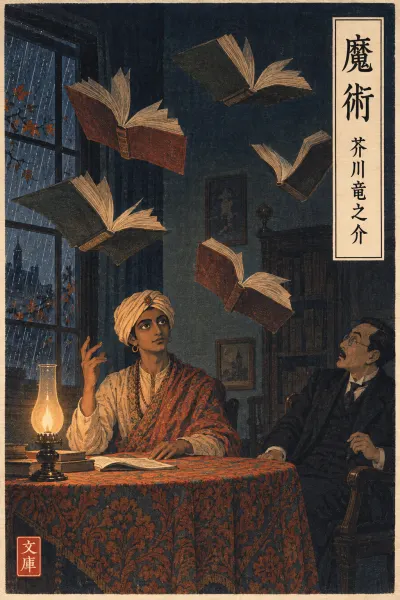
ふと気がついてあたりを見廻すと、私はまだうす暗い石油ランプの光を浴びながら、まるであの骨牌の王様のような微笑を浮べているミスラ君と、向い合って坐っていたのです。Suddenly coming to myself, I looked around. I was still sitting in the light of the dim oil lamp, face to face with Misra, who wore a smile just like that of the king on the card.
私が指の間に挟んだ葉巻の灰さえ、やはり落ちずにたまっている所を見ても、私が一月ばかりたったと思ったのは、ほんの二三分の間に見た、夢だったのに違いありません。Even the ash of the cigar held between my fingers had gathered without falling. Judging from that, what I had taken for a whole month must have been nothing but a dream, dreamt in the space of two or three minutes.
けれどもその二三分の短い間に、私がハッサン・カンの魔術の秘法を習う資格のない人間だということは、私自身にもミスラ君にも、明かになってしまったのです。And yet in those short two or three minutes it had become plain, both to me and to Misra, that I was a man unfit to learn the secret arts of Hassan Khan's magic.
私は恥しそうに頭を下げたまま、しばらくは口もきけませんでした。I hung my head in shame and for some time could not say a word.
「私の魔術を使おうと思ったら、まず欲を捨てなければなりません。あなたはそれだけの修業が出来ていないのです。」"If you wish to use my magic, you must first cast away greed. You have not yet trained enough for that."
ミスラ君は気の毒そうな眼つきをしながら、縁へ赤く花模様を織り出したテエブル掛の上に肘をついて、静にこう私をたしなめました。Misra looked at me with pity. Resting his elbows on the tablecloth, whose edge was woven with a pattern of red flowers, he quietly reproved me in these words.
(大正八年十一月十日)(10 November, Taishō 8 [1919])
Vocabulary
| Word | Meaning | JLPT |
|---|---|---|
| 押問答おしもんどう | arguing back and forth, a war of wordsdictionary form: 押し問答Each side keeps pushing (押す) its own position without giving way. | — |
| 元手もとで | stake, starting capitalThe money you begin a venture or a gamble with. | — |
| 羽目はめ | (unpleasant) position, predicamentUsually appears as 〜羽目になる or 〜羽目に陥る, meaning to end up having to do something you would rather not do. | — |
| 急き立てるせきたてる | to hurry someone, to press someone to act quickly | — |
| 捲き上げるまきあげる | to fleece, to take money from someonedictionary form: 巻き上げるThe literal meaning is 'to roll up'. 捲 is an older spelling of 巻. | — |
| 血相けっそう | look on one's face, complexionAlmost always appears as 血相を変える, 'to change colour' from anger or panic. | — |
| 躍起やっき | frantic, desperately worked upCommon as 躍起になる or, in literary style, 躍起となる. | — |
| 家作かさく | houses owned for letting, rental propertyAn old-fashioned word. | — |
| 刹那せつな | instant, momentOriginally a Buddhist term for the smallest unit of time. | — |
| 甲斐かい | worth, reward (for effort)Appears in 苦心の甲斐がある ('the effort pays off') and in 〜甲斐がない ('there is no point in ...'). | — |
| 矢も楯もたまらなくやもたてもたまらない | unable to hold oneself back, impatient to actdictionary form: 矢も楯もたまらないAn idiom. The literal image is that neither arrows nor shields could stop you. | — |
| 勝ち誇ったかちほこる | to triumph, to exult in victorydictionary form: 勝ち誇る | — |
| 秘法ひほう | secret method, secret art | — |
| たしなめましたたしなめる | to reprove gently, to admonishdictionary form: たしなめる | — |
Grammar
〜給え N1 do ... (familiar command)
The verb stem plus 給え gives a command used by men toward equals or juniors. It sounds educated and old-fashioned. Here the friend uses it to push the narrator to draw.
さあ、引き給え。
Come on, draw.
〜に限って N2 on that particular occasion (of all times)
Attached to a noun, it singles out one case in which something unusual or unexpected happens. The narrator, normally a poor player, wins on this particular night.
その夜に限って、ふだんは格別骨牌上手でもない私が、嘘のようにどんどん勝つのです。
On that night of all nights, I, who was ordinarily no great hand at cards, won and won again, almost past belief.
〜ばかりか N2 not only ... but also
The first clause is followed by a second, stronger fact. He did not merely avoid losing; he won a sum equal to the coins.
私は一度も負けないばかりか、とうとうしまいには、あの金貨とほぼ同じほどの金高だけ、私の方が勝ってしまったじゃありませんか。
Not only did I never lose once, but in the end, would you believe it, I had won a sum roughly equal to the gold coins themselves.
〜たが最後 N1 once ... happens, that's the end
The past form plus が最後 means that once the event occurs, a bad and irreversible result follows. A single loss would mean giving everything up.
今度運悪く負けたが最後、皆相手の友人に取られてしまわなければなりません。
If I had the bad luck to lose this time, that would be the end: everything would be taken by my opponent.
〜さえ〜ば N3 if only ..., as long as ...
The verb stem plus さえすれば marks the one condition that is enough to bring about the result. Winning this single game would be all it takes to gain the whole fortune.
この勝負に勝ちさえすれば、私は向うの全財産を一度に手へ入れることが出来るのです。
If only I won this game, I could get my opponent's whole fortune into my hands at one stroke.
〜に違いない N3 must be, surely
This pattern states a confident conclusion drawn from evidence. Here the evidence is the unfallen cigar ash. The polite form is 違いありません.
私が一月ばかりたったと思ったのは、ほんの二三分の間に見た、夢だったのに違いありません。
What I had taken for a whole month must have been nothing but a dream, dreamt in the space of two or three minutes.