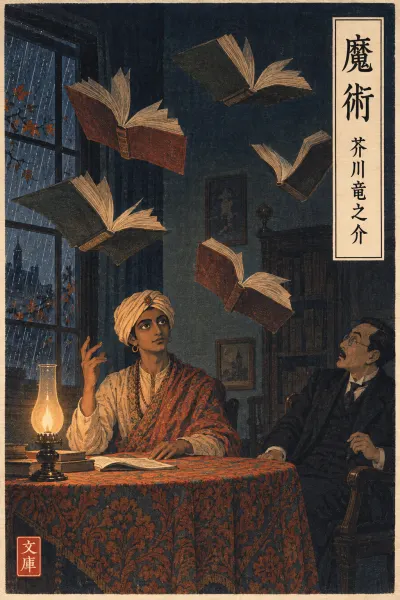
Part 4 of 5 · JLPT N2
魔術 Majutsu, part 4: Coal Turned to Gold at the Club
In this part
The narrator scatters burning coal across the club floor, and it turns into a shower of real gold coins. His friends are stunned and eager to keep the fortune, but he insists he will throw it back into the fire, as he promised Misra. The most cunning of the friends proposes a card game for the gold and mocks him, suggesting that his refusal proves he has not given up greed after all.
AI translation · independently checked
そこで私の方はいよいよ落着き払って、その掌の上の石炭の火を、しばらく一同の眼の前へつきつけてから、今度はそれを勢いよく寄木細工の床へ撒き散らしました。At this I grew more composed than ever. For a little while I held the burning coal on my palm out before the eyes of the whole company, and then I flung it with a flourish across the parquet floor.
その途端です、窓の外に降る雨の音を圧して、もう一つ変った雨の音が俄に床の上から起ったのは。It was at that very instant that, drowning out the sound of the rain falling outside the window, another and stranger sound of rain suddenly rose from the floor.
と言うのはまっ赤な石炭の火が、私の掌を離れると同時に、無数の美しい金貨になって、雨のように床の上へこぼれ飛んだからなのです。That was because, the instant the red-hot coal fire left my palm, it turned into countless beautiful gold coins that went scattering over the floor like rain.
友人たちは皆夢でも見ているように、茫然と喝采するのさえも忘れていました。My friends all looked as though they were dreaming, and stood dumbfounded, forgetting even to applaud.
「まずちょいとこんなものさ。」"There. Something like that, for a start."
私は得意の微笑を浮べながら、静にまた元の椅子に腰を下しました。With a proud smile on my face, I quietly sat down again in my chair.
「こりゃ皆ほんとうの金貨かい。」"I say, is all this real gold?"
呆気にとられていた友人の一人が、ようやくこう私に尋ねたのは、それから五分ばかりたった後のことです。It was about five minutes later that one of my friends, who had been staring in blank astonishment, at last put this question to me.
「ほんとうの金貨さ。嘘だと思ったら、手にとって見給え。」"Real gold, of course. If you think I'm lying, pick some up and see for yourself."
「まさか火傷をするようなことはあるまいね。」"You're quite sure we won't burn ourselves?"
友人の一人は恐る恐る、床の上の金貨を手にとって見ましたが、One of my friends timidly picked up a gold coin from the floor and looked at it.
「成程こりゃほんとうの金貨だ。おい、給仕、箒と塵取りとを持って来て、これを皆掃き集めてくれ。」"By Jove, it really is gold. Here, waiter, bring a broom and a dustpan and sweep all this up, would you?"
給仕はすぐに言いつけられた通り、床の上の金貨を掃き集めて、堆く側のテエブルへ盛り上げました。The waiter at once did as he was told, swept up the gold coins from the floor and heaped them high on a table close by.
友人たちは皆そのテエブルのまわりを囲みながら、My friends all gathered round the table,
「ざっと二十万円くらいはありそうだね。」"There must be something like two hundred thousand yen here, at a rough guess."
「いや、もっとありそうだ。華奢なテエブルだった日には、つぶれてしまうくらいあるじゃないか。」"No, more than that, I'd say. There's enough to break a flimsy table, isn't there?"
「何しろ大した魔術を習ったものだ。石炭の火がすぐに金貨になるのだから。」"Well, that's quite some magic you've learned. Coal straight into gold, just like that."
「これじゃ一週間とたたない内に、岩崎や三井にも負けないような金満家になってしまうだろう。」などと、口々に私の魔術を褒めそやしました。"At this rate you'll be as rich as the Iwasakis or the Mitsuis inside a week." And so they all heaped praise on my magic at once.
が、私はやはり椅子によりかかったまま、悠然と葉巻の煙を吐いて、But I simply stayed leaning back in my chair, calmly blowing out cigar smoke, and said,
「いや、僕の魔術というやつは、一旦欲心を起したら、二度と使うことが出来ないのだ。だからこの金貨にしても、君たちが見てしまった上は、すぐにまた元の暖炉の中へ抛りこんでしまおうと思っている。」"No. This magic of mine can never be used again once a man has let greed arise in him. So as for this gold, now that you have all seen it, I mean to toss it straight back into the fireplace where it came from."
友人たちは私の言葉を聞くと、言い合せたように、反対し始めました。When my friends heard this, they began to object as if they had agreed on it beforehand.
これだけの大金を元の石炭にしてしまうのは、もったいない話だと言うのです。It would be a sinful waste, they said, to turn such a great fortune back into coal.
が、私はミスラ君に約束した手前もありますから、どうしても暖炉に抛りこむと、剛情に友人たちと争いました。But because of the promise I had made to Misra, I stubbornly argued with them that I would throw it into the fireplace no matter what.
すると、その友人たちの中でも、一番狡猾だという評判のあるのが、鼻の先で、せせら笑いながら、Then the one among them who had the reputation of being the most cunning of all gave a sneering laugh down his nose and said,
「君はこの金貨を元の石炭にしようと言う。僕たちはまたしたくないと言う。それじゃいつまでたった所で、議論が干ないのは当り前だろう。"You say you want to turn this gold back into coal. We, on the other hand, say we don't. Then naturally, no matter how long we go on, the argument will never be settled.
そこで僕が思うには、この金貨を元手にして、君が僕たちと骨牌をするのだ。そうしてもし君が勝ったなら、石炭にするとも何にするとも、自由に君が始末するが好い。So here is what I propose: you play cards with us, with this gold as your stake. And if you win, you are free to do with it as you please, turn it into coal or anything else you like.
が、もし僕たちが勝ったなら、金貨のまま僕たちへ渡し給え。そうすれば御互の申し分も立って、至極満足だろうじゃないか。」But if we win, you hand it over to us just as it is, gold coins and all. That way both sides get their due, and we'll all be perfectly satisfied, won't we?"
それでも私はまだ首を振って、容易にその申し出しに賛成しようとはしませんでした。Even so, I still shook my head and was not at all willing to agree to his proposal.
所がその友人は、いよいよ嘲るような笑を浮べながら、私とテエブルの上の金貨とを狡るそうにじろじろ見比べて、But my friend, with an ever more mocking smile, looked slyly back and forth between me and the gold on the table,
「君が僕たちと骨牌をしないのは、つまりその金貨を僕たちに取られたくないと思うからだろう。それなら魔術を使うために、欲心を捨てたとか何とかいう、折角の君の決心も怪しくなってくる訳じゃないか。」"The reason you won't play cards with us must be that you don't want us to take that gold away from you. In that case, this fine resolve of yours, about having cast off greed in order to use magic and so forth, starts to look rather doubtful, doesn't it?"
Vocabulary
| Word | Meaning | JLPT |
|---|---|---|
| 落着き払っておちつきはらう | to be perfectly calm and composeddictionary form: 落ち着き払う払う after a noun stem intensifies it: fully, thoroughly calm. Old spelling 落着 without ち. | — |
| 撒き散らしましたまきちらす | to scatter, strew aboutdictionary form: 撒き散らす | — |
| 俄ににわか | suddenly, all at oncedictionary form: 俄Literary; common in 俄雨 (にわかあめ, sudden shower). | N2 |
| 茫然とぼうぜん | dumbfounded, in a dazedictionary form: 茫然Also written 呆然. | N1 |
| 喝采かっさい | applause, cheering | — |
| 呆気にとられていたあっけにとられる | to be taken aback, stunneddictionary form: 呆気にとられるSet phrase; usually written in kana today. | — |
| 堆くうずたかい | piled highdictionary form: 堆い | — |
| 金満家きんまんか | a very rich man, millionaireOld-fashioned; today 大金持ち. | — |
| 褒めそやしましたほめそやす | to praise lavishlydictionary form: 褒めそやす | — |
| 欲心よくしん | greed, avaricious desireKey word of the story: Misra's magic works only for one free of greed. | — |
| もったいないもったいない | wasteful, a shame to waste | N2 |
| 剛情にごうじょう | obstinate, stubborn (剛情に = stubbornly)dictionary form: 剛情Now usually written 強情. | — |
| 狡猾こうかつ | cunning, sly | — |
| 骨牌かるた | playing cards; a card gameOld kanji spelling of カルタ, from Portuguese carta. | N2 |
Grammar
〜給え N1 do ~ (command from a man to an equal or junior)
The imperative of 給う attached to a verb stem gives a firm but friendly order in educated male speech of the period. Here 見給え means 'take a look'.
嘘だと思ったら、手にとって見給え。
If you think I'm lying, pick some up and see for yourself.
〜まい N2 surely not ~ (negative conjecture)
まい after a verb expresses the speaker's guess that something will not happen. With まさか and ね, the friend is anxiously seeking reassurance.
まさか火傷をするようなことはあるまいね。
You're quite sure we won't burn ourselves?
〜た日には N1 if it happens to be ~; in the case of ~
Past tense + 日には sets up a hypothetical situation, usually with a bad result. Here: if the table were a flimsy one, it would be crushed.
華奢なテエブルだった日には、つぶれてしまうくらいあるじゃないか。
There's enough to break a flimsy table, isn't there?
〜た上は N2 now that ~; since ~ has happened
上は after a past verb marks a completed fact that leads to a decision or obligation. Once the friends have seen the gold, he means to throw it away.
君たちが見てしまった上は、すぐにまた元の暖炉の中へ抛りこんでしまおうと思っている。
Now that you have all seen it, I mean to toss it straight back into the fireplace.
〜た所で N2 even if ~; no matter how much ~
Past tense + ところで means that even if the action is done, the expected result will not follow. With いつまで, it means the argument would never end however long they went on.
それじゃいつまでたった所で、議論が干ないのは当り前だろう。
Then naturally we could go on as long as we like and the argument would never be settled.
〜手前 N1 because of (one's position / what one has said or done)
手前 after a clause means that, having done something, one feels bound to act consistently with it. The narrator must keep face with Misra because of his promise.
私はミスラ君に約束した手前もありますから
because of the promise I had made to Misra