Part 2 of 5 · JLPT N3
港に着いた黒んぼ Minato ni Tsuita Kuronbo, part 2: A Summer Day and a Rich Man's Summons
In this part
On a hazy summer day by the harbour, a crowd gathers again to hear the blind boy's flute and watch his sister dance, and each person has a different opinion about the pair. At sunset, as the sister is leaving with her brother, a messenger arrives and says that a wealthy gentleman of the town wishes to see her. Uneasy but unable to refuse, she asks whether she may bring her brother with her.
AI translation · independently checked
ある夏の日のことでありました。It happened on a certain summer's day.
その日も太陽は、早くから上がって、みつばちは花を探ねて歩き、広場のかなたにそびえる木立は、しょんぼりと静かに、ちょうど脊の高い人が立っているように、うるんだ空の下に浮き上がって見えました。That day, too, the sun had risen early. The honeybees went wandering in search of flowers, and the grove of trees that towered beyond the square stood out against the hazy, moist sky, quiet and forlorn, just like tall people standing there.
港の方では、出入りする船の笛の音が、鈍く聞こえていました。Over toward the harbour, the whistles of ships coming and going could be heard, dull and muffled.
明るい、あめ色の空に、黒い煙の跡がわずかに漂っている。In the bright, amber sky, a faint trail of black smoke drifts.
それは、これから、青い、青い波を分けて、遠く出てゆく船があるのでありました。It meant that a ship was about to set out for distant parts, parting the blue, blue waves.
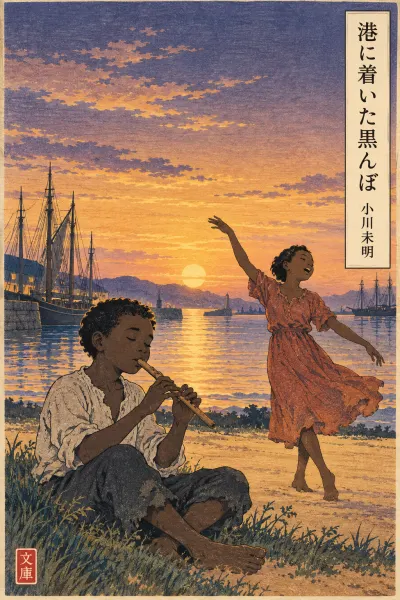
その日も、二人のまわりには、いつものごとく、人が黒山のように集まっていました。That day, as always, people had gathered around the two of them in a great dark crowd.
「こんないい、笛の音を聞いたことがない。」と、一人の男がいいました。"I have never heard such lovely flute music," said one man.
「私は、ほうぼう歩いたものだが、こんないい笛の音を聞いたことがなかった。なんだか、この笛の音を聞いていると、忘れてしまった過去のことが、一つ、一つ心の底に浮かび上がって目に見えるような気がする。」と、他の一人の男がいいました。"I have travelled to many places in my time, but I never heard flute music as fine as this. Somehow, as I listen to it, I feel as though the things of the past I had forgotten are rising up, one by one, from the bottom of my heart, until I can see them before my eyes," said another man.
「あれで目があいていたら、どんなかわいい男の子でしょう。」と、ある一人の女がいいました。"If only his eyes could see, what a sweet little boy he would be," said a woman.
「私は、あんな器量よしの娘を見たことがない。」と、他の年をとった、荷物をかついだ旅の女らしい人がいいました。"I have never seen such a good-looking girl," said another person, an old woman who seemed to be a traveller, with a bundle on her back.
「あれほどの器量なら、こんなことをしていなくてもよさそうなものだ。あんな美しい娘なら、だれでももらい手があるのに。」と、脊の低い男がのびあがって、あちらを見ながら、いっていました。"With looks like that, you'd think she wouldn't need to be doing this. Anyone would gladly take a girl as beautiful as that for a wife," said a short man, stretching up on his toes to look over at them.
「きっと、あれには、だれかついているものがあるでしょう。そして、金もうけをしようというのでしょう。」"Surely there must be someone behind them. Someone who means to make money out of them, I suppose."
「いいえ、あの娘は、そんな下卑た子供ではありません。きっと、あの弟のために、こうして苦労をしているのです。」と、さっきから黙って、じっと娘の踊るのを見ていた女の人がいいました。"No, that girl is not that sort of vulgar child. I am sure she is working this hard for the sake of her little brother," said a woman who had been silently and intently watching the girl dance all along.
人々は、思い思いのことをいいました。The people each said whatever came into their heads.
中には、金を足もとへ投げてやったものもありました。Some of them tossed money at her feet.
中には、いろいろのことをしゃべりながら、いつか消えるように、銭もやらずに去ってしまったものもありました。Others, chattering about this and that, slipped away before anyone noticed, as if they had faded out, without giving a single coin.
つつがなく、やがて、その日も暮れようとしていました。And so, with nothing amiss, that day too was soon drawing to a close.
海の上の空を、いぶし銀のように彩って、西に傾いた夕日は赤く見えていました。The evening sun, sinking in the west, glowed red, tinting the sky above the sea like darkened silver.
人々は、おいおいにその広場から立ち去りました。Little by little, the people left the square.
うす青い着物をきた姉は、弟をいたわって、自分たちもそこを去ろうとしたときであります。It was just as the sister in her pale blue kimono, tenderly looking after her brother, was about to leave the place herself.
一人の見なれない男が、姉の前に進み出ました。A man she had never seen before stepped forward in front of her.
「この町の大尽のお使いでまいったものです。ちょっと大尽がお目にかかってお話したいことがあるからいらっしてくださるように。」といいました。"I have come as a messenger from a wealthy gentleman of this town. My master would like to meet you, as there is something he wishes to speak with you about, and he asks that you kindly come," he said.
姉は、これまでこんなことをいったものが、幾人もありましたから、またかと思いましたが、その大尽というのは、名の聞こえている大金持ちだけに、娘はすげなく断ることもできないという気がして、少なからず当惑いたしました。Many people had said such things to her before, so the sister thought, "Not again." But this gentleman was a great millionaire whose name was known far and wide, and so the girl felt she could not coldly refuse him, and she was more than a little troubled.
「どんなご用があって、わたしにあいたいと申されるのですか?」と、姉は、その使いの男にたずねました。"On what business does he wish to see me?" the sister asked the messenger.
「私にはわかりません。あなたがいらしてくださればわかることです。けっして、あなたのお身にとって悪いことでないことだけはたしかであります。」と、その男は答えました。"That I cannot say. You will understand if you are kind enough to come. Only this much is certain: it is by no means anything that will do you harm," the man replied.
「わたしは、弟を置いて、どこへもいくことはできません。弟を連れていってもいいのでしょうか?」と、姉はたずねました。"I cannot go anywhere and leave my brother behind. Would it be all right if I brought him with me?" the sister asked.
Vocabulary
| Word | Meaning | JLPT |
|---|---|---|
| そびえるそびえる | to tower, to rise highUsed for tall things such as mountains, trees and buildings. The kanji form is 聳える. | N1 |
| 木立こだち | grove, cluster of trees | — |
| しょんぼりしょんぼり | forlorn, dejected, lonely-lookingMimetic word normally used for downcast people. Here it is applied to trees, which makes them seem human. | — |
| 漂ってただよう | to drift, to floatdictionary form: 漂う | N1 |
| 黒山くろやま | a dense crowdUsually appears as 黒山のような人だかり. It pictures a mass of people as a dark mountain (from their black hair). | — |
| ほうぼうほうぼう | here and there, many placesdictionary form: 方々 | N3 |
| 器量よしきりょうよし | a good-looking person (especially a girl)Old-fashioned word. In this sense 器量 means 'looks, features'. | — |
| もらい手もらいて | someone who will take (her) in, especially as a brideDated expression. 嫁をもらう meant 'to take a wife'. | — |
| 下卑たげびる | vulgar, base, lowdictionary form: 下卑るAlmost always used in the form 下卑た + noun. | — |
| 思い思いおもいおもい | each in their own way, as each pleases | — |
| つつがなくつつがない | without mishap, safely and smoothlydictionary form: つつがないA formal, somewhat old word. It is still heard in set phrases such as 式はつつがなく終わった. | — |
| いぶし銀いぶしぎん | oxidised (darkened) silver; a subdued silver-greyAlso used figuratively for quiet, understated excellence. | — |
| 大尽だいじん | a very rich man, a magnateOld-fashioned word. Do not confuse it with 大臣 (だいじん, 'minister'). | — |
| すげなくすげない | curt, cold, unsympathetic (すげなく: curtly, coldly, flatly)dictionary form: すげない | — |
| 当惑とうわく | bewilderment, being at a loss | — |
Grammar
〜たことがない N4 have never done
The past tense plus ことがない denies any experience of the action. Here the speaker uses it to praise the music: he has never heard anything like it.
こんないい、笛の音を聞いたことがない。
I have never heard such lovely flute music.
〜たものだ N3 used to; did often (looking back)
The past tense plus ものだ looks back on something done often or at length in the past, with a nostalgic tone. Followed by が, it sets up a contrast.
私は、ほうぼう歩いたものだが、こんないい笛の音を聞いたことがなかった。
I have travelled to many places in my time, but I never heard flute music as fine as this.
〜てもよさそうなものだ N1 you would think that ~ would be the case (but it isn't)
そうなものだ expresses what would naturally be expected, together with mild surprise or criticism that reality is different. Here the man wonders why so pretty a girl has to perform in the street.
あれほどの器量なら、こんなことをしていなくてもよさそうなものだ。
With looks like that, you'd think she wouldn't need to be doing this.
〜ずに N3 without doing
〜ずに means 'without doing'. It is the negative connective equivalent to 〜ないで, somewhat more formal or written in tone: 銭もやらずに means 'without giving any money'.
銭もやらずに去ってしまったものもありました。
Others left without giving a single coin.
〜ようとしている N3 be about to; be on the point of
The volitional form plus としている describes something about to happen. It is used even for things that act without will, such as the day coming to an end.
やがて、その日も暮れようとしていました。
Soon that day too was drawing to a close.
〜だけに N2 precisely because; as might be expected since
だけに gives a reason that naturally leads to the result that follows. Because the man is such a famous millionaire, the girl feels she cannot simply refuse.
その大尽というのは、名の聞こえている大金持ちだけに、娘はすげなく断ることもできないという気がして
Since this gentleman was a millionaire whose name was known far and wide, the girl felt she could not coldly refuse him