Part 5 of 5 · JLPT N3
港に着いた黒んぼ Minato ni Tsuita Kuronbo, part 5: News of a Sister and Brother Far Away
In this part
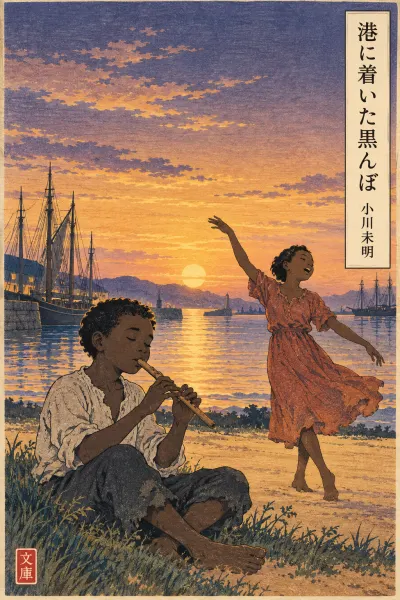
The sister searches sadly for her lost little brother. When a ship arrives from the south, a short, dark-skinned man meets her in the town and insists he saw her on a southern island, singing and dancing to the flute of a blind boy. Wondering whether another, kinder self has taken her brother away, she is filled with regret and asks the way to the island, but he tells her it lies thousands of leagues away beyond a silver sea and snowy mountains.
AI translation · independently checked
姉は、あてもなくそれらの景色をながめ、悲しみに沈みながら、弟をさがしていました。The sister gazed aimlessly at all these sights and searched for her little brother, sunk deep in sorrow.
けれど、弟は、どこへいったのかわかりませんでした。But she had no idea where her brother had gone.
一日、この港に外国から一そうの船が入ってきました。One day, a ship from a foreign land came into this harbour.
やがて、いろいろなふうをした人々が、港の陸へうれしそうに上がってきました。Before long, people dressed in all kinds of fashions came up onto the shore, looking glad to be there.
なんでも、南の方からきたので、人々の姿は軽やかに、顔は日に焼けて、手には、つるで編んだかごをぶらさげていました。They had come, it seemed, from somewhere in the south, so they were lightly dressed, their faces were burnt by the sun, and in their hands they carried baskets woven from vines.
それらの群れの中に、見なれない、小人のように脊の低い、黒んぼが一人混じっていました。Among that crowd, mixed in with the others, was a strange-looking dark-skinned man, as short as a dwarf.
黒んぼは、日当たりの途を歩いて、あたりを物珍しそうに、きょろきょろとながめながらやってきますと、ふと、町角のところで、うす青い着物をきた娘に出あいました。The dark-skinned stranger walked along the sunny road, gazing curiously around him in every direction, and at a street corner he happened to meet a girl in a pale blue kimono.
娘は黒んぼを、物珍しそうに振り返りますと、黒んぼは立ち止まって、不思議そうに、娘の顔を見つめていましたが、やがて近寄ってまいりました。The girl turned to look back at the stranger with curiosity, and he stopped and stared at her face in wonder for a while, and then came up to her.
「あなたは、南の島で、唄をうたっていた娘さんではありませんか。いつ、こちらにこられたのですか。私は、あちらの島をたつ前の日に、あなたを、島で見ましたはずですが。」と、黒んぼはいいました。“Aren’t you the young lady who was singing on the southern island? When did you come here? I am quite sure I saw you on the island the day before I left it,” said the dark-skinned stranger.
姉は、不意に問いかけられたのでびっくりして、The sister was startled at being questioned so suddenly,
「いえ、わたしは南の島にいたことはありません。それはきっと人違です。」と答えました。and she answered, “No, I have never been to the southern island. You must surely have mistaken me for someone else.”
「いや、人違いでない。まったくあなたでした。水色の着物をきて、盲目の十ばかりになる、男の子が吹く笛の調子に合わせて、唄をうたって踊っていたのは、たしかにあなたです。」と、黒んぼは疑い深い目つきで、娘をながめながらいいました。“No, I am not mistaken. It was you, without a doubt. It was certainly you, in a light blue kimono, singing and dancing to the tune of a flute played by a blind boy of about ten,” said the stranger, watching the girl with doubtful eyes.
姉は、これを聞くと、さらにびっくりしました。When the sister heard this, she was more startled still.
「十ばかりの男の子が笛を吹いている? そして、その子供は盲目なんですか?」“A boy of about ten playing the flute? And that child is blind?”
「それは、島でたいした評判でした。娘さんが美しいので、島の王さまが、ある日金の輿を持って迎えにこられたけれど、娘は弟がかわいそうだといって、お断りしてゆきませんでした。“They were the talk of the whole island. The girl was so beautiful that one day the King of the island came to fetch her with a golden palanquin, but she said she felt sorry for her brother, and she refused and did not go.
その島には、白鳥がたくさんすんでいますが、二人が笛を吹いたり、踊ったりしている海岸には、ことにたくさんな白鳥がいて、夕暮れ方の空に舞っているときは、それはみごとであります。Many swans live on that island, and on the shore where the two of them play the flute and dance there are especially many swans; when they wheel through the evening sky, it is a splendid sight indeed.
」と、黒んぼは答えて、それなら、やはり、この娘は人違いかというような顔つきをしていました。So the stranger answered, and he wore a look as if to say, “Then perhaps this girl is someone else after all.”
「ああ、わたしは、どうしたらいいだろう。」と、姉は、自分の長い髪を両手でもんで悲しみました。“Oh, what am I to do?” cried the sister, and in her grief she wrung her long hair with both hands.
「もう一人、この世の中には、自分というものがあって、その自分は、わたしよりも、もっとしんせつな、もっと善良な自分なのであろう。その自分が、弟を連れていってしまったのだ。」と、姉は胸が張り裂けそうになって、後悔しました。“There must be another me in this world, and that other me must be kinder and better than I am. It is she who has taken my brother away,” thought the sister, and her heart nearly burst with regret.
「その島というのは、どこなんですか。わたしは、どうかしていってみたい。」と、姉はいいました。“Where is this island? I want to go there somehow,” said the sister.
黒んぼは、このとき、港の方を指さしながら、At this, the stranger pointed toward the harbour
「ずっと、幾千里となく遠いところに、銀色の海があります。それを渡って陸に上がり、雪の白く光った、高い山々が重なっている、その山を越えてゆくので、それは、容易にゆけるところでない。」と答えました。and answered, “Far, far away, many thousands of leagues from here, there is a silver sea. You must cross it, go ashore, and then cross the high mountains, range upon range, shining white with snow. It is not a place one can reach easily.”
このとき、夏の日は暮れかかって、海の上が彩られ、空は、昨日のように真っ赤に燃えて見られました。Just then the summer day was drawing to a close; the sea was tinged with colour, and the sky could be seen burning bright red, just as it had the day before.
Vocabulary
| Word | Meaning | JLPT |
|---|---|---|
| あてもなくあてもなく | aimlessly, without any particular goaldictionary form: 当てもなく当て means 'aim' or 'something to rely on'; 当てもなく = 'without even an aim'. | — |
| 沈みしずむ | to sink; (悲しみに沈む) to be sunk in sorrowdictionary form: 沈むUsed literally for ships and the sun, and figuratively for deep feelings. | N3 |
| 陸おか | land, shore (as opposed to the sea)Usually read りく; the reading おか is older and used from the point of view of people at sea. | N3 |
| ぶらさげてぶらさげる | to carry dangling, to let hang from the handdictionary form: ぶら下げる | N2 |
| 黒んぼくろんぼ | (dated, offensive) a dark-skinned or Black personA common word in early twentieth-century writing, now considered a discriminatory slur and not used today. It is translated here as 'dark-skinned stranger'. | — |
| 物珍しそうにものめずらしい | curious, finding everything new and interestingdictionary form: 物珍しい〜そうに: 'with a curious look'. | — |
| きょろきょろきょろきょろ | looking around restlessly in all directionsOnomatopoeic (mimetic) word, often used with 見る or ながめる. | — |
| 人違ひとちがい | mistaking one person for anotherdictionary form: 人違いHere the okurigana い follows the bracketed reading: 人違い. | — |
| 評判ひょうばん | reputation; the talk of the townたいした評判 = 'everyone was talking about it'. | N3 |
| 輿こし | palanquin (a covered seat carried on poles)Used to carry nobles and brides; 金の輿 suggests a royal marriage proposal. | — |
| 後悔こうかい | regret, remorseKanji: 後 'after' + 悔 'regret'. Used as 後悔する. | N1 |
| 善良ぜんりょう | good-hearted, virtuous | N1 |
| 容易ようい | easy, simpleA more formal word than 簡単; 容易に〜ない = 'cannot easily ~'. | N3 |
| 彩られいろどる | to colour, to tint, to adorndictionary form: 彩るPassive here: the sea 'was coloured' by the sunset. | — |
Grammar
〜ながら N4 while doing ~
Attached to the verb stem, it links two actions done by the same person at the same time. Here the sister looks at the scenery and searches while sinking into sorrow.
悲しみに沈みながら、弟をさがしていました
searched for her little brother, sunk deep in sorrow
〜そうに (appearance) N4 looking ~, seemingly ~
An adjective stem plus そう describes how something looks from the outside, and with に it becomes an adverb. うれしそうに means the people looked glad.
人々が、港の陸へうれしそうに上がってきました
people came up onto the shore, looking glad to be there
〜たり〜たりする N4 doing things such as ~ and ~
It lists representative actions without giving a fixed order. The two children play the flute, dance, and so on.
二人が笛を吹いたり、踊ったりしている海岸
the shore where the two of them play the flute and dance
〜であろう N2 it must be ~, probably ~
This is a literary form of だろう, used for confident guesses. The sister reasons that her other self must surely be kinder than she is.
もっと善良な自分なのであろう
that other me must be kinder and better than I am
幾〜となく N1 countless ~, many ~
幾 + a number or counter + となく stresses an uncountably large amount. 幾千里となく means 'many thousands of ri', which is an enormous distance.
ずっと、幾千里となく遠いところに、銀色の海があります
Far, far away, many thousands of leagues from here, there is a silver sea.
〜かかる N2 to be about to ~, to begin to ~
Added to a verb stem, it shows that an action has just started or is on the point of happening. 暮れかかる means the day is just beginning to end.
夏の日は暮れかかって
the summer day was drawing to a close