Part 4 of 5 · JLPT N3
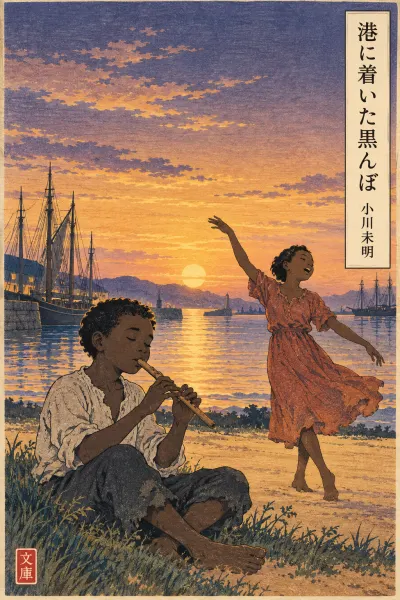
港に着いた黒んぼ Minato ni Tsuita Kuronbo, part 4: The Swan and the Blind Boy's Flute
In this part
A grieving swan who has lost her child is flying south when she hears the boy's sorrowful flute in the dark square. She offers to care for him in place of his sister, turns him into a white bird, and the two fly away together into the night. When the sister returns from the rich man's house, she finds only evening primroses and a jewel shining on her collar, and from then on she wanders the harbour town barefoot, searching for him in vain.
AI translation · independently checked
ちょうど、ここに一羽の白鳥があって、北の海で自分の子供をなくして、心を傷めて、南の方へ帰る途中でありました。Just then there happened to be a swan here. She had lost her child in the northern sea, and with an aching heart she was on her way back to the south.
白鳥は黙って、山を越え、森を越え、河を越えて、青い、青い海を遠く後にして、南の方をさして旅をしていました。In silence the swan crossed mountains, crossed forests and crossed rivers, and leaving the blue, blue sea far behind her, she journeyed on toward the south.
白鳥は疲れると流れの辺に降り、翼を休めて、また旅に上りました。Whenever she grew tired, the swan would come down beside a stream, rest her wings, and then set out on her journey once more.
かわいい子供をなくして、白鳥は、歌う気にもなれなかったのです。Having lost her darling child, the swan could not even bring herself to sing.
ただ、黙って暗い夜を、星の下を駆けていました。She only sped on in silence through the dark night, beneath the stars.
白鳥は、ふと、悲しい笛の音をききました。All at once the swan heard the sad sound of a flute.
それは、普通の人の吹く笛の音色とは思われない。It did not seem like the sound of a flute played by any ordinary person.
なんでも胸になやみのあるものが、はじめてこんな笛の音色を出し得ることを白鳥は知りました。The swan knew that only someone with a troubled heart could ever bring forth such a sound from a flute.
白鳥は、子供をなくして、しみじみと悲しみを味わっていましたから、その笛の音色をくみとることができたのです。Because the swan had lost her child and had tasted sorrow to the full, she could understand the feeling in that flute's song.
白鳥は、その目に見えない細い糸の、切れては、また、つづくような、悲しい音色がどこから聞こえてくるかと翼をゆるやかに刻んで、しばらくは夜の空をまわっていましたが、やがて、広場から起こることを知りました。The sad melody was like a fine, invisible thread that broke off and then ran on again. Wondering where it was coming from, the swan beat her wings slowly and circled the night sky for a while, until at last she found that it rose from the square.
白鳥は、注意深くその広場に降りたのであります。The swan came down carefully into the square.
そして、そこに、一人の少年が草の上にすわって、笛を吹いているのを見ました。And there she saw a boy sitting on the grass, playing a flute.
白鳥は、少年に近づきました。The swan drew near to the boy.
「どうして、こんなところに、たった一人で笛を吹いているのですか。」とたずねました。"Why are you playing your flute in a place like this, all alone?" she asked.
盲目の少年は、やさしい声で、だれかこうしんせつに聞いてくれましたので、少年は、姉が自分をここに置いて、どこへかいってしまったことをありのままに告げました。Because someone had asked him so kindly, in such a gentle voice, the blind boy told her plainly how his sister had left him here and gone off somewhere.
「ほんとうに、かわいそうに。わたしが、姉さんにかわってめんどうを見てあげます。わたしは、子供をなくした白鳥です。"Oh, you poor thing. I will look after you in your sister's place. I am a swan who has lost her child.
これから、あちらの遠い国へ帰ろうと思っています。二人は、南の国へいって、波の穏やかな岸辺で笛を吹いたり、踊ったりして送りましょう。I am going back now to a faraway land over there. Let the two of us go to the southern land and pass our days on a shore where the waves are gentle, playing the flute and dancing.
わたしは、いまあなたをわたしとおなじ白い鳥の姿にしてあげます。海を越え、山を越えてゆくのですから……。」と、白鳥はいいました。Now I will give you the shape of a white bird, just like mine. For we must cross seas and cross mountains…" said the swan.
ついに、盲目の少年は、白い鳥となりました。And so at last the blind boy became a white bird.
夜のうちに、二羽の白鳥は、このさびしい、暗い広場から飛びたって、ほんのりと明るく、空を染めた港を見下ろしながら、その上を過ぎて、遠くいずこへとなく、消え去ってしまったのであります。While it was still night, the two swans flew up from that lonely, dark square. Looking down on the harbour, whose lights tinged the sky with a faint glow, they passed over it and vanished far away, to no one knows where.
後には、空に星が輝いていました。Behind them, the stars shone in the sky.
大地は黒く湿って、草木は音なく眠っていました。The earth lay dark and damp, and the grass and trees slept without a sound.
姉は、それから程経て、大尽の屋敷からもどってきました。Some while after that, the sister came back from the rich man's mansion.
思ったより、たいへんに時間がたったので、弟はどうしたろうと心配してきたのであります。Far more time had passed than she had expected, and she had hurried back worrying about what had become of her brother.
けれど、そこには、弟の姿が見えませんでした。But her brother was nowhere to be seen.
どこを探ねても見えませんでした。Wherever she searched, she could not find him.
星の光が、かすかに地の上を照らしています。The starlight faintly lit the ground.
そこには、いままで目に入らなかった月見草が、かわいらしい花を開いていました。There, evening primroses that she had not noticed until then had opened their lovely flowers.
そして、これもいままで見なかった、姉の青い着物のえりに、宝石が星の光に射られて輝いていました。And on the collar of the sister's blue kimono — this too was something never seen before — a jewel glittered, struck by the light of the stars.
明くる日から、姉は、狂人のようになって、すはだしで港の町々を歩いて、弟を探しました。From the next day on, the sister went barefoot through the streets of the harbour town like a woman out of her mind, searching for her brother.
月の光が、しっとりと絹糸のように、空の下の港の町々の屋根を照らしています。The moonlight, soft as silk thread, shone on the roofs of the harbour streets beneath the sky.
そこの、果物屋には、店頭に、遠くの島から船に積んで送られてきた、果物がならんでいました。At the fruit shop there, fruit that had been loaded onto ships and sent from a faraway island was laid out at the front of the shop.
それらの果物の上にも、月の光が落ちるときに、果物は、はかない香りをたてていました。When the moonlight fell on that fruit too, it gave off a faint, fleeting fragrance.
また、酒場では、いろいろの人々が集まって、唄をうたったり、酒を飲んだりして笑っていました。And in the bar, all sorts of people had gathered and were laughing, singing songs and drinking.
その店頭のガラス戸にも、月の光はさしています。The moonlight shone on the glass door at the front of that place as well.
また、港にとまっている船の旗の揺れている、ほばしらの上にも月の光は当たっています。And it fell, too, on the tops of the masts where flags fluttered on the ships lying in the harbour.
波は、昔からの、物憂い調子で、浜に寄せては返していました。The waves, in the same weary rhythm they had always kept, rolled up onto the beach and drew back again.
Vocabulary
| Word | Meaning | JLPT |
|---|---|---|
| 途中とちゅう | on the way, partway through a journey〜へ帰る途中 = on the way back to … | N4 |
| 辺ほとり | side, bank (of a stream or pond)Literary word. The same kanji is also read へん (area, vicinity). | N1 |
| 翼つばさ | wing | N3 |
| 音色ねいろ | tone, timbre; the sound of an instrument音 is read ね in poetic words such as 笛の音 (sound of a flute) and 音色. | N1 |
| しみじみとしみじみ | deeply, keenly, from the heartdictionary form: しみじみDescribes a feeling that soaks in slowly and deeply. | N2 |
| くみとるくみとる | to sense or understand (someone's feelings)dictionary form: 汲み取るLiterally 'to scoop up' water; used figuratively for grasping unspoken feelings. | — |
| 盲目めくら | blindめくら is now considered discriminatory; today 目の不自由な人 is used, and 盲目 is normally read もうもく. The story's title word 黒んぼ, an old word for a dark-skinned person, is likewise offensive and no longer used. | — |
| ありのままありのまま | just as it is; plainly, truthfully | N1 |
| 程経てほどへる | after some time has passeddictionary form: 程経るOld-fashioned literary expression. | — |
| 大尽だいじん | a very rich manOld-fashioned word; お大尽 is also used. | — |
| 月見草つきみそう | evening primroseLiterally 'moon-viewing plant'; its flowers open in the evening. | — |
| 狂人きちがい | a mad person (here: like a woman out of her mind)きちがい is strongly offensive today and should not be used. 狂人 is normally read きょうじん. | — |
| すはだしすはだし | completely barefootdictionary form: 素裸足An emphatic form of はだし (barefoot). | — |
| 物憂いものうい | weary, languid, melancholyLiterary adjective. | — |
Grammar
〜気にもなれない N3 cannot even feel like doing ~
〜気になる means 'to feel like doing'. The potential negative なれない with も stresses that the swan could not even bring herself to sing.
かわいい子供をなくして、白鳥は、歌う気にもなれなかったのです。
Having lost her darling child, the swan could not even bring herself to sing.
〜得る(うる) N2 can ~, be able to ~
Added to the masu-stem, 得る expresses possibility in a formal, written style. 出し得る means 'can bring forth'.
はじめてこんな笛の音色を出し得ることを白鳥は知りました。
The swan knew that only then could such a sound be brought forth from a flute.
〜ては、また〜 N2 ~ and then ~ again (repeated action)
The te-form plus は, followed by また, describes two actions that keep alternating. Here the thread of sound breaks off and then continues, over and over. 寄せては返す in the last sentence works the same way.
切れては、また、つづくような、悲しい音色
a sad melody that seemed to break off and then go on again
〜てあげます N4 do ~ for someone
The swan offers kindness to the boy: めんどうを見てあげます (I will look after you) and 姿にしてあげます (I will give you the shape of a bird).
わたしが、姉さんにかわってめんどうを見てあげます。
I will look after you in your sister's place.
〜たり〜たりする N4 do things such as ~ and ~
This lists example activities without giving a complete list. Here it describes how the swan and the boy will spend their days.
波の穏やかな岸辺で笛を吹いたり、踊ったりして送りましょう。
Let us pass our days on a shore where the waves are gentle, playing the flute and dancing.
〜てしまったのであります N4 ended up ~ / ~ completely (with finality)
てしまう shows that the action is complete and cannot be undone, often with a sense of loss. The old-fashioned narrative のであります gives the sentence a solemn, storytelling tone.
遠くいずこへとなく、消え去ってしまったのであります。
they vanished far away, to no one knows where.