Advanced · JLPT N1
桃太郎Momotarō — The Boy from the Peach
- JLPT N1
- 4,390 characters
- 6 parts
- about 37 minutes
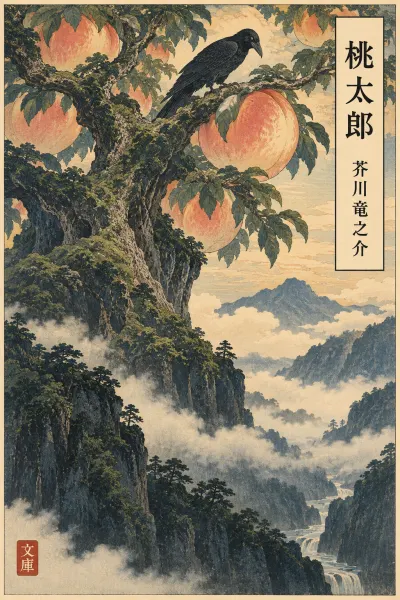
Akutagawa's 桃太郎 is a satirical retelling of the folk tale every Japanese child knows: a boy born from a peach sets out with a dog, a monkey and a pheasant to conquer the island of the oni. Akutagawa wraps it in a mythic frame, with a giant peach tree that fruits once in ten thousand years and Fate appearing as the crow Yatagarasu. His hero's motives are far from noble. Momotarō goes to war because he dislikes honest work and pays his followers in half-dumplings. On Onigashima he finds not monsters but a peaceful, pleasure-loving people. The tale is told by an ironic first-person narrator, writing in 1924, who stops to question the old legends and compare the ancient capital to Ginza. The humour is dry, the satire is pointed, and the middle of the story turns violent. The main challenge for learners is the register. The narration uses dense Sino-Japanese vocabulary in a mock-solemn way, along with classical negatives like 〜ぬ. The dialogue ranges from Momotarō's curt commands to the oni chief's stiff, old-fashioned keigo. The six parts are short, and knowing the original folk tale makes the parody easy to follow.
Contents
Before you read
- Separate the narrator's voice from the story. The first-person commentary uses hedges and asides such as 〜かも知れない, 〜ようである, 〜はいうを待たない ('it goes without saying') and 〜までもあるまい ('there is hardly any need to…'). Much of the irony sits in these phrases.
- Expect classical and archaic negatives. 〜ぬ means 〜ない, 参りませぬ means 参りません, and 〜まい means 'probably not' or 'there's no need'. They are frequent in the oni chief's and the dog's humble speech (でございます, 致します, わたくしども).
- Use speech style to tell speakers apart. Momotarō speaks in lordly plain commands with 貴様 and 〜ぞ. The oni grandmother uses warm colloquial speech. The animals and the oni chief are stiffly deferential.
- Learn the folk-tale vocabulary first, because it carries the plot: 鬼 (oni), 鬼が島, 征伐 (punitive conquest), 家来 (retainer), 黍団子 (millet dumpling), 宝物 (treasure), 人質 (hostage) and 打出の小槌 (magic mallet).
- Read part 3 slowly. It is an essay-like digression on oni legends (酒顛童子, 茨木童子, 羅生門), with dense grammar such as のみならず and 〜にさえ. It also sets up the satirical reversal of part 4. The name glossary helps here.
Words to know
The most useful words from the notes across the story.
| Word | Meaning | JLPT |
|---|---|---|
| 奥おく | the deep interior; the far depths (of mountains, a house, etc.)山の奥 is a set phrase for 'deep in the mountains'. | N3 |
| 家来けらい | retainer, vassal, follower | N1 |
| 人質ひとじち | hostage質 here is read じち (rendaku of しち, 'pledge'). | N1 |
| 孕んではらむ | to carry (a child) inside; to be pregnant withdictionary form: 孕むLiterary. Also used figuratively: 危険を孕む, 'to be fraught with danger'. | — |
| 累々るいるい | in heaps; piled up thickly, one after anotherLiterary adverb, used with と. | — |
| 谷川たにがわ | a mountain stream; a river in a valleyRendaku: たに + かわ → たにがわ. | — |
| 征伐せいばつ | subjugation; punitive expeditionA grand, official-sounding word, used here with mock solemnity. | — |
| 鬼おに | oni; horned ogre or demon of Japanese folkloreKept as 'oni' because 'demon' or 'ogre' does not quite fit. Oni are horned, often red or blue, and are traditionally villains in folk tales. | N3 |
| 破ったやぶる | to break through, to piercedictionary form: 破るThe basic meaning is 'to tear' or 'to break'. Here the tree is so tall it pierces the clouds. | N3 |
| 実み | fruit (on a plant)実をつける means 'to bear fruit'. When the kanji stands alone in this sense it is read み, not じつ. | N3 |
| 姿すがた | figure, form, appearance姿を現す (to show oneself) is a set phrase meaning 'to appear'. | N3 |
| 算盤そろばん | abacus算盤を取る/はじく = to calculate gains and losses; here it shows Momotarō's stinginess. | N2 |
| 拵えたりこしらえる | to make, to put togetherdictionary form: 拵えるA slightly old-fashioned, colloquial alternative to 作る. | N2 |
| 饑えたうえる | to starve, be famisheddictionary form: 饑えるUsually written 飢える today; 饑 is an older variant kanji. | N2 |
| 口惜しそうくやしい | vexed, indignantdictionary form: 口惜しいOlder spelling of 悔しい. | N2 |
Plot summary
Show the full summary (contains spoilers)
A giant peach tree in the mountains bears a baby inside each fruit once every ten thousand years. Fate, in the form of the crow Yatagarasu, knocks one peach into a stream, and it floats down to the old woman washing clothes. Once grown, Momotarō sets off to conquer Onigashima because he hates work. His relieved foster parents equip him, and he hires a quarrelsome dog, monkey and pheasant for half a dumpling each. Onigashima turns out to be a peaceful tropical island, yet Momotarō's band massacres its people. The chief surrenders his treasure and his children. When he asks what wrong the oni did, Momotarō gives no real answer. Back home, the triumph sours. The hostage child kills the pheasant and escapes, the monkey is murdered, oni raid the house, and young oni plot independence with coconut bombs. In the mountains, the peach tree waits for the crow's return.
About the author
Akutagawa Ryūnosuke (1892–1927) was one of the most important writers of modern Japanese short fiction. Born in Tokyo, he studied English literature at Tokyo Imperial University, and his early story 鼻 (The Nose) won praise from Natsume Sōseki. Many of his works retell older Japanese and Chinese tales with modern psychological insight, including 羅生門 (Rashōmon) and 藪の中 (In a Grove), which later inspired Kurosawa Akira's film Rashomon. He died by suicide at the age of 35. The Akutagawa Prize was named in his honour by his friend Kikuchi Kan.