Part 6 of 6 · JLPT N1
桃太郎(六) Momotarō, part 6: The Tree Still Bears Its Fruit
In this part
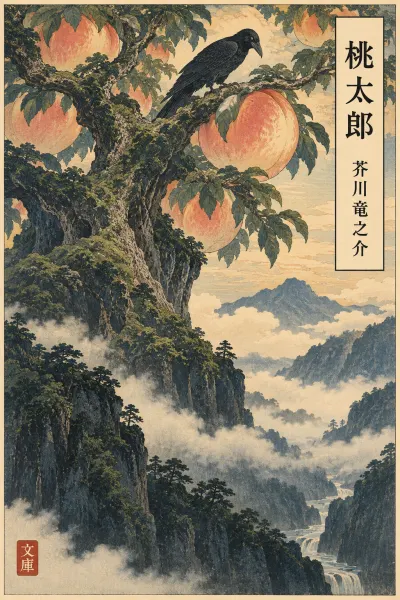
Deep in the mountains, the peach tree still bears countless fruit, just as it always has. Only the peach that held Momotarō is gone, swept away long ago by the mountain stream. Unknown numbers of future geniuses still sleep inside the remaining fruits, and the narrator wonders when the great crow Yatagarasu will appear at the top of the tree again.
AI translation · independently checked
人間の知らない山の奥に雲霧を破った桃の木は今日もなお昔のように、累々と無数の実をつけている。Deep in mountains no human knows, the peach tree that pierced the clouds and mist still bears, today as in days of old, countless fruit hanging in heavy clusters.
勿論桃太郎を孕んでいた実だけはとうに谷川を流れ去ってしまった。Of course, the one fruit that once held Momotarō in its womb floated away down the mountain stream long ago.
しかし未来の天才はまだそれらの実の中に何人とも知らず眠っている。Yet within those fruits the geniuses of the future still lie sleeping, in numbers no one can tell.
あの大きい八咫鴉は今度はいつこの木の梢へもう一度姿を露わすであろう?When, one wonders, will that enormous Yatagarasu appear once more among the topmost branches of this tree?
ああ、未来の天才はまだそれらの実の中に何人とも知らず眠っている。Ah, within those fruits the geniuses of the future still lie sleeping, in numbers no one can tell.
…………
(大正十三年六月)(June, Taishō 13)
Vocabulary
| Word | Meaning | JLPT |
|---|---|---|
| 奥おく | the depths, the innermost part山の奥 means the remote heart of the mountains. | N3 |
| 雲霧くもきり | clouds and mistAlso read うんむ. A poetic compound of 雲 (cloud) and 霧 (mist). | — |
| 破ったやぶる | to break through, to piercedictionary form: 破るThe basic meaning is 'to tear' or 'to break'. Here the tree is so tall it pierces the clouds. | N3 |
| 累々るいるい | in heaps, piled one on anotherA literary word. It is used with と to describe many things clustered together. | — |
| 無数むすう | countless, innumerable | N2 |
| 実み | fruit (on a plant)実をつける means 'to bear fruit'. When the kanji stands alone in this sense it is read み, not じつ. | N3 |
| 孕んでいたはらむ | to carry (a child) in the womb, to be pregnant withdictionary form: 孕むA literary word, used here half-solemnly for a peach 'pregnant' with the hero. | — |
| とうにとうに | long ago, long sinceA slightly old-fashioned adverb, often written 疾うに. It means the same as とっくに. | — |
| 谷川たにがわ | mountain stream, valley riverThe が is voiced by rendaku: たに + かわ becomes たにがわ. | — |
| 天才てんさい | genius, prodigy | N1 |
| 梢こずえ | treetop, the tips of the branches | N1 |
| 姿すがた | figure, form, appearance姿を現す (to show oneself) is a set phrase meaning 'to appear'. | N3 |
| 露わすあらわす | to show, to reveal (older spelling of 現す; 姿を露わす = to appear)This is an older way of writing the verb. Today it is usually written 現す or 表す. | — |
Grammar
Nの + verb (の as subject marker in a modifying clause) N4 the N that someone does / that is done by someone
Inside a clause that modifies a noun, the subject can be marked with の instead of が. 人間の知らない describes 山の奥 as 'that humans do not know'.
人間の知らない山の奥に
deep in mountains no human knows
今もなお / 今日もなお N2 even now, still
なお adds the sense that something continues unchanged. Combined with 昔のように, it stresses that nothing about the tree has changed since ancient times.
今日もなお昔のように、累々と無数の実をつけている
still bears, today as in days of old, countless fruit hanging in heavy clusters
〜てしまう N4 to have done completely / to have gone for good
This form marks an action as finished and beyond undoing. Combined with 流れ去る ('flow away'), it says the peach is gone for good.
とうに谷川を流れ去ってしまった
floated away down the mountain stream long ago
〜とも知らず N1 without anyone knowing (how many, what, etc.)
This is a literary pattern built from a question word + とも + 知らず (the classical negative of 知る). 何人とも知らず means 'how many, no one knows', so an unknown and possibly vast number.
未来の天才はまだそれらの実の中に何人とも知らず眠っている
within those fruits the geniuses of the future still lie sleeping, in numbers no one can tell
〜であろう N2 will probably…; I wonder…
であろう is the written, formal form of だろう. Here it follows a question word (いつ) and gives the narrator's wondering question a solemn, rhetorical tone.
今度はいつこの木の梢へもう一度姿を露わすであろう?
When, one wonders, will it appear once more among the topmost branches of this tree?