Part 1 of 6 · JLPT N1
桃太郎(一) Momotarō, part 1: The Great Peach Tree Deep in the Mountains
In this part
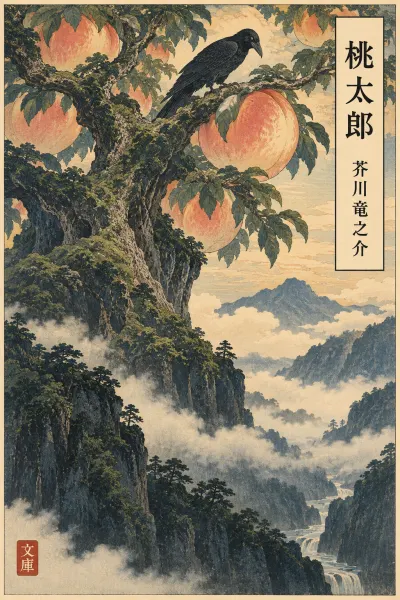
Deep in the mountains stands an enormous peach tree that, since the dawn of the world, has flowered and borne fruit once every ten thousand years, each peach carrying a beautiful baby where its stone should be. One lonely morning, Fate takes the form of a Yatagarasu and pecks one small peach loose, and it falls into a mountain stream far below. The stream carries it toward the land of humans, where, as every Japanese child knows, an old woman is washing clothes.
AI translation · independently checked
むかし、むかし、大むかし、ある深い山の奥に大きい桃の木が一本あった。Long, long ago, in the very distant past, there stood a great peach tree deep within some remote mountains.
大きいとだけではいい足りないかも知れない。Perhaps merely calling it "great" does not say enough.
この桃の枝は雲の上にひろがり、この桃の根は大地の底の黄泉の国にさえ及んでいた。The branches of this peach spread out above the clouds, and its roots reached down even to the Land of the Dead at the very bottom of the earth.
何でも天地開闢の頃おい、伊弉諾の尊は黄最津平阪に八つの雷を却けるため、桃の実を礫に打ったという、――その神代の桃の実はこの木の枝になっていたのである。It is said that around the time when heaven and earth were first parted, Izanagi no Mikoto hurled peaches like stones at Yomotsu Hirasaka to drive back the eight thunders, and those peaches of the age of the gods had grown on the branches of this very tree.
この木は世界の夜明以来、一万年に一度花を開き、一万年に一度実をつけていた。Since the dawn of the world, this tree had flowered once every ten thousand years and borne fruit once every ten thousand years.
花は真紅の衣蓋に黄金の流蘇を垂らしたようである。Its blossoms looked like crimson canopies hung with tassels of gold.
実は――実もまた大きいのはいうを待たない。As for its fruit, it hardly needs saying that the fruit too was enormous.
が、それよりも不思議なのはその実は核のあるところに美しい赤児を一人ずつ、おのずから孕んでいたことである。But stranger still, each peach, of its own accord, carried a beautiful baby where the stone should be.
むかし、むかし、大むかし、この木は山谷を掩った枝に、累々と実を綴ったまま、静かに日の光りに浴していた。Long, long ago, in the very distant past, this tree basked quietly in the sunlight, its fruit strung thick along branches that overspread the mountains and valleys.
一万年に一度結んだ実は一千年の間は地へ落ちない。Fruit that set once every ten thousand years did not fall to the ground for a thousand years.
しかしある寂しい朝、運命は一羽の八咫鴉になり、さっとその枝へおろして来た。But one lonely morning, Fate became a Yatagarasu and swooped down onto those branches.
と思うともう赤みのさした、小さい実を一つ啄み落した。No sooner had it landed than it pecked loose one small fruit, already flushed with red.
実は雲霧の立ち昇る中に遥か下の谷川へ落ちた。Amid rising clouds and mist, the fruit fell to a mountain stream far below.
谷川は勿論峯々の間に白い水煙をなびかせながら、人間のいる国へ流れていたのである。The stream, of course, trailing white spray between the peaks, flowed on toward the land where humans live.
この赤児を孕んだ実は深い山の奥を離れた後、どういう人の手に拾われたか?Once it had left the depths of those mountains, what sort of person picked up this fruit with a baby inside?
――それはいまさら話すまでもあるまい。There is surely no need to tell that story now.
谷川の末にはお婆さんが一人、日本中の子供の知っている通り、柴刈りに行ったお爺さんの着物か何かを洗っていたのである。At the lower end of the stream, as every child in Japan knows, an old woman was washing the clothes, or something of the sort, of an old man who had gone off to gather firewood.
…………
Vocabulary
| Word | Meaning | JLPT |
|---|---|---|
| 奥おく | the deep interior; the far depths (of mountains, a house, etc.)山の奥 is a set phrase for 'deep in the mountains'. | N3 |
| いい足りないいいたりない | to fall short of saying enough; to understatedictionary form: 言い足りない言う + 足りない (be insufficient). Here 言う is written in kana as いい. | — |
| 及んでおよぶ | to reach; to extend (as far as)dictionary form: 及ぶFormal. Also common in the expression 〜に及ばない, 'there is no need to'. | N1 |
| 却けるしりぞける | to drive back; to repeldictionary form: 退けるUsually written 退ける; 却 is an older spelling. | N1 |
| 礫つぶて | a thrown stone; a missile〜を礫に打つ means to throw something as if it were a stone. | — |
| 神代かみよ | the age of the gods (mythical prehistory of Japan) | — |
| 孕んではらむ | to carry (a child) inside; to be pregnant withdictionary form: 孕むLiterary. Also used figuratively: 危険を孕む, 'to be fraught with danger'. | — |
| 赤児あかご | a baby; an infantdictionary form: 赤子Old-fashioned; the everyday word is 赤ちゃん. | — |
| 累々るいるい | in heaps; piled up thickly, one after anotherLiterary adverb, used with と. | — |
| 浴してよくする | to bathe in; to bask in (light, favour)dictionary form: 浴するFormal equivalent of 浴びる. | — |
| 運命うんめい | fate; destiny | N1 |
| 啄みついばむ | to peck (as a bird does)dictionary form: 啄むHere combined with 落とす: 啄み落とす, 'to peck something so that it falls'. | — |
| 谷川たにがわ | a mountain stream; a river in a valleyRendaku: たに + かわ → たにがわ. | — |
| 柴刈りしばかり | gathering brushwood for firewoodA key phrase from the traditional Momotarō tale: the old man goes to 柴刈り while the old woman washes clothes in the river. | — |
Grammar
〜かも知れない N4 may; might; perhaps
Attached to a plain form, it marks a possibility the speaker is unsure of. The narrator uses it to playfully hedge his own description.
大きいとだけではいい足りないかも知れない。
Perhaps merely calling it "great" does not say enough.
〜にさえ N3 even (to/at)
さえ stresses that something extends to an extreme or unexpected case. Here it follows the particle に to say the roots reached even as far as the underworld.
この桃の根は大地の底の黄泉の国にさえ及んでいた。
Its roots reached down even to the Land of the Dead at the very bottom of the earth.
〜ようである N4 looks like; is like
This is the written, de aru form of 〜ようだ, used for comparisons and resemblances. It follows a plain-form clause, here 〜を垂らした.
花は真紅の衣蓋に黄金の流蘇を垂らしたようである。
Its blossoms looked like crimson canopies hung with tassels of gold.
〜はいうを待たない N1 it goes without saying that…
This is a stiff literary set phrase meaning 'it need not wait to be said'. The modern equivalent is 〜は言うまでもない. Its solemnity adds to the mock-heroic tone.
実もまた大きいのはいうを待たない。
It hardly needs saying that the fruit too was enormous.
〜と思うと N2 no sooner than…; the moment that…
This pattern describes a second action that follows the first almost immediately. Here the sentence opens with と思うと, so the first action is the crow swooping down in the previous sentence.
と思うともう赤みのさした、小さい実を一つ啄み落した。
No sooner had it landed than it pecked loose one small fruit, already flushed with red.
〜までもあるまい N2 there is surely no need to…
〜までもない means 'there is no need to go so far as to…'. Replacing ない with the literary negative conjecture まい softens it to 'surely there is no need'.
それはいまさら話すまでもあるまい。
There is surely no need to tell that story now.