 N5 · easy
Simplified retelling · JLPT N5
虫の生命 Mushi no Seimei in easy Japanese (N5)
This is our own simplified retelling of The Charcoal Burner's First Dream, written for N5 learners and checked word by word against the N5 vocabulary list. A few story words and grammar patterns go beyond N5; the notes below give each one's level. It keeps the characters, events and ending of the original. When it feels easy, move on to the N4 version or the original text.
The story in brief
A lonely charcoal burner named Kantarō dreams on the first night of the New Year that a princess is singing for the tiny insects that die in his kiln. He searches the wood, finds one log with a small hole, carries it far into the mountains, and then gets lost and dies on the road in spring. He wakes as a god among heavenly maidens, the insects he saved, but at his old hut he meets a double of himself who ignored the dream and goes on burning charcoal.
AI translation · independently checked
山に、男が一人いました。In the mountains, there lived a man all by himself.
名前はかんたろうです。His name was Kantarō.
かんたろうは、毎日山ですみをつくっていました。Every day, Kantarō made charcoal in the mountains.
かぞくはいません。He had no family.
いつも一人で、かまのけむりを見ていました。He was always alone, watching the smoke from his kiln.
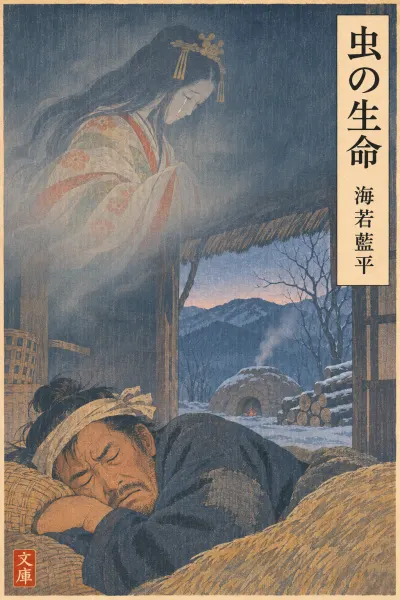
あたらしい年のはじめの夜、かんたろうはゆめを見ました。On the first night of the new year, Kantarō had a dream.
小さいこえのうたです。It was a song, sung in a small voice.
「わたしたちは、木の中にすんでいます。人は木をかまに入れます。小さいむしは、みんなしにます。だれが、わたしたちを見ますか。」"Within the wood we make our home; / men put the wood into the kiln. / The little insects, one and all, will die. / Who, then, will look upon us?"
くらい中に、きれいなおひめさまが一人たっていました。In the darkness stood a beautiful princess, all alone.
おひめさまは、小さいこえでうたっていました。The princess was singing in a small voice.
かんたろうはおきました。Kantarō woke up.
ゆめでした。It had been a dream.
外はもうあさで、ゆきがたくさんふっていました。Outside it was already morning, and a lot of snow was falling.
かまの中には、木がたくさんあります。Inside the kiln there was a lot of wood.
かんたろうは、ゆめのうたをわすれませんでした。Kantarō did not forget the song from his dream.
「木の中に、むしがいるでしょう。」"There must be insects inside the wood."
かんたろうは、かまをあけました。Kantarō opened the kiln.
木を一本ずつ出して、よく見ました。He took the logs out one at a time and looked at each one carefully.
でも、むしのあなはありませんでした。But there were no insect holes.
「ああ、これではすみができない。」"Oh, at this rate I won't be able to make any charcoal."
いちばん後に、大きな木が一本ありました。At the very end, there was one big log.
その木に、小さなあなが一つありました。In that log there was one small hole.
かんたろうは、その木をもって、山の中をたくさんあるきました。Kantarō picked up that log and walked a long way through the mountains.
そして、人がいない所に木をおきました。Then he set the log down in a place where no people lived.
「はるに、むしは外に出て、ちょうになるでしょう。」"In spring the insects will come out and turn into butterflies."
かんたろうは、もうすみをつくりたくありませんでした。Kantarō no longer wanted to make charcoal.
でも、ほかのしごとをしりません。But he knew no other work.
かえるみちで、かんたろうはみちがわからなくなりました。On the way home, Kantarō lost his way.
山はどこもおなじです。Every part of the mountains looked the same.
食べものもありません。He had no food, either.
ゆきがふって、さむいかぜがふきました。Snow fell, and a cold wind blew.
かんたろうは、山のものをすこし食べて、あるきました。Kantarō ate a little of what he found in the mountains and kept walking.
とても大へんでした。It was very hard.
はるが来ました。Spring came.
かぜはあたたかくなって、とりがないていました。The wind grew warm, and birds were singing.
でも、かんたろうはとてもつかれていました。But Kantarō was very tired.
かんたろうはみちにねて、もうおきませんでした。Kantarō lay down on the road and did not get up again.
どこかで、うたが聞こえます。Somewhere, a song could be heard.
「小さなむしをたすけても、大きな動物をたすけても、おなじです。むしをたすける人は、かみさまとおなじです。」"To save a little insect, / or save a mighty beast, it is the same. / The one who saves an insect / is the equal of a god."
かんたろうは目をあけました。Kantarō opened his eyes.
きれいなベッドの上にねていました。He was lying on a beautiful bed.
そばに、きれいな天女が大勢いました。Beside him were many beautiful heavenly maidens.
あのゆめのおひめさまも、たっていました。The princess from that dream was standing there too.
かんたろうのあたまは白くなっていました。Kantarō's hair had turned white.
大きな白いふくをきていました。He was wearing large white clothes.
大へんだった山のみちも、ぜんぶわすれました。He had forgotten all about the hard mountain roads, too.
「かみさまがおきました。」"The god has woken up."
天女たちは、みんなかんたろうの前にすわりました。All the heavenly maidens sat down before Kantarō.
かんたろうは、かみさまになりました。Kantarō had become a god.
もう食べものはいりません。He no longer needed food.
毎日、天女たちのたのしいはるのうたを聞きました。Every day he listened to the maidens' happy songs of spring.
はるのあさ、かんたろうは天女たちと外にとんで出ました。One spring morning, Kantarō flew outside with the heavenly maidens.
後ろを見ました。He looked back.
みんなの家は、あの大きな木の、小さなあなでした。Their home had been the small hole in that big log.
かんたろうは、前の家に行きました。Kantarō went to his old home.
そこには、前とおなじ家とかまがありました。There stood the same house and kiln as before.
家から、男が一人出て来ました。A man came out of the house.
前のかんたろうとおなじ男で、ふくもおなじでした。He was the same man as the old Kantarō, and even his clothes were the same.
男は、かみさまのかんたろうを見て、いいました。The man looked at Kantarō the god and spoke.
「ああ、ちょうがたくさん来たな。年のはじめに、わたしはゆめを見た。でも、むしはたすけなかった。むしをたすける人は、山でしぬだろう。むしと人はおなじじゃない。さあ、すみをつくろう。今年の木は、むしのあながたくさんあったな。」Ah, lots of butterflies have come. I had a dream at the start of the year. But I didn't save the bugs. Anyone who saves bugs will probably die in the mountains. Bugs and people aren't the same. Well, let's make charcoal. This year's wood sure had a lot of bug holes in it.
男は、かまにひを入れました。The man lit the fire in the kiln.
くろいけむりが、そらへたくさん出ました。Thick black smoke poured up into the sky.
かみさまのかんたろうは、これがゆめか本とうか、わかりませんでした。Kantarō the god could not tell whether this was a dream or real.
Vocabulary
| Word | Meaning | JLPT |
|---|---|---|
| すみすみ | charcoaldictionary form: 炭Made by slowly burning wood in a kiln. 炭をつくる means to make charcoal. | — |
| かまかま | kiln (for making charcoal)dictionary form: 窯The same sound かま (釜) also means a cooking pot. | — |
| けむりけむり | smokedictionary form: 煙 | N3 |
| ゆめゆめ | dreamdictionary form: 夢Japanese says ゆめを見る, literally "see a dream", for "have a dream". | N4 |
| むしむし | insect, bugdictionary form: 虫Covers insects, grubs and other small creatures. | N4 |
| おひめさまおひめさま | princessdictionary form: お姫様 | — |
| あなあな | holedictionary form: 穴 | N3 |
| ちょうちょう | butterflydictionary form: 蝶 | N1 |
| つかれてつかれる | to get tireddictionary form: 疲れるつかれています means "is tired", a state that results from getting tired. | N5 |
| たすけてたすける | to save, to helpdictionary form: 助けるUsed here for rescuing a life. | N3 |
| かみさまかみさま | god, a deitydictionary form: 神様The polite 様 shows respect. | N2 |
| 天女てんにょ | heavenly maidenA beautiful female spirit of the heavens. 天 means sky or heaven and 女 means woman. | — |
| 大勢おおぜい | many (people), a crowdUsed only for people or beings, not for things. | N5 |
| 本とうほんとう | true, realdictionary form: 本当 | N5 |
Grammar
〜ていました N5 was doing / used to do (ongoing or habitual past)
The て-form plus いました describes an action that went on over time in the past. Here it tells us that making charcoal was Kantarō's daily habit.
かんたろうは、毎日山ですみをつくっていました。
Every day, Kantarō made charcoal in the mountains.
〜ずつ N4 … at a time, … each
ずつ follows a number and counter and means the same amount each time. 一本ずつ means one log after another.
木を一本ずつ出して、よく見ました。
He took the logs out one at a time and looked at each one carefully.
〜なくなる N4 to come to not do / no longer be able to
The negative form of a verb (〜ない) changes ない to なく and adds なる. This shows a change into a state where something is no longer the case. わからなくなりました means he reached a point where he no longer knew the way.
かえるみちで、かんたろうはみちがわからなくなりました。
On the way home, Kantarō lost his way.
〜たくありません N5 don't want to do
The verb stem plus たい means "want to". Its negative form たくない becomes たくありません in polite speech. With もう, it means he no longer wanted to.
かんたろうは、もうすみをつくりたくありませんでした。
Kantarō no longer wanted to make charcoal.
〜ても、〜ても N4 whether … or …
The て-form plus も means "even if". Using it twice shows that both choices lead to the same result, which is おなじです here.
小さなむしをたすけても、大きな動物をたすけても、おなじです。
To save a little insect, or save a mighty beast, it is the same.
〜か〜か、わかりません N4 can't tell whether … or …
Putting か after each choice turns them into an embedded question. The question is then followed by a verb such as わかる.
かみさまのかんたろうは、これがゆめか本とうか、わかりませんでした。
Kantarō the god could not tell whether this was a dream or real.