 N4 · easy
Simplified retelling · JLPT N4
虫の生命 Mushi no Seimei in easy Japanese (N4)
This is our own simplified retelling of The Charcoal Burner's First Dream, written for N4 learners and checked word by word against the N4 vocabulary list. A few story words and grammar patterns go beyond N4; the notes below give each one's level. It keeps the characters, events and ending of the original. When it feels easy, move on to the N3 version or the original text.
The story in brief
On the second day of the New Year, a lonely charcoal burner named Kantarō dreams of a crying princess and a sad song about an insect sleeping in the wood in his kiln. He empties the kiln, finds a log with an insect hole and carries it far into the mountains to keep it safe, but he gets lost and wanders through winter until he collapses. He wakes as a god in a palace inside the insect hole, and when he visits his old home he finds his own double, who scoffs at the idea of saving insects and lights the kiln.
AI translation · independently checked
むかし、山のおくに、かんたろうという男が住んでいました。Long ago, a man named Kantarō lived deep in the mountains.
かんたろうの仕事はすみやきでした。Kantarō's work was burning charcoal.
家族はいません。He had no family.
毎日かまどの前に立って、けむりを見ながら「さびしいなあ」と思っていました。Every day he stood in front of his kiln, watched the smoke, and thought, "How lonely I am."
今年も、かんたろうはかまどの中にかしの木などをいっぱい入れました。This year too, Kantarō filled his kiln with oak wood and other logs.
あとは火をつけるだけです。All that was left was to light the fire.
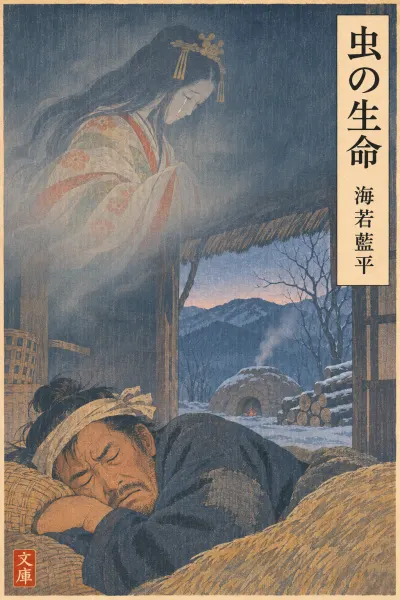
そして一月二日の朝、へんなゆめを見ました。Then, on the morning of the second day of the first month, he had a strange dream.
ゆめの中で、小さくてかなしいこえが歌っていました。In the dream, a small, sad voice was singing.
「冬の間、小さなむしは木の中で休んでいます。でも、その木はかまどに入れられて、明日はけむりになります。むしもいっしょにきえてしまいます。小さなむし一つのいのちを、だれが大切に思うでしょう。」All winter, the little insect rests inside the tree. But that tree will be put into the kiln, and tomorrow it will become smoke. The insect will vanish along with it. Who would care about the life of one little insect?
かんたろうが目を開けると、くらい中に、きれいなおひめさまが一人立っていました。When Kantarō opened his eyes, a beautiful princess was standing alone in the darkness.
おひめさまはないていました。The princess was crying.
かんたろうはびっくりして起きました。Kantarō sat up with a start.
それはゆめでした。It had been a dream.
もう朝で、外はゆきで真っ白でした。It was already morning, and outside everything was white with snow.
かんたろうは急いでかまどに火を入れようとしました。Kantarō hurried to light the fire in his kiln.
でも、ゆめのことが気になりました。But he could not stop thinking about the dream.
かまどの中には木がたくさんあります。There was a lot of wood inside the kiln.
むしがいるかもしれません。There might be an insect in it.
今日やかれることを知ったら、むしはきっとかなしいでしょう。If the insect knew it was going to be burned today, it would surely be sad.
かんたろうは、かまどをこわして、木を一本ずつ出しました。Kantarō broke open the kiln and took the logs out one by one.
そして、よく見ました。Then he looked at them carefully.
でも、むしのあなのある木は、なかなか見つかりません。But he could not easily find a log with an insect hole.
「つまらないゆめをほんとうにしてしまった。木をやかなければ、ご飯が食べられないのに」とかんたろうは思いました。"I've gone and taken a silly dream seriously. If I don't burn the wood, I can't eat," Kantarō thought.
さいごに、大きなかしのまるたが一本のこりました。In the end, one big oak log was left.
その真ん中に、小さなあなが一つありました。Right in the middle of it there was one small hole.
「これがむしの家だな」とかんたろうは思いました。"So this is the insect's home," thought Kantarō.
でも、中は見えません。But he could not see inside.
木を切ったら、中のむしが死ぬかもしれません。If he cut the log, the insect inside might die.
かんたろうはおべんとうを作って、まるたを持って出かけました。Kantarō made himself a packed lunch, picked up the log, and set out.
山のおくの、もっとおくの、人が来ないところまで行きました。He went deep into the mountains, and deeper still, to a place where no one ever came.
そして、いわの間にまるたをしずかに立てておきました。There he gently stood the log up between some rocks and left it.
「春になったら、むしは外に出て、ちょうになって、とべるだろう」と思ったからです。He did this because he thought, "When spring comes, the insect will come out, become a butterfly, and fly away."
むしはたすかりました。The insect was saved.
でも、かんたろうはもうすみやきをしたくありませんでした。But Kantarō no longer wanted to burn charcoal.
しかし、ほかの仕事は何も知りません。Yet he knew no other kind of work.
「何をしようか」と考えながら歩いていると、道がわからなくなりました。As he walked along, thinking, "What shall I do?", he lost his way.
行っても行っても山ばかりです。However far he went, there was nothing but mountains.
食べ物もありません。He had no food either.
かんたろうはくさを食べながら、家の方へ歩きました。Eating grass as he went, Kantarō walked toward home.
ゆきや雨や風の中を歩くのは、とてもたいへんでした。Walking through snow and rain and wind was very hard.
「むし一つをたすけたから、こんなことになった。へんなゆめをほんとうにしたからだ」と思って、かんたろうはなきながら歩きました。"This happened because I saved one insect. It's because I took a strange dream seriously," he thought, and he wept as he walked.
そのうちに春が来ました。Before long, spring came.
風があたたかくなって、鳥の楽しいこえが聞こえるようになりました。The wind grew warm, and the cheerful voices of birds could be heard.
でも、かんたろうはとてもつかれて、目も見えなくなりました。But Kantarō was so tired that his eyes could no longer see.
ゆっくりゆっくり歩いて、とうとうたおれてしまいました。He walked slowly, very slowly, and at last he collapsed.
すると、どこからか明るい歌が聞こえてきました。Then, from somewhere, a bright song came to his ears.
「小さなむしをたすけても、大きな動物をたすけても、いのちは一つです。どちらも、たすけた心はうつくしい。人のいのちをたすけるのは、人の心を持った人。むしのいのちをたすけるのは、かみさまの心を持った人です。」Whether you save a little insect or a large animal, a life is one life. Either way, the heart that saved it is beautiful. The one who saves a human life is a person with a human heart; the one who saves an insect's life is a person with the heart of a god.
かんたろうが目を開けると、りっぱなベッドの上にねていました。When Kantarō opened his eyes, he was lying on a splendid bed.
そばでは、おおぜいのきれいな天女がかんたろうの世話をしていました。Beside him, many beautiful heavenly maidens were taking care of him.
そして、あのゆめのおひめさまが、やさしくわらって立っていました。And the princess from that dream stood there, smiling gently.
かんたろうはびっくりして起きました。Kantarō sat up in surprise.
あたまもひげも真っ白になって、かみさまのような白い大きな着物を着ていました。His hair and beard had turned pure white, and he was wearing a large white robe like a god's.
心もきれいになって、今までのくるしいことも、かなしいことも、すっかりわすれました。His heart had become pure too, and he completely forgot all the hardship and sadness he had known until then.
天女たちは「かみさまが起きた」と言って、みんなあたまを下げました。"The god has woken up!" said the heavenly maidens, and they all bowed their heads.
かんたろうはかみさまになって、そこに住みました。Kantarō became a god and lived there.
もう食べ物のしんぱいはいりません。He no longer needed to worry about food.
毎日、天女たちの春の歌を聞いて、おどりを見て楽しみました。Every day he enjoyed listening to the maidens' spring songs and watching their dances.
ある日、かんたろうは天女たちといっしょに外へ出ました。One day, Kantarō went outside together with the heavenly maidens.
後ろを見ると、じぶんたちの家は、あの日いわの間に立てたまるたの、小さなむしのあなでした。When he looked back, he saw that their home was the little insect hole in the log he had stood between the rocks that day.
かんたろうは、まず、むかしのじぶんの家へ行ってみました。First of all, Kantarō went to have a look at his old home.
家もかまども、むかしと同じでした。The house and the kiln were just the same as before.
家から一人の男が出てきました。A man came out of the house.
むかしのかんたろうと同じかおで、同じ着物を着ていました。He had the same face as the old Kantarō and wore the same clothes.
男はかみさまのかんたろうを見て、言いました。The man looked at Kantarō the god and said:
「ああ、ちょうがたくさんとんで来たな。あのゆめをほんとうにして、むしをたすけていたら、ぼくも今ごろはちょうになっていたかもしれない。でも、その前に、ぼくは死んでいただろう。むしのいのちのために、じぶんのいのちはあげられない。さあ、火をつけよう。今年の木はむしのあなが多いようだ。」"Huh, look at all those butterflies flying in. If I'd taken that dream seriously and saved the bug, maybe I'd be a butterfly myself by now. But I'd have been dead long before that. I'm not giving up my own life for some bug. Right, time to light the fire. Looks like this year's wood has plenty of bug holes."
男はかまどに火を入れました。The man lit the fire in the kiln.
すぐに、けむりが空へ高く上がっていきました。At once, smoke rose high into the sky.
かみさまのかんたろうは、これがゆめなのか、ほんとうのことなのか、ぜんぜんわからなくなりました。Kantarō the god could no longer tell at all whether this was a dream or something real.
Vocabulary
| Word | Meaning | JLPT |
|---|---|---|
| すみやきすみやき | charcoal burning; charcoal burnerdictionary form: 炭焼き炭 (charcoal) + 焼き (burning). It can mean the work or the person who does it. | — |
| かまどかまど | kiln (for making charcoal)Usually a cooking stove, but here it means the charcoal kiln. | — |
| けむりけむり | smokedictionary form: 煙 | N3 |
| いのちいのち | lifedictionary form: 命Life as something living beings have and can lose. This is the key word of the story's title. | N3 |
| 気になりましたきになる | to be on one's mind; to bother someonedictionary form: 気になるUsed when something keeps nagging at you. | — |
| こわしてこわす | to break; to tear downdictionary form: 壊す | N4 |
| まるたまるた | logdictionary form: 丸太Literally 'round wood': a whole tree trunk. | — |
| あなあな | holedictionary form: 穴 | N3 |
| たすかりましたたすかる | to be saved; to survivedictionary form: 助かるThis is the intransitive partner of 助ける (to save someone), which appears in the same passage. | N2 |
| たおれてたおれる | to collapse; to fall downdictionary form: 倒れる | N4 |
| 天女てんにょ | heavenly maidenA beautiful female spirit from heaven in Buddhist and folk tales. 天 means heaven and 女 means woman. | — |
| 世話せわ | care; looking after〜の世話をする means 'to take care of ~'. | N4 |
| ひげひげ | bearddictionary form: 髭 | N4 |
| しんぱいしんぱい | worry; concerndictionary form: 心配 | N4 |
Grammar
〜ようとする N3 to try to do; to be about to do
This is the volitional form plus とする. It shows an action that someone starts or means to do but does not finish. Here Kantarō is about to light the kiln when the dream stops him.
かんたろうは急いでかまどに火を入れようとしました。
Kantarō hurried to light the fire in his kiln.
〜かもしれない N4 might; may
This is added to the plain form to show that something is possible but not certain. かもしれません is the polite form.
むしがいるかもしれません。
There might be an insect in it.
〜てしまう N4 to end up doing; to do completely (often with regret)
The te-form plus しまう shows that an action is finished, and it often adds a feeling of regret. Kantarō feels he has foolishly acted on a dream.
つまらないゆめをほんとうにしてしまった。
I've gone and taken a silly dream seriously.
〜ておく N4 to do something and leave it that way; to do in advance
The te-form plus おく means doing an action and leaving the result in place for later. Kantarō stands the log up and leaves it there for the insect.
いわの間にまるたをしずかに立てておきました。
He gently stood the log up between some rocks and left it.
〜ても〜ても N3 no matter how much ~; however much ~
Repeating the te-form plus も stresses that the result never changes, however often the action is done. ばかり then adds 'nothing but'.
行っても行っても山ばかりです。
However far he went, there was nothing but mountains.
〜ようになる N4 to come to (be able to) do; to begin to
This is the dictionary form or potential form plus ようになる. It describes a change into a new state. Here the birds can now be heard because spring has come.
鳥の楽しいこえが聞こえるようになりました。
The cheerful voices of birds could be heard.