 N5 · easy
Simplified retelling · JLPT N5
なめとこ山の熊 Nametokoyama no Kuma in easy Japanese (N5)
This is our own simplified retelling of Kojūrō and the Bears of Nametoko, written for N5 learners and checked word by word against the N5 vocabulary list. A few story words and grammar patterns go beyond N5; the notes below give each one's level. It keeps the characters, events and ending of the original. When it feels easy, move on to the N4 version or the original text.
The story in brief
Kojūrō, a strong hunter, kills bears to feed his family, although the bears love him and he sells their pelts cheaply to a hard-hearted storekeeper. He spares a mother bear and her cub, and later a bear who asks for two more years of life and then keeps its promise by dying at his door. In winter an old Kojūrō is killed by a great bear, and on the third night the bears gather in silence around his body, which seems to be smiling.
AI translation · independently checked
なめとこ山は大きな山です。Nametoko-yama is a big mountain.
山には、くまがたくさんいました。There were many bears on the mountain.
こじゅうろうは、くまをとるりょうしです。Kojūrō is a hunter who catches bears.
からだが大きくて、つよい男です。He is a big, strong man.
いつもきいろい犬といっしょに、山をあるきます。He always walks the mountains with his yellow dog.
山のくまたちは、こじゅうろうがすきでした。The bears of the mountain liked Kojūrō.
こじゅうろうが川をあるくとき、くまたちは木の上から、しずかに見ていました。When Kojūrō walked along the river, the bears quietly watched him from up in the trees.
でも、こじゅうろうはくまをてっぽうでうちます。But Kojūrō shoots bears with his gun.
くまがしぬと、こじゅうろうはいいます。When a bear dies, Kojūrō says this:
「くま、おれはおまえがきらいだから、ころしたのではない。これがおれのしごとだ。つぎは、くまに生まれるなよ。」"Bear, I didn't kill you because I hate you. This is my job. Next time, don't be born a bear."
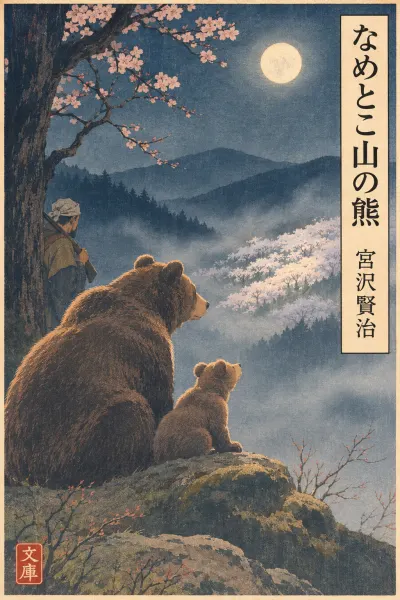
ある年のはるのよる、こじゅうろうは、くまのおかあさんと子ぐまを見ました。One spring night, Kojūrō saw a mother bear and her cub.
二ひきは月のひかりの中で、むこうの山を見ていました。The two of them were looking at the mountain across the way, in the moonlight.
子ぐまが「あの白いのは、ゆきだよ」といいました。The cub said, "That white stuff is snow."
おかあさんは「いいえ、あれは、はなですよ」といいました。The mother said, "No, those are flowers."
こじゅうろうは、てっぽうをうちませんでした。Kojūrō did not fire his gun.
しずかに山をおりました。He went quietly down the mountain.
こじゅうろうは、まちのみせへ、けがわをうりに行きます。Kojūrō goes to a shop in town to sell the pelts.
みせの人は「いりません」といいます。The man at the shop says, "I don't want them."
こじゅうろうはこまりました。Kojūrō didn't know what to do.
いえには、九十さいのおかあさんと子どもたち、七人のかぞくがいます。At home he has a family of seven, including his ninety-year-old mother and his children.
お金がいります。He needs money.
「やすくてもいいです。かってください。」みせの人は、二まいのけがわを、二円でかいました。"A low price is fine. Please buy them." The shopman bought the two pelts for two yen.
とてもやすいです。That is very cheap.
でも、こじゅうろうは、ほかの人にうることができません。But Kojūrō cannot sell to anyone else.
ある年のなつ、こじゅうろうは、木の上の大きなくまに、てっぽうをむけました。One summer, Kojūrō pointed his gun at a big bear up in a tree.
くまはおりてきて、いいました。The bear came down and spoke.
「なぜ、おれをころすのか。」「おまえのけがわがほしい。でも、本当は、おれもころしたくない。」くまはいいました。"Why are you going to kill me?" "I want your pelt. But truth is, I don't want to kill you either." The bear spoke.
「二年まってくれ。まだ、するしごとがある。二年後に、おまえのいえの前でしんでいるよ。」こじゅうろうは、うちませんでした。"Wait two years for me. I still have work to do. In two years, I'll be lying dead in front of your house." Kojūrō did not shoot.
くまは、ゆっくりあるいて行きました。The bear walked slowly away.
ちょうど二年後の朝、いえの外で、あのくまがしんでいました。Exactly two years later, one morning, that bear was lying dead outside the house.
こじゅうろうは、そっとてをあわせました。Kojūrō quietly put his hands together in prayer.
一月のある朝、こじゅうろうはおかあさんにいいました。One morning in January, Kojūrō spoke to his mother.
「おれも年をとった。今日は、はじめて、川に入るのがいやだ。」子どもたちは「はやくかえってね」とわらいました。"I've got old too. Today, for the first time, I don't want to go into the river." The children laughed and said, "Come home soon."
こじゅうろうは犬と、ゆきの山にのぼりました。Kojūrō climbed the snowy mountain with his dog.
山の上で休んでいると、犬が大きなこえでなきました。While he was resting at the top of the mountain, the dog barked loudly.
うしろから、大きなくまが来ました。A big bear came up from behind.
こじゅうろうは、てっぽうをうちました。Kojūrō fired his gun.
でも、くまはとまりません。But the bear did not stop.
こじゅうろうのあたまが、があんとなりました。Kojūrō's head rang with a great boom.
とおくで、こんなことばを聞きました。Far away, he heard these words:
「おお、こじゅうろう、ころしたくなかった。」こじゅうろうは「くまたち、ゆるしてくれ」といいました。"Oh, Kojūrō, I didn't want to kill you." Kojūrō said, "Bears, forgive me."
三日めのよる、月が白くひかっていました。On the third night, the moon was shining white.
山の上に、くろい大きなくまたちが、たくさんならんでいました。On top of the mountain, many big black bears sat in rows.
まん中の高いところに、こじゅうろうのからだがありました。In the middle, in a high place, lay Kojūrō's body.
そのかおは、わらっているようでした。His face seemed to be smiling.
くまたちはしずかにすわって、いつまでも、じっとしていました。The bears sat quietly and stayed perfectly still for a long, long time.
Vocabulary
| Word | Meaning | JLPT |
|---|---|---|
| りょうしりょうし | hunterdictionary form: 猟師Written 猟師. Don't confuse it with 漁師 (りょうし, fisherman), which sounds the same. | — |
| てっぽうてっぽう | gun, rifledictionary form: 鉄砲An older word for a firearm. Modern Japanese often says 銃 (じゅう). | N2 |
| うちますうつ | to shoot, to fire (a gun)dictionary form: 撃つIn this sense it is written 撃つ. 打つ (うつ) means 'to hit'. | N3 |
| ころしたころす | to killdictionary form: 殺す | N3 |
| けがわけがわ | fur, animal peltdictionary form: 毛皮Made from 毛 (hair) + 皮 (skin). The か becomes が in this compound. | N2 |
| こまりましたこまる | to be in trouble, to not know what to dodictionary form: 困る | N5 |
| いりますいる | to needdictionary form: 要るIt is a godan verb, so it conjugates いります / いりません. Don't mix it up with いる 'to exist'. | N5 |
| むけましたむける | to point (something) at, to aimdictionary form: 向ける | N3 |
| てをあわせましたてをあわせる | to put one's palms together (in prayer)dictionary form: 手を合わせるThis is a gesture of prayer or respect, often made for the dead. | — |
| 年をとったとしをとる | to grow olddictionary form: 年を取る | — |
| ゆるしてゆるす | to forgivedictionary form: 許す | N3 |
| ならんでならぶ | to line up, to stand or sit in a rowdictionary form: 並ぶ | N5 |
| じっとじっと | motionless, perfectly stillIt is often used as じっとする, meaning 'to keep still'. | N3 |
Grammar
〜とき N5 when ~
A plain-form verb before とき tells you when the main action happens. Here Kojūrō's walking is the moment at which the bears watch him.
こじゅうろうが川をあるくとき、くまたちは木の上から、しずかに見ていました。
When Kojūrō walked along the river, the bears quietly watched him from up in the trees.
〜と (natural result) N4 when / whenever ~
A dictionary-form verb + と means that whenever the first thing happens, the second thing follows. Every time a bear dies, Kojūrō speaks to it.
くまがしぬと、こじゅうろうはいいます。
When a bear dies, Kojūrō says this:
〜に行く (purpose) N5 go (somewhere) to do ~
Take the verb's ます-stem (うります → うり), then add に and a movement verb. This shows the purpose of the trip: to sell.
こじゅうろうは、まちのみせへ、けがわをうりに行きます。
Kojūrō goes to a shop in town to sell the pelts.
〜てもいい N5 ~ is okay / it's fine even if ~
For an い-adjective, drop い and add くても. Then add いい. Kojūrō says that even a cheap price is acceptable to him.
「やすくてもいいです。かってください。」
"A low price is fine. Please buy them."
〜たくない N5 don't want to ~
The ます-stem + たい means 'want to'. Its negative たくない means 'don't want to'. With も, it becomes 'I don't want to either'.
でも、本当は、おれもころしたくない。
But truth is, I don't want to kill you either.
〜ようだ N4 seems / looks as if ~
A plain form + ようだ describes how something appears to the speaker. Here, the dead face looks as though it is smiling.
そのかおは、わらっているようでした。
His face seemed to be smiling.