Part 2 of 5 · JLPT N2
なめとこ山の熊 Nametokoyama no Kuma, part 2: A Mother and Cub in the Moonlight
In this part
Kojūrō tells a bear he has just shot that he kills only because he has no other way to live, and then skins it while the narrator admits he hates this part. One early spring evening, on his way to an old hut, Kojūrō comes upon a mother bear and her cub gazing at a white slope across the valley. He listens to them talk about whether it is snow, frost or blossoms, and, deeply moved, he quietly backs away without harming them.
AI translation · independently checked
「熊。おれはてまえを憎くて殺したのでねえんだぞ。おれも商売ならてめえも射たなけぁならねえ。ほかの罪のねえ仕事していんだが畑はなし木はお上のものにきまったし里へ出ても誰も相手にしねえ。仕方なしに猟師なんぞしるんだ。てめえも熊に生れたが因果ならおれもこんな商売が因果だ。やい。この次には熊なんぞに生れなよ」"Bear. I didn't kill you because I hated you, you hear? It's my trade, so I've got to shoot you. I'd do some other work, work with no sin in it, but I've got no fields, the forests have been made government property, and when I go down to the villages nobody'll have anything to do with me. There's nothing for it but to be a hunter. If it was your fate to be born a bear, then it's my fate to be in this trade. Hey. Next time, don't you go and get born a bear."
そのときは犬もすっかりしょげかえって眼を細くして座っていた。At such times even the dog would sit there completely crestfallen, its eyes narrowed.
何せこの犬ばかりは小十郎が四十の夏うち中みんな赤痢にかかってとうとう小十郎の息子とその妻も死んだ中にぴんぴんして生きていたのだ。After all, this dog alone had stayed alive and well through the summer when Kojūrō was forty, when his whole household came down with dysentery and in the end even Kojūrō's son and the son's wife died.
それから小十郎はふところからとぎすまされた小刀を出して熊の顎のとこから胸から腹へかけて皮をすうっと裂いていくのだった。Then Kojūrō would take a finely sharpened knife from the front of his kimono and slit the bear's skin smoothly open, from the jaw down through the chest to the belly.
それからあとの景色は僕は大きらいだ。I really hate the scene that comes after that.
けれどもとにかくおしまい小十郎がまっ赤な熊の胆をせなかの木のひつに入れて血で毛がぼとぼと房になった毛皮を谷であらってくるくるまるめせなかにしょって自分もぐんなりした風で谷を下って行くことだけはたしかなのだ。But at any rate, this much is certain: in the end Kojūrō puts the bright red bear gall into the wooden box on his back, washes the pelt, its fur matted into dripping tufts with blood, in the stream, rolls it up tight, shoulders it, and goes off down the valley, looking limp and worn out himself.
小十郎はもう熊のことばだってわかるような気がした。Kojūrō felt as if by now he could even understand what the bears said.
ある年の春はやく山の木がまだ一本も青くならないころ小十郎は犬を連れて白沢をずうっとのぼった。One year, early in spring, when not a single tree on the mountain had yet turned green, Kojūrō took his dog and climbed all the way up Shirozawa.
夕方になって小十郎はばっかぃ沢へこえる峯になった処へ去年の夏こさえた笹小屋へ泊ろうと思ってそこへのぼって行った。When evening came, Kojūrō headed up toward the spot on the ridge that crosses over to Bakkai-zawa, meaning to spend the night in the bamboo-grass hut he had put together there the summer before.
そしたらどういう加減か小十郎の柄にもなく登り口をまちがってしまった。But then, somehow or other, and quite unlike him, he took the wrong way up.
なんべんも谷へ降りてまた登り直して犬もへとへとにつかれ小十郎も口を横にまげて息をしながら半分くずれかかった去年の小屋を見つけた。After going down into the valley and climbing back up again many times, with the dog utterly exhausted and Kojūrō himself breathing through a mouth twisted to one side, he found last year's hut, half fallen down.
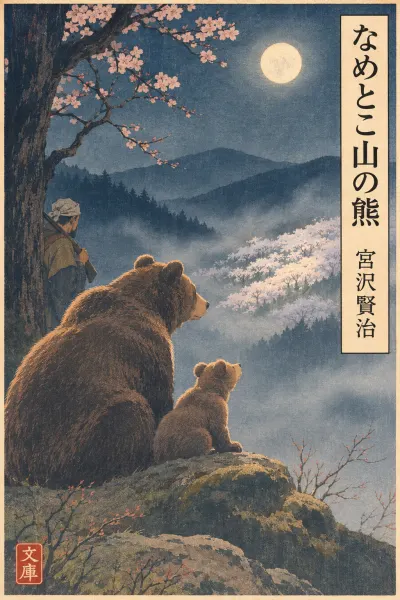
小十郎がすぐ下に湧水のあったのを思い出して少し山を降りかけたら愕いたことは母親とやっと一歳になるかならないような子熊と二疋ちょうど人が額に手をあてて遠くを眺めるといったふうに淡い六日の月光の中を向うの谷をしげしげ見つめているのにあった。Kojūrō remembered that there was a spring just below, and he had started a little way down the mountain when, to his surprise, he came upon two bears, a mother and a cub barely a year old, if that, gazing intently at the far side of the valley in the faint light of the six-day moon, just the way a person looks into the distance with a hand held to the forehead.
小十郎はまるでその二疋の熊のからだから後光が射すように思えてまるで釘付けになったように立ちどまってそっちを見つめていた。It seemed to Kojūrō as if a halo were shining from the bodies of the two bears, and he stood stock-still, as though nailed to the spot, staring over at them.
すると小熊が甘えるように言ったのだ。Then the cub spoke, in a coaxing little voice.
「どうしても雪だよ、おっかさん谷のこっち側だけ白くなっているんだもの。どうしても雪だよ。おっかさん」"It must be snow, Mother, because only this side of the valley has gone white. It must be snow, Mother."
すると母親の熊はまだしげしげ見つめていたがやっと言った。The mother bear was still gazing intently, but at last she said:
「雪でないよ、あすこへだけ降るはずがないんだもの」"It isn't snow. Snow couldn't fall on just that one place."
子熊はまた言った。The cub spoke again.
「だから溶けないで残ったのでしょう」"Then it must have stayed there because it didn't melt."
「いいえ、おっかさんはあざみの芽を見に昨日あすこを通ったばかりです」"No, dear. I went by there only yesterday to look at the thistle shoots."
小十郎もじっとそっちを見た。Kojūrō, too, looked steadily over that way.
月の光が青じろく山の斜面を滑っていた。The moonlight was sliding, pale blue-white, down the mountain slope.
そこがちょうど銀の鎧のように光っているのだった。And that spot was shining just like silver armour.
しばらくたって子熊が言った。After a while the cub said:
「雪でなけぁ霜だねえ。きっとそうだ」"If it isn't snow, then it's frost. I'm sure that's it."
ほんとうに今夜は霜が降るぞ、お月さまの近くで胃もあんなに青くふるえているし第一お月さまのいろだってまるで氷のようだ、小十郎がひとりで思った。There really will be frost tonight, Kojūrō thought to himself. Near the moon even the Stomach stars are trembling so blue, and above all, the moon's colour is just like ice.
「おかあさまはわかったよ、あれねえ、ひきざくらの花」"Mother knows now. Look, it's magnolia blossoms."
「なぁんだ、ひきざくらの花だい。僕知ってるよ」"Oh, is that all? Magnolia blossoms. I know those."
「いいえ、お前まだ見たことありません」"No, dear, you've never seen them yet."
「知ってるよ、僕この前とって来たもの」"I do know them. I picked some and brought them home the other day."
「いいえ、あれひきざくらでありません、お前とって来たのきささげの花でしょう」"No, those weren't magnolias. What you brought home were catalpa flowers, weren't they?"
「そうだろうか」子熊はとぼけたように答えました。"Were they?" the cub answered, playing innocent.
小十郎はなぜかもう胸がいっぱいになってもう一ぺん向うの谷の白い雪のような花と余念なく月光をあびて立っている母子の熊をちらっと見てそれから音をたてないようにこっそりこっそり戻りはじめた。For some reason Kojūrō's heart was already full, and after one more quick glance at the snow-white flowers across the valley and at the mother and cub standing there, wholly absorbed, bathed in moonlight, he began to steal away, quietly, quietly, so as not to make a sound.
風があっちへ行くな行くなと思いながらそろそろと小十郎は後退りした。Thinking, "Wind, don't blow that way, don't blow that way," Kojūrō slowly backed away.
くろもじの木の匂が月のあかりといっしょにすうっとさした。The scent of spicebush came drifting in along with the moonlight.
Vocabulary
| Word | Meaning | JLPT |
|---|---|---|
| 因果いんが | fate; karma (a destiny caused by past deeds)A Buddhist idea: what happens to you is the result of earlier actions. Here it means an unlucky lot in life that you cannot escape. | — |
| 商売しょうばい | trade; line of work; businessUsually means buying and selling, but also any way of earning a living. | N3 |
| しょげかえってしょげかえる | to be utterly dejected; to be crestfallendictionary form: しょげかえるしょげる (to be downcast) + かえる, which makes it stronger. | — |
| 赤痢せきり | dysenteryWritten with 赤 (red) because of the bloody symptoms. Used with にかかる (to catch an illness). | — |
| ぐんなりぐんなり | limp; drained; worn outMimetic word, close to ぐったり. The hunter looks as spent as the dead bear. | — |
| へとへとへとへと | completely exhaustedCommon mimetic word, often in へとへとに疲れる. | — |
| 湧水わきみず | spring water; a springFrom 湧く (to gush out). Also read ゆうすい in more formal Japanese. | — |
| しげしげしげしげ | intently; closely (looking at something)Almost always used with 見る or 見つめる. | — |
| 後光ごこう | halo; holy light shining from behindOriginally the light around a Buddha. It shows how sacred the bears seem to Kojūrō. | — |
| 釘付けくぎづけ | nailed to the spot; unable to move釘 = nail. Often used as 釘付けになる. | — |
| 胃こきえ | the Stomach (one of the 28 lunar mansions, a star group in Aries)Normally 胃 (い) means the stomach. Here it names a traditional Chinese star group that lies along the moon's path. | N3 |
| ひきざくらひきざくら | kobushi magnolia (a local name)A regional name for コブシ, a magnolia with white flowers that blooms in early spring before the leaves come out. | — |
| とぼけたとぼける | to play innocent; to feign ignorancedictionary form: とぼけるPretending not to know something, often in a joking way. | — |
| 余念なくよねんない | 余念がない (よねんがない): wholly absorbed; with no other thought. 余念なく is its adverbial form, 'intently, single-mindedly'.dictionary form: 余念ないLiterally 'without other thoughts'. Often used as 〜に余念がない. | — |
Grammar
〜なけぁならねえ (dialect for 〜なければならない) N4 must; have to
In Kojūrō's northern dialect, なければ shrinks to なけぁ and ない becomes ねえ. The meaning is the standard 'must'.
おれも商売ならてめえも射たなけぁならねえ。
It's my trade, so I've got to shoot you.
〜ような気がする N3 to feel as if; to have a feeling that
Describes a vague impression, not a certain fact. だって adds 'even': he feels he could even understand bear speech.
小十郎はもう熊のことばだってわかるような気がした。
Kojūrō felt as if by now he could even understand what the bears said.
〜にもなく (柄にもなく) N1 unlike (someone's usual self)
柄 means one's nature or character. 柄にもなく means doing something you normally would not do. Here an expert hunter takes the wrong path.
小十郎の柄にもなく登り口をまちがってしまった。
Quite unlike him, he took the wrong way up.
Verb stem + かかる / かける N3 to be about to; to be partway through
Added to a verb stem, it shows an action that has started but is not finished. くずれかかった means 'half fallen down', and 降りかけたら means 'when he had started to go down'.
半分くずれかかった去年の小屋を見つけた。
He found last year's hut, half fallen down.
〜かならないか (〜になるかならないような) N2 barely; only just (reaching a certain point)
〜(に)なるかならないか: 'just about to become / barely reaching'. It puts the positive and negative forms of the same verb side by side to show the amount is right on the borderline. Here やっと一歳になるかならないような子熊 means 'a cub barely one year old, if that'. ような links the phrase to 子熊.
やっと一歳になるかならないような子熊
a cub barely a year old, if that
Verb (た-form) + ばかり N4 have just done
た + ばかり means the action happened only a very short time ago. The mother uses it to show she knows the slope well: she was there only yesterday.
おっかさんはあざみの芽を見に昨日あすこを通ったばかりです
I went by there only yesterday to look at the thistle shoots.