Upper intermediate · JLPT N2
なめとこ山の熊Nametokoyama no Kuma — Kojūrō and the Bears of Nametoko
- JLPT N2
- 7,265 characters
- 5 parts
- about 61 minutes
- 3 easier versions
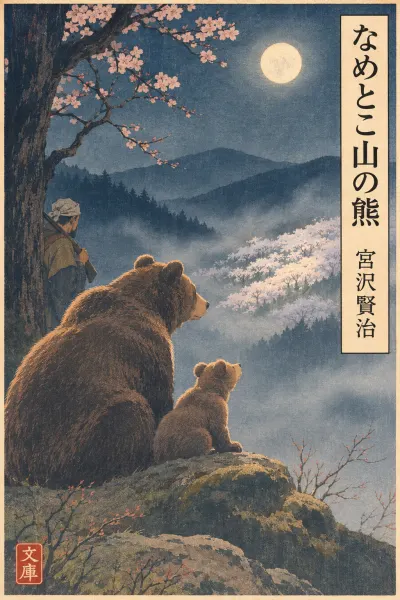
Miyazawa Kenji's "Nametoko-yama no Kuma" is a short story about Fuchizawa Kojūrō, a hunter who lives by killing the bears of a misty mountain in northern Japan. He then has to sell their skins cheaply to a town merchant. The bears know Kojūrō and are oddly fond of him, and he speaks to them as fellow beings. The story asks what it means to kill something you respect simply to stay alive. The narrator is chatty and opinionated. Scenes of quiet beauty sit beside harsh economics. One example is a mother bear and her cub wondering whether a white slope is snow, frost or blossom. For learners, the narration is in plain form with many onomatopoeic words, and the sentences are mostly manageable at upper-intermediate level. The challenge is the dialogue: Kojūrō and the storekeeper speak rustic Tōhoku dialect, while the bears speak standard Japanese. Hearing the difference between those voices is part of what makes the story rewarding.
Contents
Easier versions
This story is also retold in simpler Japanese. Reading an easier version first makes the original much more approachable.
Before you read
- Learn the core vocabulary first, because it appears on almost every page: 熊 (bear), 皮 (skin/pelt), 熊の胆 (くまのい, bear gall), 鉄砲 (gun), 沢 (mountain stream valley) and 小屋 (hut).
- Notice who is speaking. The bears use standard Japanese, and the mother bear is gently polite. Kojūrō is humble towards the shopkeeper but plain with the bears. These shifts in register show the relationships in the story.
- The narrator often closes explanations with 〜のだった and offers his own views with 〜ような気がする or 〜かもしれない. He also reports hearsay with 〜そうだ, as when he describes the bear gall's reputation. Treat these as his voice rather than as plot information.
- Onomatopoeia and mimetic words carry much of the scenery and action. When one is unfamiliar, use the context (sound, movement or light) to guess its meaning before you look it up.
Words to know
The most useful words from the notes across the story.
| Word | Meaning | JLPT |
|---|---|---|
| 胆きも | gall bladder (bear gall, used as medicine)Bear gall (熊の胆) was a valuable traditional medicine. | — |
| 渉ってわたる | to wade across (a river)dictionary form: 渉るUsually written 渡る. The kanji 渉 suggests crossing water on foot. | N5 |
| 名人めいじん | master, expertUsed for someone with outstanding skill in a craft, sport or game. | N3 |
| 迷惑めいわく | bother, nuisance, annoyance迷惑そうに means 'looking bothered'. | N3 |
| 商売しょうばい | trade; line of work; businessUsually means buying and selling, but also any way of earning a living. | N3 |
| 胃こきえ | the Stomach (one of the 28 lunar mansions, a star group in Aries)Normally 胃 (い) means the stomach. Here it names a traditional Chinese star group that lies along the moon's path. | N3 |
| 物価ぶっか | prices (of goods), cost of living | N3 |
| 進歩しんぽ | progress, advancement | N3 |
| 気の毒きのどく | pitiful; feeling sorry for someone | N3 |
| みじめさみじめ | wretchedness, miserydictionary form: 惨め〜さ turns an adjective into a noun. | N2 |
| 憎んでにくむ | to hate, to bear ill will towarddictionary form: 憎むKojūrō kills bears but holds no hatred for them, which is a central theme of the story. | N2 |
| 鉄砲てっぽう | gun, rifleOlder, everyday word. 銃 (じゅう) in the same passage is the more formal term. | N2 |
| 油断ゆだん | carelessness, letting one's guard down油断なく means 'without dropping one's guard'. | N2 |
| かきねかきね | fence, hedgedictionary form: 垣根 | N2 |
| 拝むおがむ | to put one's hands together in prayer; to worship | N2 |
Plot summary
Show the full summary (contains spoilers)
Kojūrō, a sturdy master hunter, roams Mount Nametoko with his gun and yellow dog. He tells the bears he shoots that he kills them only because he has no other way to live. One spring evening he overhears a mother bear and her cub talking about a white slope across the valley, and he slips away without harming them. In town, he must humbly beg a sly storekeeper to buy his skins, and he receives only two yen for two of them. One summer, a cornered bear asks for two years to finish its work, and Kojūrō lets it go. Two years later he finds it dead by his hedge, as it promised. One January, feeling strangely reluctant to go out, Kojūrō climbs Shirozawa after a big bear. It charges, his shot fails, and the bear kills him, saying it never meant to. Three nights later, bears gather in a silent circle around his body and bow as if in prayer.
About the author
Miyazawa Kenji was a poet and writer of children's stories from Hanamaki in Iwate Prefecture. He studied agricultural science in Morioka and later taught at an agricultural school. He devoted much of his life to helping local farmers improve their methods and their cultural lives. He was a devout Buddhist, and his faith, love of nature and interest in science run through his writing. His fame came after his death, with works such as 銀河鉄道の夜, 風の又三郎 and the poem 雨ニモマケズ.