Part 5 of 5 · JLPT N2
なめとこ山の熊 Nametokoyama no Kuma, part 5: The Last Hunt on the Snowy Ridge
In this part
Kojūrō climbs up the frozen Shirozawa valley with his dog to find a big bear he had spotted in the summer. On the snowy summit the bear charges him, his shot fails to stop it, and the bear kills him, saying it never meant to. Three nights later, under the moon and stars, many bears gather in a circle around Kojūrō's body and bow down motionless, as if in prayer.
AI translation · independently checked
犬はもう息をはあはあし赤い舌を出しながら走ってはとまり走ってはとまりして行った。The dog, panting hard with its red tongue hanging out, went on ahead, running and stopping, running and stopping.
間もなく小十郎の影は丘の向うへ沈んで見えなくなってしまい子供らは稗の藁でふじつきをして遊んだ。Soon Kojūrō's figure sank beyond the hill and could no longer be seen, and the children played at fujitsuki with millet straw.
小十郎は白沢の岸を溯って行った。Kojūrō made his way upstream along the bank of the Shirozawa.
水はまっ青に淵になったり硝子板をしいたように凍ったりつららが何本も何本もじゅずのようになってかかったりそして両岸からは赤と黄いろのまゆみの実が花が咲いたようにのぞいたりした。In places the water gathered in deep, blue pools, in places it was frozen as if sheets of glass had been laid over it, and in places icicles hung down, many and many of them, like strings of prayer beads; and from both banks the red and yellow berries of the spindle trees peeped out as if flowers had bloomed.
小十郎は自分と犬との影法師がちらちら光り樺の幹の影といっしょに雪にかっきり藍いろの影になってうごくのを見ながら溯って行った。Kojūrō went on upstream, watching the shadows of himself and his dog flicker and shine and move across the snow, together with the shadows of the birch trunks, as sharp, clear indigo shapes.
白沢から峯を一つ越えたとこに一疋の大きなやつが棲んでいたのを夏のうちにたずねておいたのだ。He had found out during the summer that one big fellow lived just over a ridge from the Shirozawa.
小十郎は谷に入って来る小さな支流を五つ越えて何べんも何べんも右から左左から右へ水をわたって溯って行った。Kojūrō crossed five small streams that flowed into the valley and made his way upstream, crossing the water again and again, from right to left and from left to right.
そこに小さな滝があった。There was a small waterfall there.
小十郎はその滝のすぐ下から長根の方へかけてのぼりはじめた。From just below that waterfall, Kojūrō began to climb toward the long ridge.
雪はあんまりまばゆくて燃えているくらい。The snow was so dazzling it almost seemed to be on fire.
小十郎は眼がすっかり紫の眼鏡をかけたような気がして登って行った。Kojūrō climbed on, feeling as though his eyes were wearing purple glasses.
犬はやっぱりそんな崖でも負けないというようにたびたび滑りそうになりながら雪にかじりついて登ったのだ。The dog, as if determined not to be beaten even by such a cliff, kept nearly slipping, but clung to the snow and climbed up.
やっと崖を登りきったらそこはまばらに栗の木の生えたごくゆるい斜面の平らで雪はまるで寒水石という風にギラギラ光っていたしまわりをずうっと高い雪のみねがにょきにょきつったっていた。When he finally reached the top of the cliff, he found a flat place, a very gentle slope with chestnut trees growing here and there; the snow glittered like white marble, and all around, high snowy peaks stood jutting up one after another.
小十郎がその頂上でやすんでいたときだ。It happened while Kojūrō was resting there on the summit.
いきなり犬が火のついたように咆え出した。Suddenly the dog began to bark wildly, as if it had caught fire.
小十郎がびっくりしてうしろを見たらあの夏に眼をつけておいた大きな熊が両足で立ってこっちへかかって来たのだ。Startled, Kojūrō looked behind him, and there was the big bear he had had his eye on since the summer, standing on its hind legs and coming at him.
小十郎は落ちついて足をふんばって鉄砲を構えた。Kojūrō stayed calm, planted his feet firmly, and raised his gun.
熊は棒のような両手をびっこにあげてまっすぐに走って来た。The bear came running straight at him, its stick-like arms raised unevenly.
さすがの小十郎もちょっと顔いろを変えた。Even Kojūrō went a little pale.
ぴしゃというように鉄砲の音が小十郎に聞えた。Kojūrō heard the gun go off with a sharp crack.
ところが熊は少しも倒れないで嵐のように黒くゆらいでやって来たようだった。But the bear did not fall at all; it seemed to come on, swaying black like a storm.
犬がその足もとに噛み付いた。The dog bit at its feet.
と思うと小十郎はがあんと頭が鳴ってまわりがいちめんまっ青になった。And then Kojūrō's head rang with a great clang, and everything around him turned deep blue.
それから遠くでこう言うことばを聞いた。After that he heard, far away, these words:
「おお小十郎おまえを殺すつもりはなかった」"Oh, Kojūrō, I didn't mean to kill you."
もうおれは死んだと小十郎は思った。"I'm dead now," Kojūrō thought.
そしてちらちらちらちら青い星のような光がそこらいちめんに見えた。And everywhere around him he saw lights like blue stars, flickering and flickering.
「これが死んだしるしだ。死ぬとき見る火だ。熊ども、ゆるせよ」と小十郎は思った。"This is the sign that I'm dead. These are the fires you see when you die. Bears, forgive me," Kojūrō thought.
それからあとの小十郎の心持はもう私にはわからない。What Kojūrō felt after that, I can no longer tell.
とにかくそれから三日目の晩だった。Anyway, it was the evening of the third day after that.
まるで氷の玉のような月がそらにかかっていた。A moon like a ball of ice hung in the sky.
雪は青白く明るく水は燐光をあげた。The snow was pale and bright, and the water gave off a phosphorescent glow.
すばるや参の星が緑や橙にちらちらして呼吸をするように見えた。The Pleiades and the stars of Orion twinkled green and orange, and seemed to be breathing.
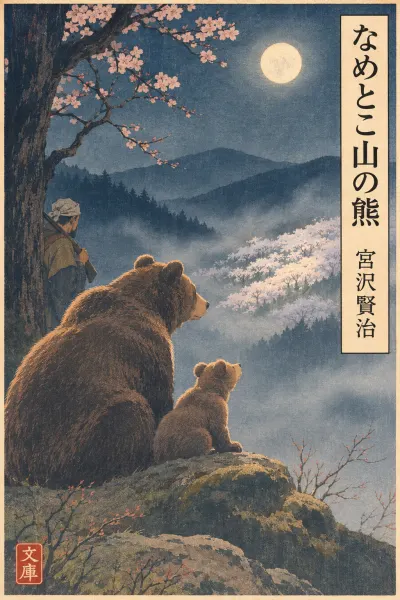
その栗の木と白い雪の峯々にかこまれた山の上の平らに黒い大きなものがたくさん環になって集って各々黒い影を置き回々教徒の祈るときのようにじっと雪にひれふしたままいつまでもいつまでも動かなかった。On the flat place at the top of the mountain, surrounded by chestnut trees and white snowy peaks, many great black shapes had gathered in a ring, each casting a black shadow, and lay bowed down in the snow, still, like Muslims at prayer, and did not move for a long, long time.
そしてその雪と月のあかりで見るといちばん高いとこに小十郎の死骸が半分座ったようになって置かれていた。And when you looked by the light of the snow and the moon, you could see Kojūrō's body placed at the highest point, half sitting up.
思いなしかその死んで凍えてしまった小十郎の顔はまるで生きてるときのように冴え冴えして何か笑っているようにさえ見えたのだ。Perhaps it was only imagination, but Kojūrō's face, dead and frozen as it was, looked clear and bright, just as when he was alive, and even seemed to be smiling a little.
ほんとうにそれらの大きな黒いものは参の星が天のまん中に来てももっと西へ傾いてもじっと化石したようにうごかなかった。Truly, those great black shapes did not move, as still as fossils, even when the stars of Orion reached the middle of the sky, and even when they sank further to the west.
Vocabulary
| Word | Meaning | JLPT |
|---|---|---|
| 溯ってさかのぼる | to go upstreamdictionary form: 溯るAlso written 遡る; also means 'to go back in time'. | N2 |
| 淵ふち | deep pool (in a river)The same kanji appears in the name Fuchizawa. | — |
| つららつらら | icicle | — |
| じゅずじゅず | Buddhist prayer beads, rosarydictionary form: 数珠 | — |
| 影法師かげぼうし | shadow (of a person)Slightly old-fashioned, poetic word for a person's shadow. | — |
| 峯みね | ridge, peakUsually written 峰 today. | N1 |
| 疋ひき | counter for animalsOld form of 匹; 一疋 is read いっぴき. | N1 |
| まばゆくてまばゆい | dazzling, blindingdictionary form: まばゆい | — |
| 構えたかまえる | to hold (a gun) ready to fire, take aimdictionary form: 構える | N1 |
| ふんばってふんばる | to plant one's feet firmlydictionary form: 踏ん張る | — |
| ひれふしたひれふす | to prostrate oneself, bow to the grounddictionary form: ひれ伏す | — |
| 死骸しがい | dead body, corpse | — |
| 思いなしかおもいなしか | perhaps it was only imagination, but…Set phrase that softens what follows as a subjective impression. | — |
| 化石かせき | fossil化石した = as if turned to stone. | N1 |
Grammar
〜ては〜 N3 doing A and then B, repeatedly
Verb て-form + は followed by another verb describes an action that keeps repeating in a cycle. Doubling it (走ってはとまり走ってはとまり) stresses the stop-start rhythm.
走ってはとまり走ってはとまりして行った
went on, running and stopping, running and stopping
〜たり〜たりした N4 doing things like A, B …
Lists several states or actions as examples. Here it paints the changing scenery along the river: pools, ice, icicles, berries.
淵になったり硝子板をしいたように凍ったり
in places forming pools, in places frozen as if sheets of glass had been laid
〜ておく N4 to do something in advance
Shows an action done beforehand with a later purpose in mind. Kojūrō had marked this bear back in summer, planning to hunt it.
あの夏に眼をつけておいた大きな熊
the big bear he had had his eye on since the summer
さすがの〜も N2 even (someone as capable as) X
Used when even a person known for skill or toughness is affected. Here even the experienced, calm Kojūrō turns pale.
さすがの小十郎もちょっと顔いろを変えた
Even Kojūrō went a little pale.
〜きる N3 to do completely, all the way
Attached to the verb stem, きる means the action is carried through to the end. 登りきる = to climb all the way to the top.
やっと崖を登りきったら
When he finally reached the top of the cliff
〜ようにさえ見えた N3 even seemed to…
ように見える means 'looks as if'; さえ adds 'even', marking a surprising extreme. The dead face not only looked alive but even seemed to smile.
何か笑っているようにさえ見えたのだ
even seemed to be smiling a little