Part 1 of 4 · JLPT N2
桜桃 Ōtō, part 1: A Father Who Jokes to Survive
In this part
The narrator, a writer, says that parents are weaker than children, and that in his home he and his wife wait on their three small children like servants. At a hot, chaotic family supper he jokes about sweat, and his wife, turning serious, replies that she sweats in 'a valley of tears' between her breasts. He then explains that he jokes constantly at home, with guests and in his fiction to mask inner anguish, though some readers and critics scorn him as frivolous.
AI translation · independently checked
われ、山にむかいて、目を挙ぐ。Facing the mountains, I lift up my eyes.
――詩篇、第百二十一。— Psalms, chapter one hundred and twenty-one.
子供より親が大事、と思いたい。I would like to think that parents matter more than children.
子供のために、などと古風な道学者みたいな事を殊勝らしく考えてみても、何、子供よりも、その親のほうが弱いのだ。I may try, with the pious air of some old-fashioned moralist, to tell myself it is all 'for the sake of the children', but really, it is the parents who are weaker than the children.
少くとも、私の家庭においては、そうである。At least, that is how it is in my household.
まさか、自分が老人になってから、子供に助けられ、世話になろうなどという図々しい虫のよい下心は、まったく持ち合わせてはいないけれども、この親は、その家庭において、常に子供たちのご機嫌ばかり伺っている。Not that I harbour any brazen, self-serving hope of being helped and looked after by my children once I am old — I have no such ulterior motive whatsoever — and yet this parent, in his own home, is forever anxiously minding the children's moods.
子供、といっても、私のところの子供たちは、皆まだひどく幼い。When I say children, mine are all still terribly young.
長女は七歳、長男は四歳、次女は一歳である。The eldest daughter is seven, the son is four, and the younger daughter is one.
それでも、既にそれぞれ、両親を圧倒し掛けている。Even so, each of them is already on the verge of overpowering their parents.
父と母は、さながら子供たちの下男下女の趣きを呈しているのである。The father and the mother present, one might say, the very picture of the children's manservant and maidservant.
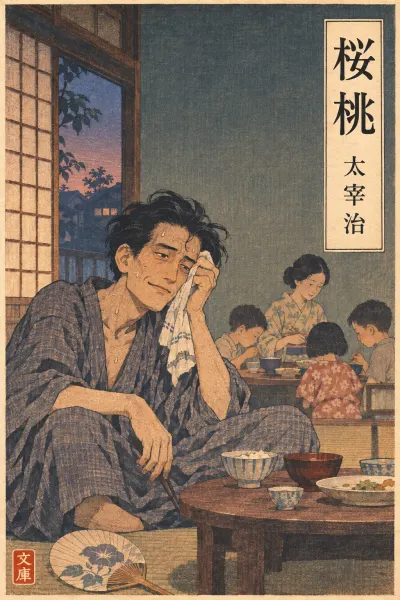
夏、家族全部三畳間に集まり、大にぎやか、大混乱の夕食をしたため、父はタオルでやたらに顔の汗を拭き、In summer, the whole family gathers in the three-mat room and takes a riotously noisy, utterly chaotic supper, while the father keeps mopping the sweat from his face with a towel,
「めし食って大汗かくもげびた事、と柳多留にあったけれども、どうも、こんなに子供たちがうるさくては、いかにお上品なお父さんといえども、汗が流れる」"'Sweating buckets over your rice is a vulgar thing,' says the Yanagidaru, but honestly, with the children making such a racket, even the most refined of fathers is bound to sweat,"
と、ひとりぶつぶつ不平を言い出す。and he starts grumbling and complaining to himself.
母は、一歳の次女におっぱいを含ませながら、そうして、お父さんと長女と長男のお給仕をするやら、子供たちのこぼしたものを拭くやら、拾うやら、鼻をかんでやるやら、八面六臂のすさまじい働きをして、The mother, giving her breast to the one-year-old, waits on the father, the eldest daughter and the son, wipes up what the children spill, picks things up, blows their noses for them, working at a ferocious pace as if she had eight faces and six arms,
「お父さんは、お鼻に一ばん汗をおかきになるようね。いつも、せわしくお鼻を拭いていらっしゃる」"It seems Father perspires most of all on his nose. He is always so busily wiping it."
父は苦笑して、The father smiled wryly.
「それじゃ、お前はどこだ。内股かね?」"Then where do you sweat? The inside of your thighs?"
「お上品なお父さんですこと」"What a refined father we have."
「いや、何もお前、医学的な話じゃないか。上品も下品も無い」"Come now, this is a medical question, isn't it? There's nothing refined or vulgar about it."
「私はね」"As for me,"
と母は少しまじめな顔になり、says the mother, her face growing a little serious,
「この、お乳とお乳のあいだに、……涙の谷、……」"here, between my breasts … a valley of tears …"
涙の谷。A valley of tears.
父は黙して、食事をつづけた。The father said nothing and went on eating.
私は家庭に在っては、いつも冗談を言っている。At home, I am always cracking jokes.
それこそ「心には悩みわずらう」事の多いゆえに、「おもてには快楽」をよそわざるを得ない、とでも言おうか。Shall I say that precisely because 'in the heart there is much grief and care', one cannot help but feign 'gladness on the face'?
いや、家庭に在る時ばかりでなく、私は人に接する時でも、心がどんなにつらくても、からだがどんなに苦しくても、ほとんど必死で、楽しい雰囲気を創る事に努力する。No, it is not only at home: whenever I deal with people, however painful my heart and however wretched my body, I strive almost desperately to create a cheerful atmosphere.
そうして、客とわかれた後、私は疲労によろめき、お金の事、道徳の事、自殺の事を考える。And then, after the guests have gone, I stagger with exhaustion and think about money, about morality, about suicide.
いや、それは人に接する場合だけではない。No, it is not only when I am dealing with people.
小説を書く時も、それと同じである。It is the same when I write fiction.
私は、悲しい時に、かえって軽い楽しい物語の創造に努力する。When I am sad, I strive, if anything, to create light and cheerful stories.
自分では、もっとも、おいしい奉仕のつもりでいるのだが、人はそれに気づかず、太宰という作家も、このごろは軽薄である、面白さだけで読者を釣る、すこぶる安易、と私をさげすむ。For my part, I mean it as the most delicious kind of service, but people do not notice, and they scorn me: that writer Dazai has turned shallow lately, he baits his readers with nothing but amusement, he is terribly facile.
人間が、人間に奉仕するというのは、悪い事であろうか。Is it a bad thing for a human being to serve other human beings?
もったいぶって、なかなか笑わぬというのは、善い事であろうか。Is it a good thing to put on airs and hardly ever laugh?
つまり、私は、糞真面目で興覚めな、気まずい事に堪え切れないのだ。In short, I simply cannot bear deadly earnest, dampening, awkward moments.
私は、私の家庭においても、絶えず冗談を言い、薄氷を踏む思いで冗談を言い、一部の読者、批評家の想像を裏切り、私の部屋の畳は新しく、机上は整頓せられ、夫婦はいたわり、尊敬し合い、夫は妻を打った事など無いのは無論、出て行け、出て行きます、などの乱暴な口争いした事さえ一度も無かったし、父も母も負けずに子供を可愛がり、子供たちも父母に陽気によくなつく。In my own household, too, I joke without pause, joke as if treading on thin ice, and, betraying what some readers and critics imagine, the mats in my room are new, my desk is kept tidy, husband and wife are considerate of each other and respect each other, and it goes without saying that the husband has never struck his wife — they have never once even had a violent quarrel of the 'Get out!' 'Then I'll go!' sort; the father and the mother, neither to be outdone by the other, dote on the children, and the children are cheerfully fond of both their parents.
Vocabulary
| Word | Meaning | JLPT |
|---|---|---|
| 殊勝しゅしょう | admirable, commendable, pious殊勝らしく = 'with a show of piety'; here ironic. | — |
| 下心したごころ | ulterior motive, hidden intention虫のよい下心 = a selfish, convenient hidden motive. | N1 |
| ご機嫌きげん | mood, temperdictionary form: 機嫌機嫌を伺う = to check on someone's mood, to curry favour. | N3 |
| 圧倒あっとうする | to overwhelm, to overpowerdictionary form: 圧倒する | — |
| 下男げなん | manservantOld-fashioned; paired with 下女 (maidservant). | — |
| 呈してていする | to present (an appearance), to showdictionary form: 呈するBookish: 〜の趣を呈する = to take on the look of ~. | — |
| 柳多留やなぎだる | the Yanagidaru, a famous Edo-period anthology of senryū (short comic verse)A book title with no English equivalent; full name 誹風柳多留. | — |
| 不平ふへい | complaint, grievanceぶつぶつ = muttering. | N3 |
| 八面六臂はちめんろっぴ | doing many things at once; versatile, tireless activityLiterally 'eight faces, six arms', like a many-armed Buddhist deity. | — |
| 苦笑くしょうする | to smile wryly, to give a bitter smiledictionary form: 苦笑する | — |
| 軽薄けいはく | frivolous, shallow | — |
| さげすむさげすむ | to despise, to look down onKanji: 蔑む. | — |
| 興覚めきょうざめ | spoiling the fun, dampening糞真面目 (くそまじめ) = deadly serious, humourlessly earnest. | — |
| 薄氷を踏むはくひょうをふむ | to tread on thin ice; to act with great anxiety〜思いで = with the feeling of ~. | — |
Grammar
〜ざるを得ない N2 cannot help but ~, have no choice but to ~
The classical negative ざる attaches to the irrealis (ない-form stem) of the verb (よそう → よそわ), followed by を得ない, literally 'cannot obtain not doing'. It means 'cannot help but ~, have no choice but to ~'. する becomes せざるを得ない.
「おもてには快楽」をよそわざるを得ない
one cannot help but feign 'gladness on the face'
〜やら〜やら N2 what with ~ and ~; doing ~ and ~ (among other things)
Listing actions with やら suggests a hectic, disorderly mix of tasks. Here it piles up the mother's chores to show how busy she is.
子供たちのこぼしたものを拭くやら、拾うやら、鼻をかんでやるやら
wiping up what the children spill, picking things up, blowing their noses for them
いかに〜といえども N1 no matter how ~, even though ~
といえども is a literary 'even if/although', and いかに strengthens it to 'however much'. The father uses this stiff phrasing jokingly about himself.
いかにお上品なお父さんといえども、汗が流れる
even the most refined of fathers is bound to sweat
Verb stem + 掛ける (かける) N3 to be about to ~, to be on the verge of ~
Attached to a verb stem, かける means an action has just started or is about to happen. し掛けている says the children are on the point of overpowering their parents.
既にそれぞれ、両親を圧倒し掛けている
each of them is already on the verge of overpowering their parents
どんなに〜ても N4 no matter how ~
どんなに with the て-form + も gives a concession: whatever the degree, the result stays the same. It is repeated here for emphasis.
心がどんなにつらくても、からだがどんなに苦しくても
however painful my heart and however wretched my body
〜ぬ (negative) N2 not ~ (literary form of 〜ない)
ぬ is a classical negative ending attached to the ない-stem, so 笑わぬ = 笑わない. It gives the narration a bookish, slightly stiff tone.
もったいぶって、なかなか笑わぬというのは、善い事であろうか。
Is it a good thing to put on airs and hardly ever laugh?