Upper intermediate · JLPT N2
桜桃Ōtō — Summer Cherries
- JLPT N2
- 4,813 characters
- 4 parts
- about 40 minutes
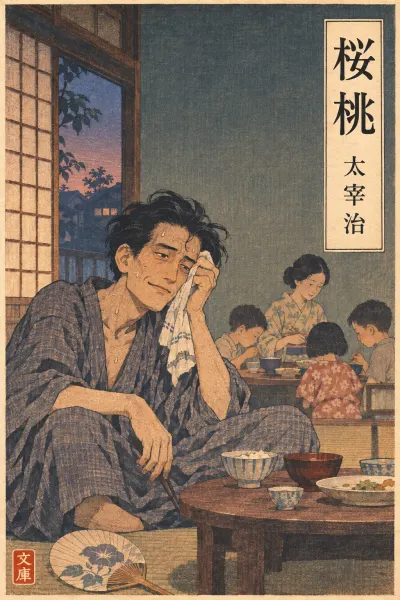
"Summer Cherries" (桜桃) is a short autobiographical story by Dazai Osamu, published in 1948, the year of his death. The anniversary of his death is still marked as Ōtōki (桜桃忌), named after this story. A writer named Dazai describes one sweltering summer evening at home with his wife and three small children. On the surface it is a domestic sketch: a messy supper, a joke about sweat, an awkward exchange between husband and wife. Underneath are worries neither of them will say aloud, about money, about his drinking, and about their four-year-old son. The narration is confessional and wryly self-mocking. It shifts between 'I' and a more distant 'the father' and 'the mother', as if the narrator cannot quite face himself directly. For a learner, the story is short and built around a single scene, so it is manageable at N2. The difficulty lies in the bookish phrasing, the older negative forms, and the gap between what characters say and what they mean. Much of the drama happens in silences and polite deflections. Reading closely for tone pays off here.
Contents
Before you read
- Watch the point of view. The narrator moves between 私 and the more distant 父 and 母. When he says 父, he is describing himself from the outside, often at his most painful or embarrassing moments.
- Learn the older and literary forms early. The negative 〜ぬ (知らぬ, 言わぬ) is common, and so are 〜ざるを得ない ('cannot help but') and いかに〜といえども ('no matter how…'). Stiff phrasings such as 在って for いて also appear.
- Notice the gap in speech styles. The wife uses polite and honorific forms (お〜になる) even to her husband. He answers plainly, and at the drinking place he slips into rough colloquial speech, as in やりきれねえ, where ねえ replaces ない. Her politeness often signals coolness or reproach, not warmth.
- Read the dialogue for what is left unsaid. The quarrel happens through a joke, a single phrase (涙の谷, 'valley of tears') and a request that is never finished. The narrator's silent thoughts after each line tell you how he takes it.
- Useful words to learn first: 冗談 (joke), 汗 (sweat), 涙の谷 (valley of tears), 夫婦喧嘩 (marital quarrel), 仕事部屋 (workroom), 原稿料 (manuscript fee), 自殺 (suicide), 桜桃 (cherries), and 〜しか〜ない for 'only'.
Words to know
The most useful words from the notes across the story.
| Word | Meaning | JLPT |
|---|---|---|
| 配給はいきゅう | rationing, ration distributionKey word for the post-war setting, when food was distributed by ration. | N1 |
| 圧倒あっとうする | to overwhelm, to overpowerdictionary form: 圧倒する | — |
| ヤケ酒やけざけ | drinking out of despair or frustrationdictionary form: やけ酒From やけ (desperation); 酒 becomes ざけ by rendaku. A key word of the story. | — |
| 遠慮えんりょ | restraint, holding back out of consideration遠慮深い means 'very reserved, cautious with others'. | N4 |
| ご機嫌きげん | mood, temperdictionary form: 機嫌機嫌を伺う = to check on someone's mood, to curry favour. | N3 |
| 不平ふへい | complaint, grievanceぶつぶつ = muttering. | N3 |
| 雇いやとう | to hire, employdictionary form: 雇う | N3 |
| 見舞いみまい | visit to a sick person見舞いに行く = to go and visit someone who is ill. | N3 |
| 鎖くさり | chain | N3 |
| ぜいたくぜいたく | luxurious, extravagantdictionary form: 贅沢Usually written in kana because the kanji are difficult. | N3 |
| 重態じゅうたい | critical condition, gravely illAlso written 重体. | N2 |
| 風呂敷ふろしき | furoshiki (square wrapping cloth)A square cloth for wrapping and carrying things, with no exact English equivalent. | N2 |
| 下心したごころ | ulterior motive, hidden intention虫のよい下心 = a selfish, convenient hidden motive. | N1 |
| 呟くつぶやく | to mutter, to murmur | N1 |
| 無能むのう | incompetent, useless無 (without) + 能 (ability). | N1 |
Plot summary
Show the full summary (contains spoilers)
The narrator, a writer, says parents are weaker than their children, and that he and his wife serve their three small children like servants. At a hot, chaotic supper he jokes about sweating. His wife answers seriously that she sweats most in the 'valley of tears' between her breasts. He explains that he jokes constantly to hide his anguish, and that critics call him frivolous. Both carry unspoken pain. He works little and drinks heavily, and their four-year-old son cannot stand or speak. He takes the 'valley of tears' as a reproach. He timidly suggests hiring help, but she deflects. When she says she must visit her gravely ill sister and leave him with the children, he says nothing more. He slips out with his manuscript fee, thinking of suicide, and goes to a drinking place. There he is served cherries, which his own children have probably never tasted. He eats them joylessly, telling himself that parents matter more than children.
About the author
Dazai Osamu (太宰治) was the pen name of Tsushima Shūji, born into a wealthy landowning family in Aomori Prefecture in northern Japan. He studied French literature at Tokyo Imperial University but did not graduate, devoting himself instead to writing. He is best known for the novels The Setting Sun (斜陽) and No Longer Human (人間失格), which draw heavily on his own troubled life. Much of his work is dark and confessional. Keep Running, Melos shows a brighter, more straightforwardly heroic side of his writing. He died by suicide in 1948.