Part 4 of 4 · JLPT N2
桜桃 Ōtō, part 4: Escape to the Drinking Place
In this part
The narrator says he will go to his workroom, and his wife says she wants to visit her gravely ill sister, which would leave him minding the children. He starts to suggest hiring help but stops, since any mention of her family makes things tense. He slips out with his manuscript fee, thinking only of suicide, and heads straight for a drinking place. There he is served cherries his own children have probably never tasted, and he eats them joylessly, telling himself that parents matter more than children.
AI translation · independently checked
「仕事部屋のほうへ、出かけたいんだけど」"I'd like to go over to my workroom."
「これからですか?」"Right now?"
「そう。どうしても、今夜のうちに書き上げなければならない仕事があるんだ」"Yes. There's a piece I absolutely have to finish tonight."
それは、嘘でなかった。That was no lie.
しかし、家の中の憂鬱から、のがれたい気もあったのである。But I also wanted to get away from the gloom inside the house.
「今夜は、私、妹のところへ行って来たいと思っているのですけど」"Tonight I was hoping to go and see my sister, if I may."
それも、私は知っていた。I knew that, too.
妹は重態なのだ。Her sister is gravely ill.
しかし、女房が見舞いに行けば、私は子供のお守りをしていなければならぬ。But if my wife went to visit her, I would have to stay home and mind the children.
「だから、ひとを雇って、……」"So, if we hired someone, ..."
言いかけて、私は、よした。I started to say it, then stopped.
女房の身内のひとの事に少しでも、ふれると、ひどく二人の気持がややこしくなる。Whenever the subject of her relatives came up, however slightly, feelings between the two of us became terribly tangled.
生きるという事は、たいへんな事だ。Living is a hard business.
あちこちから鎖がからまっていて、少しでも動くと、血が噴き出す。Chains are wound around you from every side, and if you move even a little, blood spurts out.
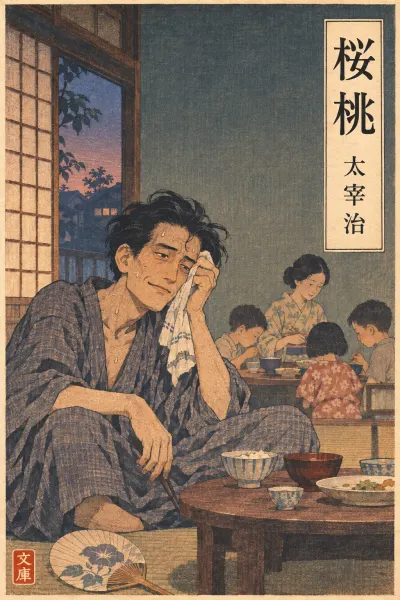
私は黙って立って、六畳間の机の引出しから稿料のはいっている封筒を取り出し、袂につっ込んで、それから原稿用紙と辞典を黒い風呂敷に包み、物体でないみたいに、ふわりと外に出る。Without a word I get up, take the envelope with my manuscript fee out of the desk drawer in the six-mat room, stuff it into my sleeve, then wrap some manuscript paper and a dictionary in a black carrying cloth, and drift out of the house as if I had no body at all.
もう、仕事どころではない。Work is out of the question now.
自殺の事ばかり考えている。I think of nothing but suicide.
そうして、酒を飲む場所へまっすぐに行く。And then I go straight to the place where I drink.
「いらっしゃい」"Welcome."
「飲もう。きょうはまた、ばかに綺麗な縞を、……」"Let's drink. My, you're wearing an awfully pretty striped kimono today..."
「わるくないでしょう? あなたの好く縞だと思っていたの」"Not bad, is it? I thought it was the kind of stripe you'd like."
「きょうは、夫婦喧嘩でね、陰にこもってやりきれねえんだ。飲もう。今夜は泊るぜ。だんぜん泊る」"Had a fight with the wife today, and it's all festering inside. I can't stand it. Let's drink. I'm staying the night. Damn right I'm staying."
子供より親が大事、と思いたい。I want to believe that parents matter more than children.
子供よりも、その親のほうが弱いのだ。After all, the parents are weaker than their children.
桜桃が出た。Cherries were served.
私の家では、子供たちに、ぜいたくなものを食べさせない。In my house we don't let the children eat luxuries.
子供たちは、桜桃など、見た事も無いかもしれない。The children may never even have seen cherries.
食べさせたら、よろこぶだろう。If I gave them some, they would be delighted.
父が持って帰ったら、よろこぶだろう。They would be delighted if their father brought some home.
蔓を糸でつないで、首にかけると、桜桃は、珊瑚の首飾りのように見えるだろう。If you tied the stems together with thread and hung them around your neck, the cherries would look like a coral necklace.
しかし、父は、大皿に盛られた桜桃を、極めてまずそうに食べては種を吐き、食べては種を吐き、食べては種を吐き、そうして心の中で虚勢みたいに呟く言葉は、子供よりも親が大事。But the father eats the cherries heaped on the big plate as if they tasted dreadful, eating and spitting out the stones, eating and spitting out the stones, eating and spitting out the stones, and the words he mutters inside, like a show of bravado, are: parents matter more than children.
Vocabulary
| Word | Meaning | JLPT |
|---|---|---|
| 憂鬱ゆううつ | gloom, depressionA notoriously hard kanji pair. As a な-adjective it means 'gloomy'. | N1 |
| 重態じゅうたい | critical condition, gravely illAlso written 重体. | N2 |
| 見舞いみまい | visit to a sick person見舞いに行く = to go and visit someone who is ill. | N3 |
| お守りおもり | babysitting, looking after (a child)Read おまもり, the same kanji means a protective charm. | — |
| 身内みうち | relatives, family members | — |
| ややこしくややこしい | complicated, tangled, awkwarddictionary form: ややこしいConversational. Often used of messy human situations. | N1 |
| 鎖くさり | chain | N3 |
| 稿料こうりょう | manuscript fee, writer's payShort for 原稿料. | — |
| 袂たもと | kimono sleeve (the hanging part, used as a pocket)The hanging part of a kimono sleeve, used for carrying small things. | — |
| 風呂敷ふろしき | furoshiki (square wrapping cloth)A square cloth for wrapping and carrying things, with no exact English equivalent. | N2 |
| ばかにばかに | awfully, ridiculously (intensifier)Colloquial adverb meaning 'unusually'. It is not an insult here. | — |
| やりきれねえやりきれない | unbearable, can't stand itdictionary form: やりきれないねえ for ない is rough, masculine speech. | — |
| ぜいたくぜいたく | luxurious, extravagantdictionary form: 贅沢Usually written in kana because the kanji are difficult. | N3 |
| 虚勢きょせい | bravado, empty show of strengthCommonly found in 虚勢を張る, 'to put on a bold front'. | — |
Grammar
〜なければならぬ N3 must, have to
This is a literary version of 〜なければならない. The old negative ぬ replaces ない and gives the narration a stiff, bookish tone.
私は子供のお守りをしていなければならぬ。
I would have to stay home and mind the children.
〜かける N3 to start to do; to be in the middle of doing
When attached to a verb stem, かける marks an action that has begun but is not finished. Here he begins speaking and breaks off.
言いかけて、私は、よした。
I started to say it, then stopped.
〜どころではない N2 far from, in no state for
This pattern says that circumstances make something impossible or unthinkable. His mood is so bad that work is out of the question.
もう、仕事どころではない。
Work is out of the question now.
Causative 〜させない N4 not let / not allow someone to do
The negative causative 食べさせない means 'don't let (them) eat'. The children are marked with に as the people who are not allowed.
子供たちに、ぜいたくなものを食べさせない。
We don't let the children eat luxuries.
〜ては〜 (repeated) N3 do A and then B, over and over
The pattern Vては + another verb describes a cycle of two actions that keeps repeating. Repeating the whole phrase three times stresses the mechanical, joyless eating.
食べては種を吐き、食べては種を吐き
eating and spitting out the stones, eating and spitting out the stones