Part 2 of 4 · JLPT N2
桜桃 Ōtō, part 2: Jokes Over a Valley of Tears
In this part
Behind the joking, husband and wife each carry hidden pain. The father is useless at home, works little, and drinks hard, while their four-year-old son cannot stand or speak, a fear the parents dare not say aloud. A newspaper story about a father who killed his mute son drives the narrator to drink in despair, which he explains as the drinking of a timid man who cannot say what he thinks.
AI translation · independently checked
しかし、これは外見。But this is only the surface.
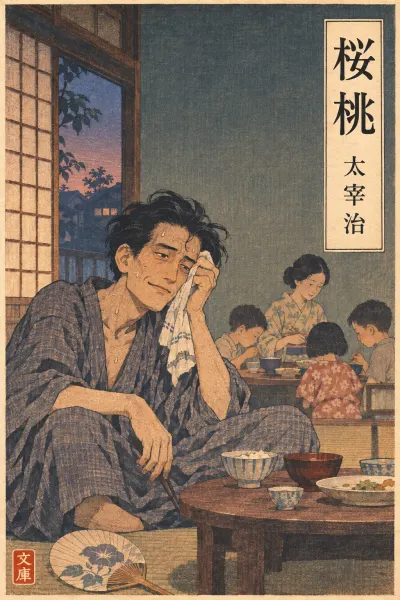
母が胸をあけると、涙の谷、父の寝汗も、いよいよひどく、夫婦は互いに相手の苦痛を知っているのだが、それに、さわらないように努めて、父が冗談を言えば、母も笑う。When the mother bares her chest, there is the valley of tears; the father's night sweats grow worse and worse, and husband and wife each know the other's suffering, yet both try not to touch on it, and when the father makes a joke, the mother laughs too.
しかし、その時、涙の谷、と母に言われて父は黙し、何か冗談を言って切りかえそうと思っても、とっさにうまい言葉が浮かばず、黙しつづけると、いよいよ気まずさが積り、さすがの「通人」の父も、とうとう、まじめな顔になってしまって、But that time, when the mother said "the valley of tears," the father fell silent. He wanted to turn it aside with some joke, but no clever words came to him on the spot, and the longer he kept silent, the more the awkwardness piled up, until even the father, that celebrated "man of the world," ended up with a serious face,
「誰か、人を雇いなさい。どうしたって、そうしなければ、いけない」"Hire someone. One way or another, that's what has to be done."
と、母の機嫌を損じないように、おっかなびっくり、ひとりごとのように呟く。he mutters, nervously, as if to himself, careful not to put the mother out of humour.
子供が三人。Three children.
父は家事には全然、無能である。The father is utterly useless at housework.
蒲団さえ自分で上げない。He does not even put away his own bedding.
そうして、ただもう馬鹿げた冗談ばかり言っている。And he does nothing but make silly jokes.
配給だの、登録だの、そんな事は何も知らない。Rations, registrations, all that sort of thing: he knows nothing about any of it.
全然、宿屋住いでもしているような形。For all the world as if he were lodging at an inn.
来客。Visitors.
饗応。Entertaining them.
仕事部屋にお弁当を持って出かけて、それっきり一週間も御帰宅にならない事もある。Sometimes he takes a packed lunch off to his workroom, and that is the last of him; the gentleman does not deign to come home for a whole week.
仕事、仕事、といつも騒いでいるけれども、一日に二、三枚くらいしかお出来にならないようである。He is forever making a fuss, "Work, work!", and yet it seems he can only manage some two or three pages a day.
あとは、酒。The rest is drink.
飲みすぎると、げっそり痩せてしまって寝込む。When he drinks too much, he grows haggard and takes to his bed.
そのうえ、あちこちに若い女の友達などもある様子だ。On top of that, he seems to have young women friends here and there.
子供、……七歳の長女も、ことしの春に生れた次女も、少し風邪をひき易いけれども、まずまあ人並。The children... the seven-year-old eldest daughter and the second daughter, born this spring, catch cold rather easily, but on the whole they are like anyone else's.
しかし、四歳の長男は、痩せこけていて、まだ立てない。But the four-year-old eldest son is skin and bone and still cannot stand.
言葉は、アアとかダアとか言うきりで一語も話せず、また人の言葉を聞きわける事も出来ない。As for words, he only makes sounds like "ah" and "da"; he cannot say a single word, nor can he make out what other people say.
這って歩いていて、ウンコもオシッコも教えない。He gets about by crawling, and never lets anyone know when he needs to poo or pee.
それでいて、ごはんは実にたくさん食べる。And yet he eats a tremendous amount.
けれども、いつも痩せて小さく、髪の毛も薄く、少しも成長しない。Still, he is always thin and small, his hair is sparse, and he does not grow in the least.
父も母も、この長男について、深く話し合うことを避ける。Father and mother both avoid talking seriously about this son.
白痴、唖、……それを一言でも口に出して言って、二人で肯定し合うのは、あまりに悲惨だからである。Imbecile, mute... to say even one of those words aloud, and to agree on it together, would be far too wretched.
母は時々、この子を固く抱きしめる。The mother sometimes hugs this child tightly.
父はしばしば発作的に、この子を抱いて川に飛び込み死んでしまいたく思う。The father is often seized by a sudden urge to take this child in his arms, leap into the river and die.
「唖の次男を斬殺す。×日正午すぎ×区×町×番地×商、何某(五三)さんは自宅六畳間で次男何某(一八)君の頭を薪割で一撃して殺害、自分はハサミで喉を突いたが死に切れず附近の医院に収容したが危篤、同家では最近二女某(二二)さんに養子を迎えたが、次男が唖の上に少し頭が悪いので娘可愛さから思い余ったもの」"Man Hacks Mute Second Son to Death. Shortly after noon on the —th, Mr. So-and-so (53), a — merchant of No. —, — Street, — Ward, struck his second son, So-and-so (18), on the head with a hatchet in the six-mat room of their home, killing him; he then stabbed himself in the throat with scissors but failed to die, and was taken to a nearby clinic, where he is in critical condition. The family had recently taken in an adopted husband for the second daughter, So-and-so (22), and it appears that, because the second son was mute and also somewhat slow-witted, the father, out of love for his daughter, was driven to desperation."
こんな新聞の記事もまた、私にヤケ酒を飲ませるのである。Newspaper stories like this, too, drive me to drink in despair.
ああ、ただ単に、発育がおくれているというだけの事であってくれたら!Oh, if only it were simply a case of slow development!
この長男が、いまに急に成長し、父母の心配を憤り嘲笑するようになってくれたら!If only this son would suddenly shoot up one day and come to resent and laugh at his parents' worrying!
夫婦は親戚にも友人にも誰にも告げず、ひそかに心でそれを念じながら、表面は何も気にしていないみたいに、長男をからかって笑っている。Telling no one, not relatives, not friends, nobody at all, husband and wife silently pray for this in their hearts, while on the surface they tease their son and laugh, as if nothing at all were on their minds.
母も精一ぱいの努力で生きているのだろうが、父もまた、一生懸命であった。The mother is no doubt living with every ounce of effort she has, but the father, too, was trying with all his might.
もともと、あまりたくさん書ける小説家では無いのである。He was never, to begin with, a novelist who could write very much.
極端な小心者なのである。He is an extremely timid man.
それが公衆の面前に引き出され、へどもどしながら書いているのである。And such a man has been dragged out before the public, and writes in a flustered stammer.
書くのがつらくて、ヤケ酒に救いを求める。Writing is painful, and so he seeks relief in drinking out of despair.
ヤケ酒というのは、自分の思っていることを主張できない、もどっかしさ、いまいましさで飲む酒の事である。Drinking out of despair means drink taken out of the frustration and vexation of being unable to assert what one really thinks.
いつでも、自分の思っていることをハッキリ主張できるひとは、ヤケ酒なんか飲まない。A person who can always state plainly what he thinks has no need of desperate drinking.
(女に酒飲みの少いのは、この理由からである)(This is the reason there are so few drinkers among women.)
Vocabulary
| Word | Meaning | JLPT |
|---|---|---|
| 寝汗ねあせ | night sweats寝 (sleep) + 汗 (sweat); a sign of illness or anxiety. | — |
| 気まずさきまずい | awkwardness, uncomfortable atmospheredictionary form: 気まずい〜さ turns an adjective into a noun: 気まずい → 気まずさ. | — |
| 通人つうじん | man of the world, sophisticateSomeone versed in fashionable pleasures and witty talk; used ironically here. | — |
| おっかなびっくりおっかなびっくり | timidly, nervouslyColloquial; from おっかない (scary) + びっくり (startled). | — |
| 呟くつぶやく | to mutter, to murmur | N1 |
| 無能むのう | incompetent, useless無 (without) + 能 (ability). | N1 |
| 配給はいきゅう | rationing, ration distributionKey word for the post-war setting, when food was distributed by ration. | N1 |
| 饗応きょうおう | entertaining guests with food and drinkFormal, old-fashioned word. | — |
| 寝込むねこむ | to be laid up in bed (from illness) | — |
| 人並ひとなみ | ordinary, average, like other peopledictionary form: 人並みOlder spelling without み. | — |
| 悲惨ひさん | miserable, wretched, tragic | N1 |
| 発作的ほっさてき | sudden, impulsive (like a fit)発作 = a fit or seizure; 〜的 makes it an adjective. | — |
| ヤケ酒やけざけ | drinking out of despair or frustrationdictionary form: やけ酒From やけ (desperation); 酒 becomes ざけ by rendaku. A key word of the story. | — |
| へどもどへどもど | flustered, stammeringOld-fashioned mimetic word, similar to しどろもどろ. | — |
Grammar
〜ないように努める N3 to try hard not to ~
ように after a negative verb names the result one wants to avoid, and 努める means 'to make an effort'. Here both partners deliberately avoid touching each other's pain.
それに、さわらないように努めて
taking care not to touch it
お/御〜になる (honorific) N4 respectful form of a verb
Respectful pattern お/御 + verb stem or Sino-Japanese noun + になる. お出来になる (お + 出来, the stem of 出来る) and 御帰宅にならない (御 + 帰宅) are honorifics. The narrator is the father himself, who calls himself 父 in the third person. He applies these honorifics to himself ironically, in a self-mocking voice ('His Lordship does not deign to come home').
それっきり一週間も御帰宅にならない事もある
and sometimes the gentleman does not deign to come home for a whole week
〜しか〜ない N4 only ~ (and no more)
しか always pairs with a negative verb and stresses how little there is. Here it mocks how few pages he writes.
一日に二、三枚くらいしかお出来にならないようである
it seems he can only manage some two or three pages a day
〜きり N2 only ~, nothing but ~
Following a verb, きり limits the action to that and nothing more: the boy just says 'ah' and 'da'. The same word appears as それっきり ('and that's the last of it').
アアとかダアとか言うきりで一語も話せず
he only makes sounds like 'ah' and 'da' and cannot say a single word
〜合う N3 to do ~ to each other, together
Attached to a verb stem, 合う makes the action mutual. 肯定し合う means both parents confirming it to one another.
二人で肯定し合うのは、あまりに悲惨だからである
because for the two of them to agree on it together would be far too wretched
〜てくれたら! N3 if only ~ would happen (for me)!
The conditional たら with the main clause left out expresses a wish, and くれる shows that the speaker would receive the benefit. It turns into a heartfelt 'if only'.
ああ、ただ単に、発育がおくれているというだけの事であってくれたら!
Oh, if only it were simply a case of slow development!