Part 1 of 5 · JLPT N2
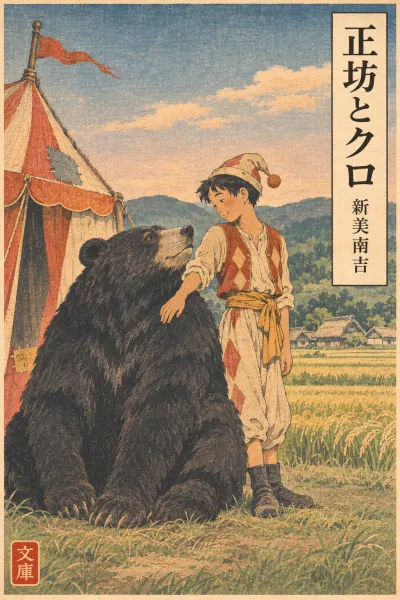
正坊とクロ(一) Shōbō to Kuro, part 1: The Circus Bear Falls Ill
In this part
A small travelling circus arrives in a village, and the villagers excitedly welcome it. On the third afternoon of shows, the old bear Kuro is suddenly in great pain and refuses all medicine, so the clown goes on stage in his place. Someone says Kuro would take his medicine from Shōbō, so the ringmaster sends the dancer Ochiyo galloping on horseback to the next village to fetch him.
AI translation · independently checked
村むらを興行して歩くサーカス団がありました。There was once a circus troupe that travelled from village to village giving shows.
十人そこそこの軽業師と、年をとった黒くまと馬二とうだけの小さな団です。It was a small troupe of ten or so acrobats, an old black bear and just two horses.
馬は舞台に出るほかに、つぎの土地へうつっていくとき、赤いラシャの毛布などをきて、荷車をひくやくめをもしていました。Besides appearing on stage, the horses also had the job of pulling the carts whenever the troupe moved on to the next place, dressed in red woollen blankets and the like.
ある村へつきました。One day they arrived in a certain village.
座員たちは、みんなで手わけして、たばこ屋の板かべや、お湯屋のかべに、赤や黄色ですった、きれいなビラをはって歩きました。The members of the troupe split up the work among themselves and went around sticking pretty posters, printed in red and yellow, on the wooden walls of the tobacco shop and the walls of the bathhouse.
村のおとなも子どもも、つよいインキのにおいのするそのビラをとりまいて、おまつりのようによろこびさわぎました。The grown-ups and children of the village crowded around those posters, which smelled strongly of ink, and made a joyful fuss as if it were a festival.
テントばりの小屋がかかってから、三日めのお昼すぎのことでした。It happened just after noon on the third day after the tent show had been set up.
見物席から、わあっという歓声といっしょに、ぱちぱちと拍手の音がひびいてきました。From the audience seats came a great cheer, together with the clap-clap of applause.
すると、ダンスをおわったお千代さんが、うすももいろのスカートをひらひらさせて、舞台うらへひきさがってきました。Then Ochiyo, who had finished her dance, came back behind the stage with her pale pink skirt fluttering.
つぎは、くまのクロが出る番になっていました。Next it was the turn of Kuro the bear.
くまつかいの五郎が、ようかん色になったビロードの上着をつけ、長ぐつをはいて、シュッシュッとむちをならしながら、おりのそばへいきました。Gorō the bear trainer, wearing a velvet jacket faded to the colour of sweet bean jelly and a pair of tall boots, went over to the cage, cracking his whip with a swish, swish.
「さあ、クロ公、出番だ。しっかりたのむよ」"Come on, Kuro old boy, you're on. I'm counting on you."
と、わらいながらとびらをあけましたが、どうしたのか、クロはいつものように立ちあがってくるようすが見えません。He opened the door with a laugh, but for some reason Kuro showed no sign of getting up and coming out as he always did.
おやと思って、五郎がこごんでみますと、クロはからだじゅうあせだくになって、目をつむり、歯をくいしばって、ふといいきをついているのです。Wondering what was wrong, Gorō bent down to look, and there was Kuro, drenched in sweat from head to toe, with his eyes shut and his teeth clenched, breathing heavily.
「たいへんだ、団長さん。クロがはらいたをおこしたらしいです」"This is terrible, boss! Kuro seems to have a stomach ache."
団長もほかの座員も、ドカドカとあつまってきました。The ringmaster and the other members of the troupe all came thundering over.
五郎は団長とふたりがかりで、竹の皮でくるんだ、黒い丸薬をのませようとしましたが、クロはくいしばった口からフウフウあわをふきふき、首をふりうごかして、どうしても口をひらきません。Gorō and the ringmaster together tried to make Kuro swallow some black pills wrapped in bamboo sheath, but Kuro kept blowing froth, puff, puff, from his clenched mouth and shaking his head, and he would not open his mouth no matter what.
しばらくして、ピリピリッとおなかのあたりが波をうったと思いますと、クロは四つんばいになって、おりの中をこまのようにくるいまわりました。After a while his belly gave a sudden twitching ripple, and then Kuro got down on all fours and whirled madly around the cage like a spinning top.
それから、わらのとこにドタリとたおれて、ふうッと大きくいきをふいて、目をショボショボさせています。After that he collapsed with a thud onto his bed of straw, let out a big huff of breath, and lay there blinking his weary eyes.
見物席のほうからは、つぎの出しものをさいそくする拍手の音が、パチパチひびいてきます。From the audience seats came the clap-clap of applause, urging on the next act.
そこでとうとう、道化役の佐吉さんが、クロにかわって、舞台に出ることにしました。So in the end it was decided that Sakichi, the clown, would go on stage in Kuro's place.
そのとき、だれかが、Just then, someone said,
「正坊がいたら、薬をのむがなあ」"If only Shōbō were here, Kuro would take his medicine."
と、ためいきをつくようにいいました。as if letting out a sigh.
団長は、The ringmaster
「そうだ。お千代、正坊をつれてこい」"That's it. Ochiyo, go and fetch Shōbō!"
と、ふといだみ声でめいじました。ordered in his thick, gravelly voice.
お千代は馬を一とうひきだして、ダンスすがたのまま、ひらりとまたがると、白いたんぼ道を、となり村へむかってかけていきました。Ochiyo led out one of the horses, swung lightly up onto its back, still in her dancing costume, and galloped off along the pale road between the rice fields towards the neighbouring village.
Vocabulary
| Word | Meaning | JLPT |
|---|---|---|
| 興行こうぎょう | putting on a show; a public performanceUsed for circuses, sumo, theatre and other paid entertainment. | — |
| そこそこそこそこ | about, barely (after a number)十人そこそこ means roughly ten, not many more. | — |
| 軽業師かるわざし | acrobat軽業 (light feats) plus 師 (practitioner); an old-fashioned word. | — |
| やくめやくめ | job, duty, roledictionary form: 役目 | N2 |
| 手わけてわけ | dividing up the workdictionary form: 手分けUsed as 手分けする. | N1 |
| ビラびら | poster, handbill | — |
| 小屋こや | hut; here, a show tent or booth小屋がかかる means a show booth is put up. | N3 |
| 歓声かんせい | cheer, shout of joy | N1 |
| 出番でばん | one's turn to go on stage | — |
| くいしばってくいしばる | to clench (one's teeth)dictionary form: 食いしばるAlmost always used as 歯を食いしばる. | — |
| はらいたはらいた | stomach achedictionary form: 腹痛Casual reading; the formal reading is ふくつう. | — |
| 丸薬がんやく | pill (traditional medicine)丸 is read がん here, not まる. | — |
| さいそくさいそく | urging, pressing fordictionary form: 催促 | N2 |
| だみ声だみごえ | thick, hoarse voice | — |
Grammar
〜て歩く N3 go around doing ~
The て-form plus 歩く describes going around from place to place doing an action. Here the troupe travels from village to village giving shows.
村むらを興行して歩くサーカス団がありました。
There was once a circus troupe that travelled from village to village giving shows.
〜ほかに N3 besides ~, apart from ~
Attached to a plain verb, it adds a further activity. It is followed by も, as in やくめをもしていました.
馬は舞台に出るほかに、つぎの土地へうつっていくとき、赤いラシャの毛布などをきて、荷車をひくやくめをもしていました。
Besides appearing on stage, the horses also had the job of pulling the carts whenever the troupe moved on to the next place, dressed in red woollen blankets and the like.
〜ようすが見えない N3 show no sign of ~
ようす means 'appearance' or 'signs'. With 見えません it says nothing suggests the action is about to happen.
クロはいつものように立ちあがってくるようすが見えません。
Kuro showed no sign of getting up and coming out as he always did.
Verb stem repeated (ふきふき) N1 keep doing ~ (while doing something else)
Repeating a verb's ます-stem is a literary way to show an action repeated over and over while another action happens. ふきふき means 'blowing and blowing'.
クロはくいしばった口からフウフウあわをふきふき、首をふりうごかして
Kuro kept blowing froth, puff, puff, from his clenched mouth and shaking his head
〜たと思うと N2 no sooner had ~ than; just as ~
This shows that a second event follows immediately after the first. Here it is the polite form と思いますと.
ピリピリッとおなかのあたりが波をうったと思いますと、クロは四つんばいになって
his belly gave a sudden twitching ripple, and then Kuro got down on all fours
〜たら…がなあ N3 if only ~, then … (wishful)
たら sets up a hypothetical condition ('if Shōbō were here'). The sentence-final が(なあ) leaves the thought trailing off, implying 'but he isn't here', and gives the line a wistful tone: 'if Shōbō were here, he'd take his medicine (but…)'.
「正坊がいたら、薬をのむがなあ」
"If only Shōbō were here, Kuro would take his medicine."