Upper intermediate · JLPT N2
正坊とクロShōbō to Kuro — Shōbō and Kuro the Circus Bear
- JLPT N2
- 4,399 characters
- 5 parts
- about 37 minutes
- 2 easier versions
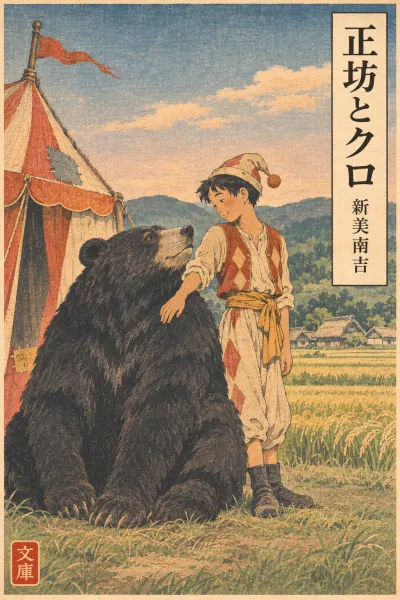
Shōbō and Kuro is a short children's story by Niimi Nankichi. It follows a small travelling circus that tours country villages, and the bond between Shōbō, a boy acrobat, and Kuro, the circus's old black bear. When Kuro suddenly falls ill and refuses all medicine, the one person he might accept it from is Shōbō. But Shōbō is in a hospital in the next village with an injured leg. From there the story moves through comic moments on stage and into harder times as the little troupe struggles to get by. The narrator uses a gentle です/ます style. The conversations between Shōbō and the young dancer Ochiyo are casual and childlike, so you practise both polite narration and everyday spoken Japanese. The tone blends warmth, humour and quiet sadness. At about 4,400 characters in five parts, the story is short enough to finish in a few sittings. It is measured at N2, though, so expect circus vocabulary and lively descriptions of movement. You will also meet patterns such as 〜たと思うと and repeated verb stems like ふきふき.
Contents
Easier versions
This story is also retold in simpler Japanese. Reading an easier version first makes the original much more approachable.
Before you read
- Learn the cast first: 正坊 (しょうぼう, also called 正ちゃん), クロ, お千代 (おちよ), 五郎 (ごろう), 佐吉 (さきち). Shōbō also plays a stage role, ソコヌケ将軍 (そこぬけしょうぐん), in the circus skit, so don't mistake that name for a new character.
- Watch for repeated verb stems such as ふきふき ('wiping again and again'), which show an action continuing while something else happens. 〜ながら and 〜て歩く do similar work in describing ongoing movement.
- 〜たと思うと marks something happening the instant after something else ('no sooner had… than…'). 〜たまま means 'while still in that state'. Both appear at moments of sudden action, such as Kuro's reactions.
- Notice how the narrator hedges with 〜ようです and how characters use 〜みたいだ. Both mean 'seems / looks like', but the first is polite narration and the second is casual speech. 〜ようすが見えない ('shows no sign of…') is used to describe how characters, including Kuro, are feeling.
- 〜たら…がなあ expresses a wistful wish ('if only…'). It carries much of the story's feeling, so pay attention to who says it and about what.
Words to know
The most useful words from the notes across the story.
| Word | Meaning | JLPT |
|---|---|---|
| 興行こうぎょう | putting on a show; a public performanceUsed for circuses, sumo, theatre and other paid entertainment. | — |
| 軽業師かるわざし | acrobat軽業 (light feats) plus 師 (practitioner); an old-fashioned word. | — |
| はらいたはらいた | stomach achedictionary form: 腹痛Casual reading; the formal reading is ふくつう. | — |
| 丸薬がんやく | pill (traditional medicine)丸 is read がん here, not まる. | — |
| かんごふかんごふ | nursedictionary form: 看護婦An older word; modern Japanese uses 看護師 (かんごし). | N4 |
| 小屋こや | hut; here, a show tent or booth小屋がかかる means a show booth is put up. | N3 |
| ながめていましたながめる | to gaze at; to look out atdictionary form: 眺めるSuggests looking calmly at a view for a while. | N3 |
| かわれるかう | to be kept (as an animal)dictionary form: 飼うPassive of 飼う 'to keep or raise an animal'. Do not confuse it with 買う 'to buy', which has the same reading. | N3 |
| うなりうなる | to hum (a tune); to groan, growldictionary form: 唸るHere it means humming a melody without words. | N3 |
| やくめやくめ | job, duty, roledictionary form: 役目 | N2 |
| さいそくさいそく | urging, pressing fordictionary form: 催促 | N2 |
| つたわってつたわる | to go along (a path or corridor)dictionary form: 伝わるHere it means moving along something, not 'to be conveyed'. | N2 |
| かわいがっているかわいがる | to dote on; to treat with affectiondictionary form: 可愛がる | N2 |
| おしいおしい | regrettable, a shame to losedictionary form: 惜しいおしいことをした: 'what a loss', said when something valuable is lost. | N2 |
| いよいよいよいよ | now really, finally (things have come to this) | N2 |
Plot summary
Show the full summary (contains spoilers)
A small travelling circus arrives in a village. On the third afternoon of shows, the old bear Kuro is in great pain and refuses his medicine. Shōbō, the boy acrobat Kuro trusts, has hurt his leg and is in a hospital in the next village. The dancer Ochiyo rides there on horseback, and Shōbō, saying he has recovered, rides back with her. He calms Kuro by singing their stage tune, and Kuro swallows the medicine. Later the clown Sakichi runs away, and the ringmaster plays a bandit in a skit. Kuro thinks Shōbō is really in danger and carries the boy out of the tent in his mouth, and the audience loves it. Then a horse dies, the other acrobats desert, and the circus breaks up. Kuro is sold to a town zoo, and Shōbō and Ochiyo are given jobs at a knitwear factory. In his cage, Kuro pines for them. On their first day off they visit. Shōbō hums 'The Brave Sailor', Kuro marches as he did in the circus, and he cries out with joy.
About the author
Niimi Nankichi was a Japanese writer of children's stories, poems and songs from Handa in Aichi Prefecture. The countryside of that area is widely thought to lie behind the village and hills of Gongitsune. He began writing as a young man. Gongitsune appeared in the children's magazine Akai Tori (The Red Bird), edited by Suzuki Miekichi. Niimi later worked as a teacher at a girls' school while continuing to write. His health was poor, and he died of tuberculosis while still in his twenties. Many of his works were published and became widely known only after his death. Besides Gongitsune, he is especially remembered for Tebukuro wo Kai ni (Buying Mittens).