Part 3 of 5 · JLPT N2
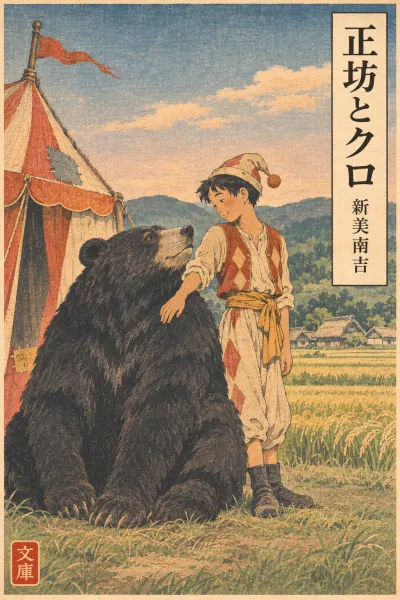
正坊とクロ(三) Shōbō to Kuro, part 3: Kuro Rescues Shōbō on Stage
In this part
Shōbō calms the sick bear Kuro by singing their stage tune and gets him to swallow his medicine, and the two become closer than ever. Later, when the clown Sakichi runs away, the fat ringmaster takes his place in a comic skit as a bandit. Kuro thinks the ringmaster is really about to beat Shōbō, so he snatches the boy up in his mouth and runs out of the tent, and the delighted audience cheers even more.
AI translation · independently checked
「クロ、ぼくだよ。クロ」"Kuro, it's me. Kuro."
正坊は手のひらに丸薬をのせて、右手でかるく、クロの鼻のうえをなでさすりました。Shōbō placed the pill on his palm and, with his right hand, gently stroked the top of Kuro's nose.
クロはさっきよりは、いくらかおちついていましたが、でも目のいろは、まだとろりとうるんで、生気がありません。Kuro was somewhat calmer than he had been a little while before, but his eyes were still dull and watery, with no life in them.
ふうふういきをするたびに、鼻さきのわらくずが動きます。Each time he huffed and puffed, the bits of straw at the tip of his nose stirred.
正坊はふと思いついて、「ゆうかんなる水兵」の曲をウウウ、ウ、ウと、うたいだしました。Then an idea suddenly came to Shōbō, and he began to hum the tune of "The Brave Sailor": "Hmm-hmm-hmm, hmm, hmm."
それは、いつも、正坊とクロが舞台に出ていくときの、たのしい曲なのです。It was the cheerful tune that always played whenever Shōbō and Kuro went out on stage.
クロは正坊のうた声をきいて、しばらく耳をぴくぴくさせていましたが、やがてヒョコリと立ちあがりました。When Kuro heard Shōbō singing, he twitched his ears for a while, and before long he got up onto his feet with a little bob.
正坊がすかさず、手のひらの丸薬を口の中へおしこむと、クロはぞうさなく、ペロリとのみこみました。Without missing a beat, Shōbō pushed the pill from his palm into Kuro's mouth, and Kuro swallowed it down in one easy gulp.
こんなことがあってから、正坊とクロは、まえよりもまたいっそう、はなれられないなかよしになり、見物人からも、団の人気者にされました。After this, Shōbō and Kuro became even closer friends than before, friends who could not be parted, and the audiences made them the favourites of the whole troupe.
これも、やはり、ある村で興行していたときでした。This, too, happened while the circus was putting on shows in a certain village.
いつも正坊やクロといっしょに出て、喜劇をする道化役の佐吉さんが、一座からぬけて、にげ出してしまったので、そのかわりを、ふとった団長がつとめることになりました。Sakichi, the clown who always went on with Shōbō and Kuro to perform a comic act, had left the troupe and run away, so it was decided that the fat ringmaster would take his place.
「クロ、出る番だよ」"Kuro, it's our turn to go on."
正坊はクロをおりの中から出すと、れいによって鼻のうえをなでさすりながら、クロの大すきなビスケットを、口の中へいれてやりました。As soon as Shōbō let Kuro out of his cage, he stroked the top of his nose as usual and popped one of Kuro's favourite biscuits into his mouth.
舞台では留じいさんが「ゆうかんなる水兵」のラッパを、ならしはじめました。On stage, Old Tome began to play "The Brave Sailor" on his trumpet.
ラロララ、ラララ、Ta-ra-ta-ta, ta-ta-ta,
ラロ、ラロ、ラ、Ta-ra, ta-ra, ta,
ラロララ、ラロラ、Ta-ra-ta-ta, ta-ra-ta,
ラロ、ラロラ、Ta-ra, ta-ra-ta,
ラロ、ラロ、ラロラ、Ta-ra, ta-ra, ta-ra-ta,
ラロ、ラロ、ラ。Ta-ra, ta-ra, ta.
正坊は、白い鳥のはねのついたぼうしをかぶり、金ピカのおもちゃのけんをこしにつるして、将軍になりすまして、クロのせなかにのっかりました。Shōbō put on a hat with a white bird's feather in it, hung a shiny gold toy sword at his waist, and, dressed up as a general, climbed onto Kuro's back.
クロはラッパの音に歩調をあわせて、元気よく舞台へ出ていきました。Kuro matched his steps to the sound of the trumpet and marched briskly out onto the stage.
「あらわれましたのは、ソコヌケ将軍に、愛馬クロにござーい」"Behooold! Here comes General Sokonuke and his beloved steed, Kuuuro!"
留じいさんが口上をのべますと、正坊はクロのせなかから、コロリところげ落ちてみせました。As Old Tome gave his announcement, Shōbō made a show of tumbling off Kuro's back with a bump.
見物人はどっとわらって、手をたたきました。The audience burst out laughing and clapped their hands.
「将軍はただいまから、盗賊たいじに出発のところでござーい」"And now the General is about to set out to defeat the baaandits!"
クロが、ああんと赤い口をあけました。Kuro opened his red mouth wide with a big "Aaah."
将軍の正坊は、クロのせなかにまたがったまま、ポケットからビスケットをつかみ出して、口の中へいれてやりました。Still astride Kuro's back, General Shōbō grabbed a biscuit from his pocket and put it into Kuro's mouth.
クロは正坊の手首までくわえてしまいました。Kuro took Shōbō's hand in his mouth right up to the wrist.
正坊は目をパチクリさせて、またクロのせなかから、落っこちてみせて、見物人をよろこばせました。Shōbō blinked his eyes in surprise and once again made a show of falling off Kuro's back, to the delight of the audience.
やがて賊にふんした団長が、銀紙をはったキラキラした大太刀をひっつかんで出てきました。Before long, the ringmaster, dressed up as a bandit, came out gripping a great glittering sword covered in silver paper.
正坊のソコヌケ将軍は、それを見ると、おどろいて、ブルブルふるえながら、剣をほうり出して、クロの首っ玉にしがみつきました。When General Sokonuke, played by Shōbō, saw it, he jumped in fright, threw down his sword, trembling all over, and clung to Kuro's neck.
見物の子どもたちが、またどっと声をあげてわらいました。The children in the audience roared with laughter again.
「こらっ」"Hey, you!"
団長はつけひげをつけた、ひげだらけの顔に、するどくとがった目をむいて、身がまえをしました。The ringmaster, his face covered in a false beard, glared with sharp, piercing eyes and took up a fighting stance.
クロはちらっと、団長のそのおそろしい顔を見ました。Kuro glanced at the ringmaster's frightening face.
それは団長が、いつも正坊をおこりつけるときの顔でした。It was the face the ringmaster always wore when he scolded Shōbō.
そこでクロはてっきり、団長がいつものように、ほんとにおこって、正坊を竹の刀でなぐりつけるのだと思いました。So Kuro was quite sure that the ringmaster was really angry, just as usual, and was going to beat Shōbō with his bamboo sword.
「こらっ」"Hey, you!"
団長はまた、刀をふりかぶりました。Once again, the ringmaster raised his sword high over his head.
と、クロは、ウオウッとひと声ほえるといっしょに、正坊のからだをかるがるとくわえて、あっといううちに、見物人の中をかけぬけて、テントの外へとび出してしまいました。At that, Kuro let out a single roar, picked Shōbō up easily in his mouth, and in the blink of an eye dashed through the audience and burst out of the tent.
これには見物人も団長も、留じいさんもあっけにとられてしまいました。The audience, the ringmaster and Old Tome were all left dumbfounded.
正坊もびっくりしてしまいました。Shōbō was astonished too.
やがて、テントの外の原っぱにおろされると、正坊は、クロの頭やせなかをやさしくなでまわして、なだめすかしました。At last, when he was set down in the field outside the tent, Shōbō gently stroked Kuro's head and back all over, soothing and coaxing him.
そしてやっと、舞台へつれてかえると、まず見物席にむかっておわびをいい、賊のすがたの団長にあやまりました。When he finally brought Kuro back to the stage, he first apologised to the audience, and then said sorry to the ringmaster in his bandit costume.
見物人はかえって、やんやとはしゃぎさわいでよろこびました。The audience, if anything, was all the more delighted, cheering and making a great happy din.
団長は舞台のうしろで、にがわらいをしていました。Behind the stage, the ringmaster wore a wry smile.
Vocabulary
| Word | Meaning | JLPT |
|---|---|---|
| 丸薬がんやく | pill (of medicine)丸 is read がん here, not まる; an old-fashioned word for a round pill. | — |
| なでさすりましたなでさする | to stroke and rub gentlydictionary form: なでさするCompound of なでる (to stroke) and さする (to rub); suggests tender, repeated stroking. | — |
| 生気せいき | life, vitality生気がない = lifeless, listless. | — |
| すかさずすかさず | immediately, without missing a beatActing at exactly the right moment, before the chance is lost. | — |
| ぞうさなくぞうさない | easily, without any troubledictionary form: 造作ないUsually written 造作なく. | — |
| 興行こうぎょう | staging a show; a performance runUsed for circuses, theatre and sumo tours. | — |
| 道化役どうけやく | clown role, the clown道化 = clowning; 役 = role. | — |
| 一座いちざ | troupe (of performers) | — |
| なりすましてなりすます | to pose as, dress up asdictionary form: なりすますPretending to be someone else completely. | — |
| 口上こうじょう | announcement, showman's patter口上をのべる = to make a formal announcement on stage. | — |
| ふんしたふんする | to dress up as, play the part ofdictionary form: 扮するTakes に: 賊にふんする = to play a bandit. | — |
| てっきりてっきり | surely, certainly (wrongly assuming)Marks a confident belief that turns out to be mistaken. | N1 |
| あっけにとられてあっけにとられる | to be dumbfounded, taken abackdictionary form: 呆気に取られる | — |
| にがわらいにがわらい | wry smile, bitter laughdictionary form: 苦笑いLiterally a 'bitter laugh': smiling at an awkward situation. | — |
Grammar
〜たびに N3 every time ~
Attached to a dictionary-form verb, it means that each time the first action happens, the second follows. Here, every breath moves the straw.
ふうふういきをするたびに、鼻さきのわらくずが動きます。
Each time he huffed and puffed, the bits of straw at the tip of his nose stirred.
〜ことになる N4 it is decided that ~; it turns out that ~
It describes an arrangement that came about through circumstances or someone else's decision, not the speaker's own choice. Because Sakichi ran away, the ringmaster ended up filling in.
そのかわりを、ふとった団長がつとめることになりました。
It was decided that the fat ringmaster would take his place.
〜てみせる N3 to do something for show; to demonstrate
The て-form plus みせる means doing an action deliberately so others will see it. Shōbō falls off on purpose as part of the comedy.
正坊はクロのせなかから、コロリところげ落ちてみせました。
Shōbō made a show of tumbling off Kuro's back with a bump.
〜にござーい (でござる) N1 is / are (old-fashioned, very formal announcer style)
ござる is an archaic polite form of ある/です. The stretched ござーい imitates a showman's drawn-out call to the crowd.
あらわれましたのは、ソコヌケ将軍に、愛馬クロにござーい
Behooold! Here comes General Sokonuke and his beloved steed, Kuuuro!
〜たまま N4 while still ~; leaving something as it is
It follows a past-tense verb and shows that a state continues unchanged while something else happens. Shōbō stays seated on Kuro while feeding him.
将軍の正坊は、クロのせなかにまたがったまま、ポケットからビスケットをつかみ出して
Still astride Kuro's back, General Shōbō grabbed a biscuit from his pocket
〜うちに N3 while; before (something changes)
あっというまに / あっといううちに is a set phrase meaning 'in the time it takes to say ah', so 'in an instant'.
あっといううちに、見物人の中をかけぬけて、テントの外へとび出してしまいました。
In the blink of an eye, he dashed through the audience and burst out of the tent.