 N4 · easy
Simplified retelling · JLPT N4
あじさい Ajisai in easy Japanese (N4)
This is our own simplified retelling of Hydrangea Weather, written for N4 learners and checked word by word against the N4 vocabulary list. A few story words and grammar patterns go beyond N4; the notes below give each one's level. It keeps the characters, events and ending of the original. When it feels easy, move on to the original text.
The story in brief
A woman tells a man that her late husband somehow knew, and that the thought troubles her. The man silently recalls how he once wished that husband dead. When the sun briefly comes out, he suggests hydrangeas for the garden, but she objects. Then her sick little daughter suddenly cries out for her father and stares into a corner of the altar room.
AI translation · independently checked
「あの人が長い病気のあとで死んだのでしたら、きっと私たちのことを、いいとか、だめだとか、はっきり話したでしょう。わたしはそう思います。」"If he had died after a long illness, I'm sure he would have told us plainly whether it was all right or not. That's what I think."
女の目にはなみだがありました。There were tears in the woman's eyes.
「あなたはあれから七年も、ずっと一人でいます。わたしはたまにおてらへ話を聞きに行きます。どうしてか、あの人は知っていました。口では何も話しませんでしたが、知っていました。だから、わたしにもっとやさしくしたのでしょう。それを思うと、わたしはどうしたらいいか分かりません。こんな話をするのも、悪い気持ちがします。」"For seven whole years since then, you have stayed alone. And I go to the temple now and then to hear the sermons. Somehow, he knew. He never said a word about it, but he knew. That must be why he was kinder to me than ever. When I think of that, I don't know what I should do. Even talking like this makes me feel I'm doing something wrong."
男は心の中で、その言葉を思い出しました。In his heart, the man went back over her words.
女の気持ちが、男にも少し分かるように思いました。He felt he could understand a little of how she felt.
男にも、女に話すかどうか、まだきめていないことがありました。The man, too, had something he had not yet decided whether to tell her.
それはこういうことです。It was this.
「あの男が死んでくれたらいい。」男はそのあと、よくそう思いました。"If only that man would die." After that, the man often thought so.
女のおっとがおぼれて死んだころも、男はとおくで何も知りませんでした。When the woman's husband drowned, the man was far away and knew nothing of it.
でも、そのころも、男はそう思っていたかもしれません。And yet, even then, he may well have been thinking it.
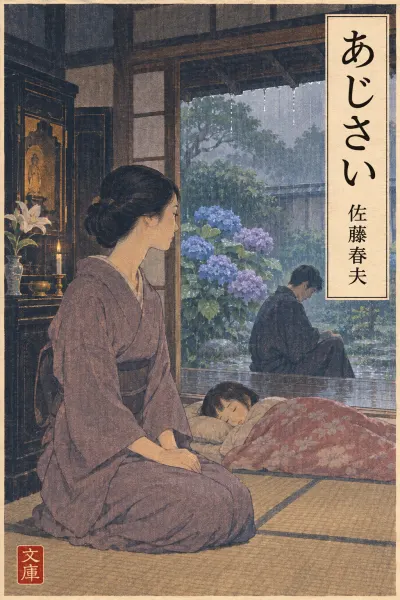
ぶつだんのある小さなへやに、病気の女の子がねています。In the small room with the household altar, a sick little girl lies asleep.
六つの子です。She is six years old.
白くて、やせています。She is pale and thin.
女は少しとおいところにすわって、ひくい音でしゃみせんをひいています。The woman sits a little way off, playing the shamisen softly, in a low tone.
目はたたみを見ています。Her eyes are on the tatami.
男も同じところを見て、考えつづけていました。The man, too, looked at the same spot and kept on thinking.
でも、そんなことを考えるのはやめようと思って、女のほうを見ました。But he told himself he would stop thinking such things, and looked toward the woman.
女は少し赤くなったように見えました。She seemed to have flushed slightly.
すると、へやの中に日のひかりが入って、しょうじが白くひかりました。Just then, sunlight came into the room, and the paper screens shone white.
「ああ、日が出てきたわ。」"Oh, the sun has come out."
女は小さな声でそう話して、しょうじを開けました。The woman said this in a small voice and slid the paper screen open.
くもの向こうに、青い空が少し見えます。Beyond the clouds, a little blue sky could be seen.
雨の多い季節の、少しのはれです。It was a brief clearing in the season of rains.
女は空を見て、それから男のほうを見ました。The woman looked at the sky, and then at the man.
少しへんなわらい方でした。It was a slightly strange smile.
まだなみだがのこる目が、ひかっていました。Her eyes, still wet with tears, were shining.
男はその目を見ることができませんでした。The man could not look into those eyes.
それで、にわのほうを見ました。So he looked out toward the garden.
家の上から、雨の水がひかりながら、ぽたぽたと下りています。From the roof, rainwater was dripping down, drop by drop, glinting as it fell.
「このにわには、あじさいがあってもいいですね。」"It would be nice to have hydrangeas in this garden, wouldn't it?"
男はそんなことを話しました。That was the sort of thing the man said.
「いやですよ、あじさいは。病気の人がいつも家にいる花だと聞きます。」"Oh no, not hydrangeas. I've heard they're the flower of a house where there's always someone ill."
「そうですね。そんな話もありますね。」"Ah, yes. People do say that, don't they."
女はまたしゃみせんを持ちました。The woman took up the shamisen again.
男は急に起きて、すわりました。The man suddenly sat up straight.
ろうかに人が来たように思ったのです。He thought someone had come into the corridor.
「ばあやがもう帰ったのかしら。」"I wonder if the old nurse is back already."
女もそう話しました。The woman said so as well.
すると、ねていた子どもが、急に大きな声でなきはじめました。Then the sleeping child suddenly began to cry out loudly.
お母さんはしゃみせんをおいて、子どものそばへ行きました。Her mother put down the shamisen and went to the child's side.
「お父さん!お父さん!お父さん!」"Father! Father! Father!"
子どもはお母さんを見ようとしません。The child will not look at her mother.
ただ、そうよびつづけます。She just keeps calling out like that.
「どうしたの。どうしたの。ゆめを見たのね。」"What is it? What's wrong? You had a dream, didn't you?"
女はこまった目で男を見ながら、話しました。The woman said this while looking at the man with troubled eyes.
「ほんとうにへんな子ですよ。今になって、お父さんのことばかりよぶの。それに、このぶつだんのへやでだけ、ねたがるのよ。」"She really is a strange child. Only now does she keep calling for her father. And she wants to sleep only here, in this room with the altar."
男は答えませんでした。The man did not answer.
心が急にさわぎはじめて、みみの中でへんな音がしました。His heart suddenly began to race, and there was a strange sound in his ears.
女は自分の後ろを見ました。The woman looked behind her.
でも、もちろん何もありません。But of course, there was nothing there.
病気でつかれた子どもは、やせて、もっと大きくなった黒い目を開いて、お母さんの後ろの、へやのすみを、いつまでも見ていました。The child, worn out by illness, kept her black eyes open, eyes that had grown larger as she grew thinner, and went on and on staring past her mother into the corner of the room.
Vocabulary
| Word | Meaning | JLPT |
|---|---|---|
| なみだなみだ | tearsdictionary form: 涙Usually written 涙. なみだがある here means her eyes are wet with tears. | N3 |
| おっとおっと | husbanddictionary form: 夫Neutral word for a husband; for someone else's husband, ご主人 is more polite. | N4 |
| おぼれておぼれる | to drowndictionary form: 溺れるおぼれて死ぬ means to die by drowning. | N3 |
| ぶつだんぶつだん | household Buddhist altardictionary form: 仏壇A cabinet altar where the family honours its dead; it makes the room feel connected to the dead husband. | — |
| やせてやせる | to become thindictionary form: 痩せるやせている describes a state: being thin. | N4 |
| しゃみせんしゃみせん | shamisen (a three-stringed Japanese lute)dictionary form: 三味線Played with the verb ひく (弾く). | N1 |
| たたみたたみ | tatami (woven straw floor mats)dictionary form: 畳Rooms are measured in tatami mats. | N4 |
| しょうじしょうじ | sliding paper screendictionary form: 障子A wooden lattice covered with thin paper that lets light through. | N2 |
| はれはれ | clear weather, a sunny breakdictionary form: 晴れNoun form of 晴れる (to clear up). | N5 |
| ろうかろうか | corridor, hallwaydictionary form: 廊下 | N5 |
| ばあやばあや | old nursemaid, elderly maiddictionary form: 婆やOld-fashioned, affectionate word for an elderly woman servant in a household. | — |
| よびつづけますよぶ | to call (out to someone)dictionary form: 呼ぶHere combined with 〜つづける: to keep calling. | N5 |
| さわぎはじめてさわぐ | to be in turmoil, to make a fussdictionary form: 騒ぐ心がさわぐ means one's heart is uneasy or racing. | N4 |
| すみすみ | corner (inside a room)dictionary form: 隅Used for the inner corner of a space; 角 (かど) is an outer corner. | N4 |
Grammar
〜のでしたら / 〜たら N4 if (something had happened)
The polite のでしたら sets up a condition. Followed by でしょう, it expresses an imagined situation that did not actually happen: if he had died of illness, he would have spoken.
あの人が長い病気のあとで死んだのでしたら、きっと私たちのことを、いいとか、だめだとか、はっきり話したでしょう。
If he had died after a long illness, I'm sure he would have told us plainly whether it was all right or not.
〜かどうか N4 whether or not
Attached to a plain-form verb, it turns a yes/no question into part of a larger sentence. Here it marks what he has not yet decided.
男にも、女に話すかどうか、まだきめていないことがありました。
The man, too, had something he had not yet decided whether to tell her.
〜てくれたらいい N4 if only (someone) would…
〜たらいい expresses a wish, and 〜てくれる shows the action would benefit the speaker. Together they express a strong private wish, here a dark one.
「あの男が死んでくれたらいい。」
"If only that man would die."
〜ように見える / 〜ように思う N4 to seem, to look as if; to feel as if
ように after a plain form expresses an impression rather than a certainty. The narrator uses it to show the man's uncertain view of her feelings and of the sounds he hears.
女は少し赤くなったように見えました。
She seemed to have flushed slightly.
〜ようとしない N3 won't (try to) do, refuses to
The volitional form plus とする means "try to". In the negative, it shows a person refusing or making no attempt to do something.
子どもはお母さんを見ようとしません。
The child will not look at her mother.
〜たがる N4 (someone else) wants to
〜たい describes your own wish; 〜たがる describes a wish you can see in another person's behaviour, here the child's.
このぶつだんのへやでだけ、ねたがるのよ。
And she wants to sleep only here, in this room with the altar.