 N5 · easy
Simplified retelling · JLPT N5
あじさい Ajisai in easy Japanese (N5)
This is our own simplified retelling of Hydrangea Weather, written for N5 learners and checked word by word against the N5 vocabulary list. A few story words and grammar patterns go beyond N5; the notes below give each one's level. It keeps the characters, events and ending of the original. When it feels easy, move on to the N4 version or the original text.
The story in brief
In a small house, a widow whose husband drowned seven years ago tells a man, hesitantly, that she wonders what her husband would have said about the two of them. The man silently recalls that he wished for the husband's death, perhaps at the very hour he drowned. When the rain lets up, her sick little daughter wakes crying for her father and stares fixedly at an empty corner of the room behind her mother.
AI translation · independently checked
あめの おおい なつの はじめです。It is the beginning of summer, when the rains are many.
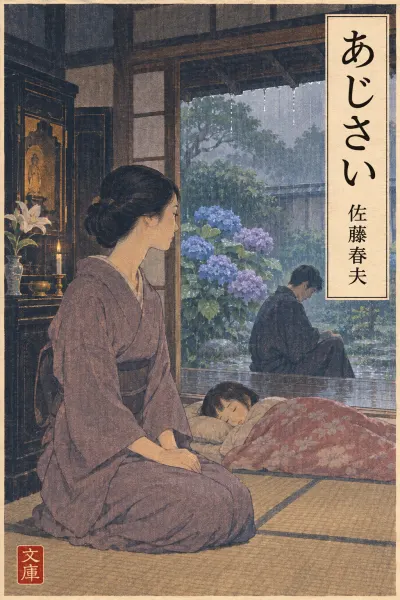
小さな いえの ぶつだんの ある へやに、女の人と 男の人が います。In a small house, in the room where the Buddhist altar stands, there are a woman and a man.
女の人の おっとは、七年前に おぼれて しにました。The woman's husband drowned seven years ago.
とても きゅうでした。It was very sudden.
女の人は、目に なみだを ためて、いいました。With tears welling in her eyes, the woman spoke.
「あの人が もっと ゆっくり しんだら、わたしたちの 話を 何か いったと おもいます。"If he had died more slowly, I think he would have said something about the two of us.
『いい』とか、『いけない』とか。あなたは 七年も 一人です。わたしは ときどき おてらへ 話を 聞きに 行きます。Something like 'It is all right,' or 'It must not be.' You have been alone for seven whole years. I go to the temple now and then to listen to the sermons.
どうしてか、あの人は しっていました。でも、何も いいませんでした。だから、わたしに もっと やさしかったです。Somehow, he knew. But he never said a word. And so he was all the kinder to me.
わたしは、どうしたら いいか、わかりません。こんな 話を するのも、わるいと おもいます。」I don't know what I ought to do. I think it is wrong of me even to talk like this."
男の人は、その ことばを もういちど あたまの 中で いいました。The man said her words over once more inside his head.
女の人が どうして こんな 話を するか、少し わかりました。He understood, a little, why the woman was speaking to him like this.
男の人にも、いいたい ことばが ありました。The man, too, had words he wanted to say.
「わたしは、あの男が しんだら いいと、なんども おもいました。あの人が おぼれた ちょうど その 時間も、たぶん おもって いました。」でも、いうか いわないか、まだ わかりません。"Many times I thought it would be good if that man died. Even at the very hour he drowned, I was probably thinking it." But he still did not know whether he would say it or not.
へやでは、六つの 女の子が ねて います。In the room, a six-year-old girl lies sleeping.
びょうきで、白い かおです。She is ill, and her face is white.
女の人は、しずかに しゃみせんを ひいて います。The woman is quietly playing the shamisen.
すると、へやが 少し あかるく なりました。Then the room grew a little brighter.
「ああ、はれて きましたね。」"Oh, it's clearing up."
女の人は まどを あけて、そらを 見ました。The woman opened the window and looked at the sky.
それから 男の人を 見て、少し へんな かおで わらいました。Then she looked at the man and smiled with a slightly strange expression.
なみだで 目が きれいでした。Her eyes were beautiful with tears.
男の人は、その 目を 見ないで、にわを 見ました。The man did not look into those eyes; he looked at the garden instead.
まどの 上から、あめの みずが おちて います。Rainwater is dripping from above the window.
「この にわには、あじさいが あっても いいですね。」"Hydrangeas would look nice in this garden, wouldn't they?"
「いやですよ、あじさいは。びょうきの 人が いつも いる いえの はなだと いいますよ。」"Oh no, not hydrangeas. They say they are the flower of a house where someone is always sick."
「ああ、そんな 話も ありますね。」"Ah, yes, there is that saying too."
女の人は、また しゃみせんを もちました。The woman took up the shamisen again.
男の人は きゅうに おきて、すわりました。The man suddenly rose from where he lay and sat up.
ろうかに だれか 来たと おもいました。He thought someone had come into the corridor.
「いえの 人が、もう かえりましたか。」"Have the others in the house come back already?"
女の人も いいました。The woman, too, said this.
すると、ねて いた 女の子が、大きな こえで なきました。Just then the little girl, who had been asleep, began to cry in a loud voice.
母は しゃみせんを おいて、女の子の そばへ 行きました。The mother put down the shamisen and went to the girl's side.
「お父さん! お父さん! お父さん!」"Father! Father! Father!"
女の子は 母の かおを 見ないで、なんども よびました。Without looking at her mother's face, the girl called out again and again.
「どうしたの。ゆめを 見たのね。」"What is it? You had a dream, didn't you?"
女の人は 男の人を 見て、いいました。The woman looked at the man and said:
「本当に へんな 女の子です。今、お父さんばかり ほしがります。それに、この ぶつだんの へやでしか ねません。」"She really is a strange little girl. Lately she wants nothing but her father. And she will only sleep in this room with the altar."
男の人は、何も こたえませんでした。The man made no answer at all.
むねが はやく どきどきして、耳も へんでした。His heart was pounding fast, and his ears felt strange as well.
女の人は うしろを 見ました。The woman looked behind her.
でも、そこには 何も ありませんでした。But there was nothing there.
びょうきで ほそく なった 女の子は、大きな くろい 目を あけて、母の うしろの、へやの かどを いつまでも 見て いました。The little girl, grown thin from her illness, opened her large black eyes and kept staring, on and on, at the corner of the room behind her mother.
Vocabulary
| Word | Meaning | JLPT |
|---|---|---|
| ぶつだんぶつだん | household Buddhist altardictionary form: 仏壇A cabinet in the home where the family honours its dead; here it quietly recalls the drowned husband. | — |
| おっとおっと | husbanddictionary form: 夫Used for one's own husband; someone else's husband is usually ごしゅじん. | N4 |
| おぼれておぼれる | to drowndictionary form: 溺れるおぼれてしぬ means 'to drown to death'; おぼれる alone can just mean 'to be drowning'. | N3 |
| なみだなみだ | tearsdictionary form: 涙 | N3 |
| ためてためる | to let collect, to fill updictionary form: 溜める目になみだをためる: tears gather in the eyes but have not yet fallen. | N2 |
| おてらおてら | Buddhist templedictionary form: お寺Shinto shrines are じんじゃ. | — |
| やさしかったやさしい | kind, gentledictionary form: 優しい | N4 |
| しゃみせんしゃみせん | shamisen (three-stringed Japanese lute)dictionary form: 三味線No English equivalent; it is played by plucking with a large pick. 'Play' a stringed instrument is ひく. | N1 |
| はれてはれる | to clear up (of weather)dictionary form: 晴れるはれ alone means 'sunny weather'. | N5 |
| あじさいあじさい | hydrangeadictionary form: 紫陽花Blooms in the rainy season of early summer; the title flower. | — |
| ろうかろうか | corridor, hallwaydictionary form: 廊下 | N5 |
| ゆめゆめ | dreamdictionary form: 夢'To have a dream' is ゆめを見る, literally 'to see a dream'. | N4 |
| どきどきどきどき | thump-thump (a pounding heart)A sound word; どきどきする means 'one's heart races' from fear or excitement. | N2 |
| かどかど | cornerdictionary form: 角へやのかど is a corner of a room; みちのかど is a street corner. | N5 |
Grammar
〜たら N4 if / when (conditional)
The た-form plus ら makes a condition. In しんだら it describes a situation that did not happen, so it means 'if he had died'; in しんだら いい the man thinks 'it would be good if he died'.
あの人が もっと ゆっくり しんだら、わたしたちの 話を 何か いったと おもいます。
If he had died more slowly, I think he would have said something about the two of us.
verb stem + に 行く N5 go (somewhere) in order to do
The masu-stem of a verb (聞き) followed by に shows the purpose of going. 聞きに行きます means 'go to listen'.
わたしは ときどき おてらへ 話を 聞きに 行きます。
I go to the temple now and then to listen to the sermons.
〜て くる N4 change that has begun and is coming on
The て-form plus くる shows a change gradually starting and reaching the speaker. はれてきました means the sky has begun clearing.
ああ、はれて きましたね。
Oh, it's clearing up.
〜ないで N4 without doing; instead of doing
The ない-form plus で links two actions, saying the first one is not done. Here the man avoids her eyes and looks at the garden instead.
男の人は、その 目を 見ないで、にわを 見ました。
The man did not look into those eyes; he looked at the garden instead.
〜ても いい N5 it's fine / it would be nice if
The て-form plus もいい usually gives permission, but here it softly suggests that something would be good. あってもいい means 'it would be nice to have'.
この にわには、あじさいが あっても いいですね。
Hydrangeas would look nice in this garden, wouldn't they?
〜しか 〜ない N4 only (nothing but)
しか always appears with a negative verb, and together they mean 'only'. でしか ねません means she sleeps nowhere except this room.
それに、この ぶつだんの へやでしか ねません。
And she will only sleep in this room with the altar.