 N5 · easy
Simplified retelling · JLPT N5
雨ふり坊主 Amefuribōzu in easy Japanese (N5)
This is our own simplified retelling of Tarō's Rain Doll, written for N5 learners and checked word by word against the N5 vocabulary list. A few story words and grammar patterns go beyond N5; the notes below give each one's level. It keeps the characters, events and ending of the original. When it feels easy, move on to the N4 version or the original text.
The story in brief
During a long dry spell the rice plants begin to wither, and Tarō's father is very worried. Tarō makes a paper rain doll, writes it a letter promising rice wine as a reward, and hangs it on the bush clover behind the house. That night a storm brings heavy rain, but by morning the doll has washed away, so Tarō's father comforts him and promises to pour rice wine into the river for it.
AI translation · independently checked
毎日 いい 天気でした。Day after day, the weather was fine.
雨が ふりません。No rain fell.
たんぼの 水が ありません。There was no water in the rice paddies.
たろうの お父さんは たんぼで はたらいて います。Tarō's father worked in the rice paddies.
いねが かれて きました。The rice plants began to wither.
お父さんは 毎日 外に 出て、そらを 見て いました。Every day Father went outside and looked up at the sky.
とても こまって いました。He was very worried.
たろうは 学校から いえに かえりました。Tarō came home from school.
「お父さんは?」と 聞きました。"Where's Father?" he asked.
お母さんは せんたくを して いました。Mother was doing the washing.
「いねが かれて いますから、たんぼを 見に 行きましたよ。」"The rice is withering, so he's gone to look at the paddies."
たろうは すぐに たんぼへ 走りました。Tarō ran straight off to the paddies.
お父さんは たんぼの 前に たって、そらを 見て いました。Father was standing in front of the paddies, looking at the sky.
「お父さん、雨が ふりませんから、こまって いますか。」"Father, are you worried because it won't rain?"
「ああ。どこの そらも 青いだけだ。こまったなあ。」"Ah, yes. Wherever you look, the sky is nothing but blue. What a fix we're in!"
「ぼくが 雨を よびましょうか。」"Shall I call the rain for you?"
お父さんは 大きな 声で「ははは」と 言いました。Father gave a big, loud laugh: "Ha ha ha!"
「子供には できないよ。」"That's not something a child can do."
「でも、お父さん。うんどうかいの 前に、雨が ふって いましたね。ぼくが てるてるぼうずを つくりました。そして、いい 天気に なりましたね。」"But Father, it was raining before sports day, remember? I made a fair-weather doll. And then the weather turned fine, didn't it?"
「ああ。」"So it did."
「みんな、たろうは りっぱだと 言いました。だから、今から あめふりぼうずを つくります。そして、雨を たのみます。」"Everyone said Tarō had done splendidly. So now I'm going to make a rain doll, and I'll ask it for rain."
「いいね。つくって みなさい。雨が ふったら、ほうびを あげるよ。」"Good idea. Go on, try making one. If it rains, I'll give you a reward."
「ぼくは いりません。ほうびは あめふりぼうずに あげて ください。」"I don't need one. Please give the reward to the rain doll."
たろうは かみを 一まい もって きました。Tarō fetched a sheet of paper.
そして、ひらがなで てがみを 書きました。Then he wrote a letter on it in hiragana.
「てるてるぼうず、天気が 上手ですね。雨も 上手でしょう。たんぼに 水が ありません。"Little fair-weather doll, you are so good at sunshine. Surely you are good at rain as well. There is no water in the paddies.
いねが かれて います。雨を ください。お父さんも お母さんも、ほかの 人も げんきに なります。The rice is withering away. Please give us rain. Then Father and Mother and everyone else will be cheerful and well again.
雨が ふらない ときは、『わるい ぼうず』と 名前を 書いて、ねこに あげます。If no rain falls, I'll write the name 'Bad Doll' on you and give you to the cat.
ほうびに おさけを かけます。たんぼにも いけにも、たくさん 雨を ください。」For your reward, I'll pour rice wine over you. Please send lots and lots of rain, on the paddies and on the pond too."
たろうは その てがみを まるく して、ぼうずの あたまに しました。Tarō rolled the letter up into a ball and made it into the doll's head.
かみの 服も つけました。He gave it clothes made of paper, too.
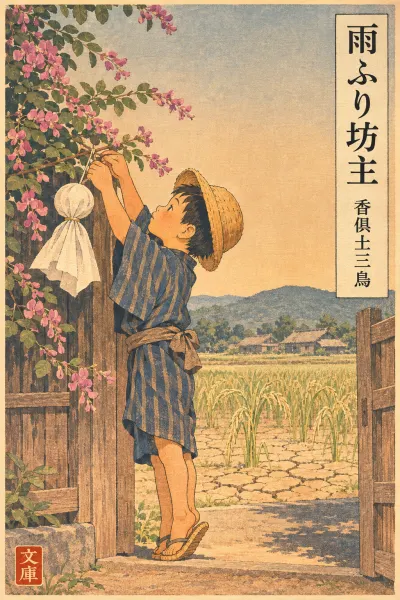
そして、いえの うしろの はぎに かけました。Then he hung it on the bush clover behind the house.
その よる、三人は ねて いました。That night, the three of them were asleep.
よる おそく、そらが あかるく なりました。Late in the night, the sky grew bright.
かみなりです。It was thunder and lightning!
そして、とても 強い 雨が ふりました。And a very heavy rain came pouring down.
たろうは おきました。Tarō woke up.
「ぼくの あめふりぼうずが 本当に 雨を よびました。あめふりぼうずの ところへ 行きます。」"My rain doll really did call the rain! I'm going out to see my rain doll."
「あぶない、あぶない。今は かみなりが あるよ。あしたの あさ 行きなさい。」"No, no, it's dangerous! There's lightning out there now. Go tomorrow morning."
たろうは また ねました。Tarō went back to sleep.
つぎの あさ、たろうは はやく おきました。The next morning, Tarō got up early.
天気は もう いいです。The weather was already fine again.
いけにも たんぼにも 水が たくさん ありました。There was plenty of water in the pond and in the paddies.
みんな とても げんきでした。Everyone was in very high spirits.
お父さんが たんぼから かえりました。Father came home from the paddies.
たろうの あたまに てを おいて、言いました。He laid his hand on Tarō's head and said,
「りっぱだ、りっぱだ。ほうびを あげるよ。」"Well done, well done! I'll give you a reward."
「ぼくは いりません。あめふりぼうずに おさけを かけて ください。」"I don't need one. Please pour rice wine over the rain doll."
「いいよ。あめふりぼうずは どこに いるの?」"All right. Where is the rain doll?"
たろうは お父さんと いえの うしろへ 行きました。Tarō went round behind the house with his father.
はぎの はなが たくさん さいて いました。The bush clover was covered in blossoms.
でも、あめふりぼうずは いませんでした。But the rain doll was not there.
雨の 水と いっしょに、どこかへ 行きました。It had gone off somewhere along with the rainwater.
「おさけを かけると 言いました。でも……」"I said I'd pour rice wine over it. But..."
たろうは なきました。Tarō began to cry.
お父さんは 言いました。Father said,
「あめふりぼうずは 雨を よんで、じぶんで 川へ 行ったよ。たろうは わるく ないよ。お父さんが 川に おさけを 入れるよ。あめふりぼうずは どこかで のむよ。だから、なかないで。たろうには ほかの ほうびを かうよ。」"The rain doll called the rain, and then it went off to the river all by itself. It's not your fault, Tarō. I'll pour some rice wine into the river, and the rain doll will drink it somewhere. So don't cry. I'll buy you a different reward instead."
Vocabulary
| Word | Meaning | JLPT |
|---|---|---|
| たんぼたんぼ | rice paddy, rice fielddictionary form: 田んぼOften written 田んぼ. The kanji 田 is a picture of a field divided into plots. | N2 |
| いねいね | rice plant (growing in the field)dictionary form: 稲Use いね for the plant, こめ for uncooked rice grains, and ごはん for cooked rice. | N3 |
| かれてかれる | to wither, to dry up (of plants)dictionary form: 枯れる | N2 |
| こまってこまる | to be worried, to be in troubledictionary form: 困るOften used in the て-form: こまって いる means 'is in trouble' or 'is at a loss'. | N5 |
| はたらいてはたらく | to work, to labourdictionary form: 働く | N5 |
| せんたくせんたく | washing, laundrydictionary form: 洗濯せんたくを する means 'to do the washing'. | N5 |
| よびましょうよぶ | to call, to summondictionary form: 呼ぶ | N5 |
| てるてるぼうずてるてるぼうず | fair-weather dolldictionary form: てるてる坊主A small white paper or cloth doll that children hang up to wish for sunny weather. ぼうず means 'little monk', because the doll has a round, bald head. | — |
| りっぱりっぱ | splendid, admirable, well donedictionary form: 立派This is a な-adjective, so you say りっぱな 人 ('an admirable person'). | N5 |
| ほうびほうび | reward, prizedictionary form: 褒美ほうびに means 'as a reward'. | N1 |
| おさけさけ | sake, rice winedictionary form: 酒Rice wine was a traditional offering to gods and spirits, so Tarō offers it to his doll. The お is a polite prefix. | N3 |
| はぎはぎ | bush cloverdictionary form: 萩A shrub with small purple flowers that bloom in late summer and autumn. | — |
| かみなりかみなり | thunder, lightning, a thunderstormdictionary form: 雷 | N3 |
| あぶないあぶない | dangerousdictionary form: 危ないSaying it twice, あぶない、あぶない, works as a warning like 'Careful!' | N5 |
Grammar
〜て くる N4 a change that has started and is continuing
When くる follows the て-form, it shows that a change has gradually begun. かれて きました means the rice has started to wither and is getting worse.
いねが かれて きました。
The rice plants began to wither.
Verb stem + に 行く N5 to go in order to do something
The verb stem (the ます-form without ます) plus に shows the purpose of going. 見に 行きました means 'went to look'.
たんぼを 見に 行きましたよ。
He's gone to look at the paddies.
〜ましょうか N5 Shall I...? (offering to do something)
The ましょう form plus the question particle か makes a polite offer to help. Here Tarō offers to call the rain for his father.
ぼくが 雨を よびましょうか。
Shall I call the rain for you?
〜て みなさい N4 try doing...
〜て みる means 'to try doing something to see how it goes'. Adding なさい turns it into a firm but kind instruction, the way a parent speaks to a child.
つくって みなさい。
Go on, try making one.
〜たら N4 if / when...
Add ら to the past plain form to make a condition. ふったら means 'if it rains'.
雨が ふったら、ほうびを あげるよ。
If it rains, I'll give you a reward.
〜ないで N4 please don't...
The ない-form plus で asks someone not to do something. It is the short, casual form of 〜ないで ください, here used gently by a father to his son.
だから、なかないで。
So don't cry.