 N4 · easy
Simplified retelling · JLPT N4
雨ふり坊主 Amefuribōzu in easy Japanese (N4)
This is our own simplified retelling of Tarō's Rain Doll, written for N4 learners and checked word by word against the N4 vocabulary list. A few story words and grammar patterns go beyond N4; the notes below give each one's level. It keeps the characters, events and ending of the original. When it feels easy, move on to the original text.
The story in brief
During a long dry spell, Tarō's father worries that his rice plants will die. Tarō makes a paper rain doll, writes a charm asking it for rain, and that night a thunderstorm fills the fields and ponds. In the morning the doll has washed away, so Tarō cannot give it the promised reward, and his father gently comforts him.
AI translation · independently checked
いい天気が、毎日つづきました。Day after day, the fine weather went on.
どこの田んぼも、水がなくなりました。In every rice field, the water dried up.
たろうのお父さんは、田んぼでこめを作っています。Tarō's father grows rice in the fields.
いねがかれそうになったので、お父さんは毎日外に出ていました。The rice plants looked ready to wither, so his father went outside every day.
そして、空を見て、しんぱいしていました。And he looked up at the sky, worried.
ある日、たろうは学校から帰ると、すぐにお母さんに聞きました。One day, as soon as Tarō came home from school, he asked his mother,
「お父さんは?」"Where is Father?"
お母さんはせんたくをしながら、かなしそうに答えました。His mother was doing the washing, and she answered sadly.
「いねがかれそうだから、田んぼを見に行っているのよ。」"The rice is about to wither, so he has gone to look at the fields."
たろうは田んぼへ走って行きました。Tarō ran off to the rice fields.
お父さんは、しんぱいそうに空を見て立っていました。His father was standing there, gazing anxiously at the sky.
「お父さん、雨がふらないから、しんぱいしているの?」"Father, are you worried because it won't rain?"
「うん。どこを見ても、くもが一つもない。こまったなあ。」"Yes. Wherever I look, there isn't a single cloud. What a fix we're in!"
「ぼくが雨をふらせてあげましょうか。」"Shall I make it rain for you?"
たろうはまじめに聞きました。Tarō asked quite seriously.
お父さんは大きなこえでわらいました。His father laughed in a loud voice.
「たろうの力で、雨がふるはずがないよ。」"There's no way a boy like you could make it rain!"
「でも、お父さん。この間、うんどうかいの前の日まで、雨がふっていたでしょう。ぼくがてるてるぼうずを作ったら、いい天気になりました。みんな、とてもよろこんでいましたよ。」"But Father, the other day it kept raining right up until the day before sports day, didn't it? When I made a sunshine doll, the weather turned fine. Everyone was very happy."
「そうか。てるてるぼうずは、たろうの話をよく聞くんだね。」"Is that so? Then the sunshine doll must listen well to what you tell it."
「はい。だから今度は雨ふりぼうずを作ります。そして、雨をふらせるように、たのみます。」"Yes. So this time I'll make a rain doll. And I'll ask it to make the rain fall."
「それは、みんながよろこぶだろう。やってみなさい。雨がふったら、ごほうびをあげるよ。」"That would make everyone happy. Go on and try it. If it rains, I'll give you a reward."
「ぼくはいりません。雨ふりぼうずにあげてください。」"I don't need one. Please give it to the rain doll."
たろうは紙を一まい持って来て、こう書きました。Tarō fetched a sheet of paper and wrote this on it:
「てるてるぼうず、てるぼうず。"Sunshine doll, oh sunshine doll,
天気にするのが上手なら、If you're so good at making skies fair,
雨をふらせるのも上手でしょう。You must be good at making rain, too.
田んぼの水がなくなって、Our rice fields' water has all run dry,
いねがみんなかれそうです。And all of the rice is about to die.
雨をふらせてください。Please, oh please, bring the rain down.
ぼくのお父さんもお母さんも、My father and my mother, too,
ほかのむらの人たちも、And all the other village folk
とてもよろこぶでしょう。Would be so glad, so very glad.
もし雨がふらなかったら、But if no rain should fall at all,
『うそつき』と書いて、I'll write "Liar" on you,
ねこのおもちゃにするよ。And give you to the cat to play with!
それがいやなら、明日からIf you don't like that, then starting tomorrow,
雨をたくさんふらせてね。Make lots and lots of rain for me.
ごほうびに、おさけをかけてあげる。For your reward, I'll pour rice wine over you.
雨ふりぼうず、ふりぼうず。Rain doll, oh rain doll,
田んぼもいけもいっぱいになるように、So fields and ponds fill to the brim,
雨をたくさんふらせてね。」Make lots and lots of rain for me!"
たろうはその手紙で、雨ふりぼうずのあたまを作りました。Tarō used that letter to make the rain doll's head.
紙の着物も作りました。He made it a paper kimono, too.
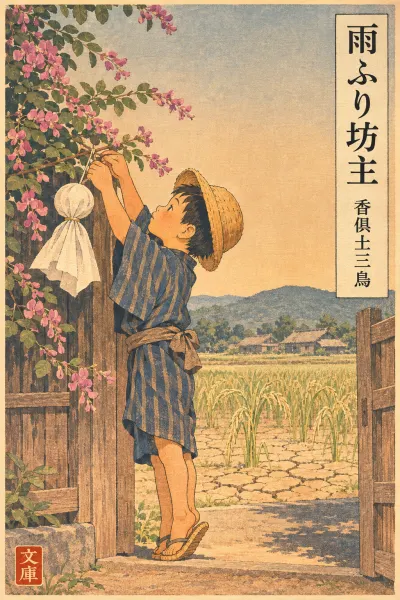
そして、家の後ろの木のえだにつけておきました。Then he tied it to a branch of the tree behind the house and left it there.
その夜、家族三人がねていると、空がぴかぴかひかって、かみなりがなり始めました。That night, while the three of them were asleep, the sky flashed and flickered, and thunder began to rumble.
そして、とても強い雨がふり出しました。And then a very heavy rain began to pour down.
「わあ、ぼくの雨ふりぼうずが、ほんとうに雨をふらせた!」"Hooray, my rain doll really did make it rain!"
たろうは起きました。Tarō got up.
「ぼく、雨ふりぼうずにおれいをしに行きます。」"I'm going to go and thank my rain doll."
たろうは出かけようとしました。Tarō tried to go out.
でも、お父さんとお母さんが止めました。But his father and mother stopped him.
「あぶないよ。今はかみなりがなっている。ゆっくりねて、明日の朝、おれいをしなさい。」"It's dangerous. The thunder is rumbling right now. Have a good long sleep, and thank it tomorrow morning."
たろうは、またねました。Tarō went back to sleep.
つぎの朝、早く起きると、もういい天気になっていました。When he woke early the next morning, the weather had already turned fine.
いけも田んぼも水がいっぱいで、みんなとてもよろこんでいました。The ponds and the rice fields were full of water, and everyone was overjoyed.
田んぼを見に行ったお父さんが、うれしそうに帰って来ました。His father, who had gone to look at the fields, came home looking happy.
そして、たろうのあたまに手をおいて、ほめました。Then he laid his hand on Tarō's head and praised him.
「よくやったね。ごほうびをあげるよ。」"Well done! I'll give you a reward."
「ぼくはいりません。雨ふりぼうずに、おさけをかけてあげてください。」"I don't need one. Please pour some rice wine over the rain doll instead."
「わかった。雨ふりぼうずは、どこにいるんだい?」"All right. So where is this rain doll of yours?"
たろうはよろこんで、お父さんを家の後ろへつれて行きました。Tarō happily led his father around to the back of the house.
でも、そこには雨にぬれた花が、たくさんさいているだけでした。But all that was there were lots of flowers in bloom, wet with rain.
雨ふりぼうずは、どこかへながれて行って、見えなくなっていました。The rain doll had been washed away somewhere and could no longer be seen.
「おさけをかけてあげると、やくそくしたのに……。」"But I promised I would pour rice wine over it..."
たろうはなき出しました。Tarō burst into tears.
お父さんは、やさしく話しました。His father spoke to him gently.
「たぶん、川へながれて行ったんだろう。雨ふりぼうずは、じぶんで雨をふらせて、じぶんでながれて行ったんだ。だから、たろうがうそをついたとは思わないよ。お父さんが川におさけを入れてあげよう。そうしたら、どこかでよろこんで飲むだろう。なかないで。たろうには、別のごほうびを買ってあげるからね。」"It probably washed away into the river. The rain doll made the rain fall all by itself, and then it floated away all by itself. So I don't think you told a lie. I'll pour some rice wine into the river for it. Then it will drink it happily somewhere. Don't cry. I'll buy you a different reward."
Vocabulary
| Word | Meaning | JLPT |
|---|---|---|
| つづきましたつづく | to continue, to go ondictionary form: 続くIntransitive. The transitive partner is 続ける (to continue something). | N4 |
| 田んぼたんぼ | rice field, paddyEveryday word for a flooded field where rice is grown. 田 alone is the written form. | N2 |
| いねいね | rice plantdictionary form: 稲The growing plant. The harvested grain is こめ (米), and cooked rice is ごはん. | N3 |
| かれそうかれる | to wither, to dry up (of plants)dictionary form: 枯れるUsed for plants dying from lack of water. Here it combines with 〜そう: "looking about to wither". | N2 |
| しんぱいしんぱい | worry, concerndictionary form: 心配心配する = to worry. 心配そうに = with a worried look. | N4 |
| せんたくせんたく | laundry, washing clothesdictionary form: 洗濯せんたくをする = to do the washing. | N5 |
| こまったこまる | to be troubled, to be at a lossdictionary form: 困るこまったなあ is a common sigh: "What a fix!" or "What am I to do?" | N5 |
| てるてるぼうずてるてるぼうず | sunshine dolldictionary form: てるてる坊主A small white paper or cloth doll hung under the eaves to wish for fine weather, often before a school event. A 雨ふりぼうず is Tarō's opposite: a doll that wishes for rain. | — |
| ごほうびごほうび | reward, prizedictionary form: ご褒美Often given to children for doing something good. ごほうびに = as a reward. | — |
| うそつきうそつき | liardictionary form: 嘘つきFrom うそをつく (to tell a lie). | N1 |
| かみなりかみなり | thunder, lightningdictionary form: 雷かみなりがなる = thunder rumbles. | N3 |
| おれいおれい | thanks, a show of gratitudedictionary form: お礼おれいをする = to thank someone, often with a gift or a visit. | N4 |
| ながれてながれる | to flow, to be washed awaydictionary form: 流れるながれて行く = to float or drift away with the water. | N3 |
| やくそくやくそく | promisedictionary form: 約束やくそくする = to make a promise. | N4 |
Grammar
〜そうになる N4 to be on the point of (doing)
The verb stem plus そう means something looks about to happen. Adding になる shows that the situation has reached that point: the rice is now close to withering.
いねがかれそうになったので、お父さんは毎日外に出ていました。
The rice plants looked ready to wither, so his father went outside every day.
〜ながら N4 while doing
The verb stem plus ながら links two actions done at the same time by the same person. The main action comes at the end: the mother answers while she does the washing.
お母さんはせんたくをしながら、かなしそうに答えました。
His mother was doing the washing, and she answered sadly.
Causative 〜せる/させる N4 to make or let something happen
ふらせる is the causative of ふる (to fall), so 雨をふらせる means "to make rain fall". Adding てあげる shows that Tarō offers to do it for his father's benefit.
ぼくが雨をふらせてあげましょうか。
Shall I make it rain for you?
〜はずがない N3 there is no way that…
The plain form plus はずがない strongly denies that something is possible. The father is sure a child's power cannot bring rain.
たろうの力で、雨がふるはずがないよ。
There's no way a boy like you could make it rain!
〜ように頼む N3 to ask someone to do something
The plain form plus ように followed by a verb of asking (頼む, 言う) reports a request. Tarō will ask the doll to make it rain.
雨をふらせるように、たのみます。
I'll ask it to make the rain fall.
〜のに N4 even though, and yet
のに after a clause expresses disappointment that things turned out differently than expected. Ending the sentence on のに leaves the regret unspoken: Tarō promised, yet now he cannot keep that promise.
おさけをかけてあげると、やくそくしたのに……。
But I promised I would pour rice wine over it...