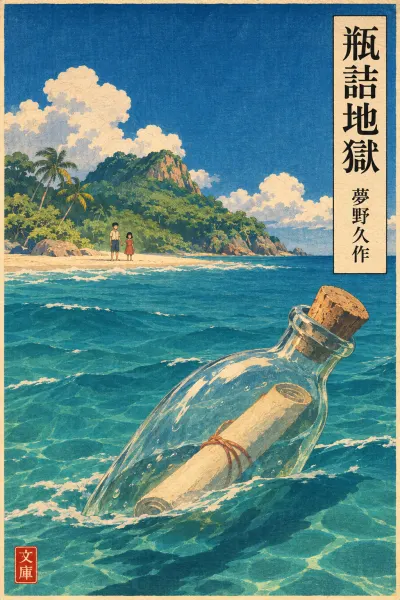
Part 2 of 6 · JLPT N2
瓶詰地獄(◇第二の瓶の内容) Binzumejigoku, part 2: Paradise Island and the First Bottle
In this part
The narrator confesses that he has often stood on a high cliff wanting to throw himself into the shark-filled waters, and that only the thought of Ayako has stopped him. He then recalls how happily the two children lived after being cast ashore, some ten years ago by his reckoning. They found plenty of food, built a hut from the wrecked boat, prayed daily, sent a letter to their parents in a bottle, and raised a signal pole on the cliff.
AI translation · independently checked
ああ。Ah.
隠微たるに鑒たまう神様よ。O God, who lookest upon things hidden.
この困難から救わるる道は、私が死ぬよりほかに、どうしても無いので御座いましょうか。Is there truly no way to be saved from this suffering, save that I should die?
私たちが、神様の足凳と呼んでいる、あの高い崖の上に私がたった一人で登って、いつも二、三匹のフカが遊び泳いでいる、あの底なしの淵の中を、のぞいてみた事は、今までに何度あったかわかりませぬ。I cannot tell how many times until now I have climbed alone to the top of that high cliff we call God's Footstool, and looked down into that bottomless pool where two or three sharks are always swimming about at play.
そこから今にも身を投げようと思ったことも、いく度であったか知れませぬ。Nor can I tell how many times I have meant to throw myself down from there that very moment.
けれども、そのたんびに、あの憐憫なアヤ子の事を思い出しては、霊魂を滅亡す深いため息をしいしい、岩の圭角を降りて来るのでした。Yet each time, I would remember poor, pitiful Ayako, and come back down over the jagged edges of the rocks, heaving deep sighs that seemed to destroy my very soul.
私が死にましたならば、あとから、きっと、アヤ子も身を投げるであろうことが、わかり切っているからでした。For I knew all too well that, if I were to die, Ayako would surely throw herself down after me.
**
私と、アヤ子の二人が、あのボートの上で、附添いの乳母夫妻や、センチョーサンや、ウンテンシュさん達を、波に浚われたまま、この小さな離れ島に漂れついてから、もう何年になりましょうか。How many years has it been now since Ayako and I, in that boat, saw our nurse and her husband who attended us, and the Captain, and the Engineer and the others, swept away by the waves, and drifted ashore on this small, lonely island?
この島は年中夏のようで、クリスマスもお正月も、よくわかりませぬが、もう十年ぐらい経っているように思います。On this island it is like summer all year round, so I can hardly tell when Christmas or New Year comes, but I believe some ten years must have passed.
その時に、私たちが持っていたものは、一本のエンピツと、ナイフと、一冊のノートブックと、一個のムシメガネと、水を入れた三本のビール瓶と、小さな新約聖書が一冊と……それだけでした。What we had with us then was one pencil, a knife, one notebook, one magnifying glass, three beer bottles filled with water, and one small New Testament... and that was all.
けれども、私たちは幸福でした。And yet we were happy.
この小さな、緑色に繁茂り栄えた島の中には、稀に居る大きな蟻のほかに、私たちを憂患す禽、獣、昆虫は一匹も居ませんでした。On this small island, so green and thick with growth, there was not one bird, beast or creeping thing to trouble us, apart from some large ants that were seldom seen.
そうして、その時、十一歳であった私と、七ツになったばかりのアヤ子と二人のために、余るほどの豊饒な食物が、みちみちておりました。And for the two of us, I who was eleven years old then, and Ayako who had only just turned seven, there was rich food in abundance, more than enough.
キュウカンチョウだの鸚鵡だの、絵でしか見たことのないゴクラク鳥だの、見たことも聞いたこともない華麗な蝶だのが居りました。There were mynah birds and parrots, birds of paradise I had only ever seen in pictures, and splendid butterflies such as I had never seen or heard of.
おいしいヤシの実だの、パイナプルだの、バナナだの、赤と紫の大きな花だの、香気のいい草だの、又は、大きい、小さい鳥の卵だのが、一年中、どこかにありました。Delicious coconuts, pineapples, bananas, big red and purple flowers, sweet-smelling grasses, and the eggs of birds both large and small, were to be found somewhere all the year round.
鳥や魚なぞは、棒切れでたたくと、何ほどでも取れました。Birds and fish we could catch as many as we liked by striking them with a stick.
私たちは、そんなものを集めて来ると、ムシメガネで、天日を枯れ草に取って、流れ木に燃やしつけて、焼いて喰べました。When we had gathered such things, we caught the sun's rays on dry grass with the magnifying glass, set driftwood alight with it, and roasted and ate them.
そのうちに島の東に在る岬と磐の間から、キレイな泉が潮の引いた時だけ湧いているのを見付けましたから、その近くの砂浜の岩の間に、壊れたボートで小舎を作って、柔らかい枯れ草を集めて、アヤ子と二人で寝られるようにしました。In time we found that a clear spring welled up between a cape and the rocks on the east of the island, but only when the tide was out, so on the sandy beach close by, between the rocks, we built a hut from the broken boat and gathered soft dry grass, so that Ayako and I could sleep there.
それから小舎のすぐ横の岩の横腹を、ボートの古釘で四角に掘って、小さな倉庫みたようなものを作りました。Then, right beside the hut, we dug a square hole into the side of a rock with old nails from the boat, and made something like a small storehouse.
しまいには、外衣も裏衣も、雨や、風や、岩角に破られてしまって、二人ともホントのヤバン人のように裸体になってしまいましたが、それでも朝と晩には、キット二人で、あの神様の足凳の崖に登って、聖書を読んで、お父様やお母様のためにお祈りをしました。In the end our coats and our undergarments were all torn away by rain and wind and the corners of the rocks, and we both became naked like real savages; yet still, every morning and every evening without fail, the two of us climbed that cliff, God's Footstool, read the Bible, and prayed for Father and Mother.
私たちは、それから、お父様とお母様にお手紙を書いて大切なビール瓶の中の一本に入れて、シッカリと樹脂で封じて、二人で何遍も何遍も接吻をしてから海の中に投げ込みました。After that, we wrote a letter to Father and Mother, put it in one of our precious beer bottles, sealed it tightly with resin, and, when we had both kissed it again and again, threw it into the sea.
そのビール瓶は、この島のまわりを環る、潮の流れに連れられて、ズンズンと海中遠く出て行って、二度とこの島に帰って来ませんでした。That beer bottle was carried by the current that circles this island, went steadily far out into the open sea, and never came back to this island again.
私たちはそれから、誰かが助けに来て下さる目標になるように、神様の足凳の一番高い処へ、長い棒切れを樹てて、いつも何かしら、青い木の葉を吊しておくようにしました。After that, so that there would be a sign for anyone who might come to rescue us, we set up a long stick at the very highest point of God's Footstool, and always kept some green leaves or other hanging from it.
Vocabulary
| Word | Meaning | JLPT |
|---|---|---|
| 困難こんなん | hardship, sufferingNormally read こんなん; here the author glosses it くるしみ (苦しみ) to give the sense of 'suffering'. | N3 |
| 崖がけ | cliff | N1 |
| 淵ふち | deep pool, abyssDeep, still water; often used figuratively, as in 絶望の淵 'the depths of despair'. | — |
| 身を投げみをなげる | to throw oneself (to one's death)dictionary form: 身を投げるA set phrase for suicide by jumping into water or off a height. | — |
| 憐憫れんびん | pity; here, pitifulNormally a noun meaning 'pity'. The gloss あわれ (哀れ) turns it into 'pitiful, poor'. | — |
| 浚われたさらう | to sweep away, to carry offdictionary form: 浚うUsually written 攫う when it means 'to snatch'. 波にさらわれる means 'to be swept away by the waves'. | — |
| 漂れついてながれつく | to drift ashoredictionary form: 流れ着くThe kanji 漂 ('drift', as in 漂流) is given the reading なが(れ). | — |
| 繁茂はんも | luxuriant growthHere glossed しげ(り), from 茂る 'to grow thick'. | — |
| 豊饒ほうじょう | abundant, richA literary word, glossed ゆたか (豊か). | — |
| 天日てんぴ | sunlight, the sun's heat | — |
| 泉いずみ | spring (of water) | N3 |
| 樹脂じゅし | resinGlossed やに, the everyday word for tree sap or resin. | — |
| 接吻せっぷん | kissAn old-fashioned word, glossed くちづけ. Modern speech usually uses キス. | — |
| 目標もくひょう | signal, landmarkNormally means 'goal'. The gloss めじるし (目印) gives the sense of 'a mark to be seen by'. | N3 |
Grammar
〜よりほかに(ない) N2 there is no way but ~; nothing except ~
The phrase よりほかに links an action to a negative, so that the action becomes the only remaining choice. Here it means that dying is the only way to escape the suffering.
私が死ぬよりほかに、どうしても無いので御座いましょうか
is there truly no way, save that I should die?
〜ては N3 repeated action: each time ~, (then) ~
The て-form plus は, used together with そのたびに, describes a sequence that happens again and again. Each time the narrator remembers Ayako, the same retreat from the cliff follows.
あの憐憫なアヤ子の事を思い出しては
each time I would remember poor Ayako
〜しいしい N1 while repeatedly doing ~
Repeating the masu-stem (here し from する, lengthened to しい) is an old-fashioned way to express an action that continues alongside another. It works much like 〜ながら.
深いため息をしいしい、岩の圭角を降りて来るのでした
came back down over the sharp rocks, sighing deeply all the while
〜切っている N3 completely, all too ~
Added to a verb stem, 切る means 'to do something completely'. わかり切っている means 'it is perfectly obvious'.
アヤ子も身を投げるであろうことが、わかり切っているからでした
for I knew all too well that Ayako would throw herself down too
〜だの〜だの N2 ~ and ~ and so on (listing examples)
This pattern gives a lively, open-ended list of examples from a larger group. Here it piles up the wonders of the island.
キュウカンチョウだの鸚鵡だの、絵でしか見たことのないゴクラク鳥だの
mynah birds and parrots, birds of paradise I had only ever seen in pictures
〜ように(する) N4 so that ~; to make a point of ~
The first ように states a purpose: 'so that it becomes a signal'. The second, 〜ておくようにしました, means the children made a habit of always keeping leaves hanging there.
誰かが助けに来て下さる目標になるように
so that there would be a sign for anyone who might come to rescue us