Upper intermediate · JLPT N2
土神ときつねDojin to Kitsune — The Birch Tree's Two Friends
- JLPT N2
- 9,333 characters
- 7 parts
- about 78 minutes
- 3 easier versions
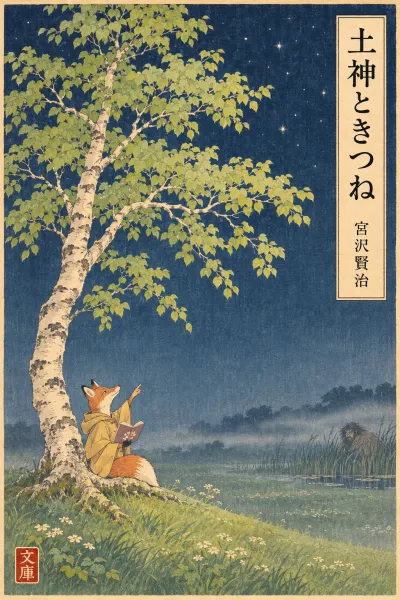
This is a short fable by Miyazawa Kenji set in Ippongi, a meadow with a marsh and a small hill. A lovely birch tree stands there and has two very different friends. One is the Earth God, rough, shabby and quick-tempered, who lives in a gloomy marsh nearby. The other is a refined fox, who visits with a book of poems and talks of stars, telescopes and aesthetics. The birch prefers the fox. The narration is gentle and polite, written in desu/masu past tense, and full of colour imagery, onomatopoeia and close attention to light, fog and seasons. The story is rewarding because each character has a distinct voice. The fox speaks affected, educated Japanese. The birch is soft and deferential. The god uses gruff, old-fashioned speech with archaic curses. Learners get a clear lesson in how register shows character. The challenge lies in the god's archaic forms, older kanji spellings and the fox's name-dropping of European places, books and brands.
Contents
Easier versions
This story is also retold in simpler Japanese. Reading an easier version first makes the original much more approachable.
Before you read
- Learn each character's speech markers first. The god uses わし/おれ, じゃ, ん-negatives and curses like うぬ and おのれ. The fox says 僕 and speaks in polished です/ます. The birch uses soft endings like 〜わ and 〜ですの, and she uses ございます when speaking to the god. These markers let you tell who is talking even without attribution.
- Expect older spellings. 云う is used for 言う (as in どちらかと云えば). Country names appear in old kanji forms such as 独乙 (Germany), 伊太利 (Italy) and 支那 (China). Check the name list before reading Parts 2, 5 and 6.
- Key vocabulary to learn in advance: 土神 (Earth God), 狐 (fox), 樺の木 (birch), 谷地/沼 (marsh), 望遠鏡 (telescope) and 美学 (aesthetics). The fox's lectures in Part 5 also use abstract terms around symmetry.
- Watch for 〜と見えて ('apparently, since…') and 〜てしまう. The narrator uses them to report inner states and actions that cannot be undone, especially in the god's scenes in Parts 3, 4 and 7.
- Read onomatopoeia and colour words as part of the meaning, not decoration. Shifts in light and colour (pale, red, rust-stained) often signal the characters' moods before the dialogue does.
Words to know
The most useful words from the notes across the story.
| Word | Meaning | JLPT |
|---|---|---|
| 谷地やち | marsh, boggy low groundMainly used in northeastern Japan and in place names. | — |
| 俄かににわか | suddenly, abruptlydictionary form: 俄かLiterary; everyday speech would use 急に. | N2 |
| 分際ぶんざい | one's (lowly) station〜の分際で/として scolds someone for acting above their place. | — |
| 祠ほこら | small wayside shrine | — |
| 木樵きこり | woodcutter | — |
| 一目散いちもくさん | at full speed, headlongMostly used as 一目散に逃げる 'to run away as fast as one can'. | — |
| いやしくもいやしくも | after all; if one is at all (a ...); at the very least (stresses one's status)Literary. Stresses one's status: 'I am, after all, a god.' | — |
| 背広せびろ | (men's) suitSlightly old-fashioned; today スーツ is more common. | N5 |
| 仲々なかなか | quite, rather (well)dictionary form: なかなかOld spelling of なかなか; with a negative it means 'not easily'. | N4 |
| 邪魔じゃま | hindrance; お邪魔する = to impose on someone, to visitPolite set phrase when visiting or taking up someone's time. | N4 |
| 灼けるやける | to burn, to scorchThe kanji 灼 suggests intense, searing heat; usually written 焼ける. | N4 |
| 滅多にめったに | rarely, hardly everAlways used with a negative verb. | N3 |
| 思わずおもわず | without thinking; before one could stop oneselfOften paired with 〜てしまう for an unintended action. | N3 |
| 霧きり | fog, mist | N3 |
| 気の毒きのどく | pitiful; feeling sorry for someone | N3 |
Plot summary
Show the full summary (contains spoilers)
A birch tree on a hill in Ippongi meadow has two friends: the rough Earth God of the nearby marsh and a refined fox. The fox visits with poems and star lore. To please her, he falsely claims to have ordered a telescope from Germany, and he lends her a book of Heine's poems. When the birch innocently suggests asking the fox a question, the god flies into a jealous fury. Vexed, he torments a passing woodcutter. One August night he overhears the fox lecturing the birch on aesthetics and describing his study and the telescope that has not arrived. The god covers his ears, runs to the foot of Mitsumoriyama and weeps until dawn. In autumn he comes to her feeling generous. But the fox arrives with a promised book and leaves without greeting him. Overcome by rage, the god chases the fox to his den and kills him. Inside the den he finds only bare red earth, and in the fox's raincoat pocket only two stalks of grass. He weeps over the body.
About the author
Miyazawa Kenji was a poet and writer of children's stories from Hanamaki in Iwate Prefecture. He studied agricultural science in Morioka and later taught at an agricultural school. He devoted much of his life to helping local farmers improve their methods and their cultural lives. He was a devout Buddhist, and his faith, love of nature and interest in science run through his writing. His fame came after his death, with works such as 銀河鉄道の夜, 風の又三郎 and the poem 雨ニモマケズ.